Finding the right salinity meter can make it easier to control salt levels in soups, sauces, brines, fermented foods, and other liquid recipes. The best models provide fast, repeatable readings without requiring complicated testing methods.
This roundup compares 10 salinity meters for home kitchens, from compact food-specific testers to multipurpose devices designed for saltwater, aquariums, and pools.
Best 10 Salinity Meters for Home Kitchens Picks for 2026
Best Compact LED Pick

- Conductivity-based liquid food testing
- Seven LED indicators
- Compact and lightweight pen design
Best For: Home cooks wanting simple visual salt-level readings
Best Wide-Range Digital Pick

- 0–10%/100 ppt measurement range
- Platinum-plated electrode
- Vibrating, locked readings
Best For: Brine, pickling, sauces, and food processing
Best Multifunction Pick
- PPT, %, and SG modes
- Includes temperature measurement
- Backlit display and maintenance supplies
Best For: Users wanting versatile food salinity testing
Best Simple Pen Pick
Electronic Food Salinity Tester

- Compact pen-style design
- Temperature compensation
- LED concentration indicators
Best For: Basic soup, stew, and sauce seasoning checks
Best Multi-Use Pick

- Measures salinity, specific gravity, and temperature
- Backlit display with automatic temperature compensation
- Compact waterproof design with auto shutoff
Best For: Aquariums, hydroponics, pools, and multipurpose water testing
Best Kitchen-Focused Pick

- Designed for salt concentration in food
- Useful for soups, broths, and sauces
- Bright LED display with ergonomic handheld body
Best For: Home cooking and food preparation
Best Multiparameter Pick
- Tests salinity, TDS, EC, pH, and temperature
- Includes a 0.01–25% food salinity range
- Shows salinity in PPM, PPT, or percentage
Best For: Mixed kitchen, aquarium, pool, and hydroponic testing
Most Versatile
- 0.01%–26.00% salinity range
- Also measures EC, TDS, temperature, and specific gravity
- Includes calibration and cleaning accessories
Best For: Home cooks handling fermentation and multiple liquid-testing tasks
Pool Specialist
SALT-3050 Waterproof Salt Meter

- Tests 0–9,999 ppm or 0.0–1.0% salt
- Precalibrated at 3,000 ppm
- IP65-rated for pool and koi-pond use
Best For: Saltwater pool and koi-pond maintenance, not kitchen foods
Best Kitchen-Focused Design

- Three-second readings from 0–10% salt
- Shows salt and sodium measurements
- 99°C-safe 304 stainless-steel probe
Best For: Everyday soups, brines, hot dishes, and low-sodium cooking
Best Compact LED Pick – Professional LED Salinometer
For shoppers comparing salinity meters for home kitchens, this compact pen-style tester offers a straightforward way to check salt concentration in liquid foods. Its conductivity-based testing method and LED indicators are designed for quick, portable use.
Best For: Home cooks who want a compact salinity tester with simple LED readouts.
Pros:
- Uses a conductivity test method to determine salt concentration in liquid foods.
- Compact, lightweight design is easy to carry and store.
- Seven LED indicators show salt concentration and power status.
Cons:
- The supplied notes describe LED levels rather than a digital numerical display.
- Designed for food liquids, so its usefulness is focused on liquid samples.
This is a practical choice when portability and simple visual feedback matter more than advanced display features.
Best Wide-Range Digital Pick – LOHAND LH-SA10 Salinity Meter
For home kitchens that handle everything from light brines to salty pickling solutions, the LOHAND LH-SA10 stands out among salinity meters for home kitchens with its 0–10%/100 ppt range. Its platinum-plated electrode, vibrating value lock, and included accessories support convenient everyday testing.
Best For: Cooks and food makers testing brine, soups, sauces, pickles, and other higher-salt liquids.
Pros:
- Measures across a stated 0–10%/100 ppt range.
- Platinum-plated electrode is corrosion-resistant and helps minimize impurity buildup.
- Vibrates and locks the reading for easier viewing in noisy environments.
- Includes batteries, cleaning cloth, user manual, and cover opener.
Cons:
- At 5.9 ounces, it is heavier than the compact pen-style options listed here.
- Battery-powered operation requires two AAA batteries.
Its broad stated range and durable electrode make it a strong fit for cooks who regularly measure different types of salty food liquids.
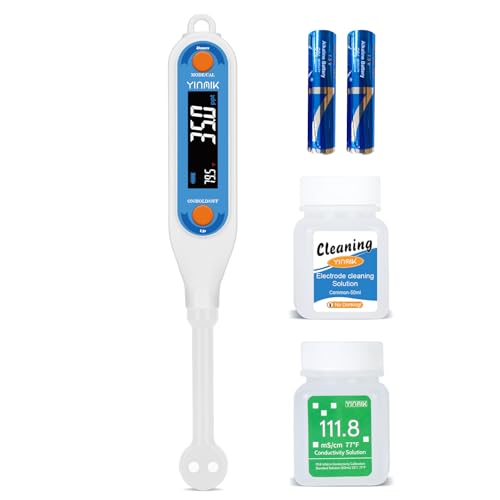
Best Multifunction Pick – YINMIK Food Salt Meter
The YINMIK offers a more feature-rich approach for shoppers comparing salinity meters for home kitchens. It supports PPT, percentage, and specific-gravity modes, while also adding temperature measurement, automatic temperature compensation, and a color backlit display.
Best For: Home users who want multiple salinity units, temperature readings, and included maintenance supplies.
Pros:
- Provides PPT, percentage, and specific-gravity testing modes.
- Also functions as a food thermometer.
- Backlit color display is intended for easier viewing in dim conditions.
- Includes batteries, calibration solution, electrode cleaning solution, sample spoon, and hanging rope.
Cons:
- Its 13.4-ounce weight is comparatively substantial for a portable kitchen tester.
- More functions and maintenance supplies may be unnecessary for users who only need basic salt checks.
Choose this model when flexibility and included calibration and cleaning accessories are priorities rather than the smallest possible form factor.
Best Simple Pen Pick – Electronic Food Salinity Tester
This electronic pen is a straightforward option for shoppers seeking salinity meters for home kitchens. Its compact ABS body, copper test top, temperature compensation, and LED salt-level indicators are suited to checking soups, stews, sauces, and similar food liquids.
Best For: Home cooks who want a small, easy-to-operate tester for everyday liquid recipes.
Pros:
- Compact 155 × 29 × 14 mm design is easy to store.
- Temperature compensation is included for liquid food testing.
- LED indicators show different salt-concentration levels.
- Corrosion-resistant copper test top is designed for service life.
Cons:
- The supplied notes do not specify a numerical measurement range.
- Package includes the tester only, with no listed calibration or cleaning accessories.
This model makes sense for basic seasoning checks when a small pen format and visual LED feedback are sufficient.
Best Multi-Use Pick – 3-in-1 Salinity Tester Pen
For shoppers comparing salinity meters for home kitchens, this pen-style tester is most useful when water testing matters as much as occasional kitchen-related measurements. It measures salinity, specific gravity, and temperature, with a backlit display and automatic temperature compensation.
Best For: Aquarium owners, hydroponics users, pool monitoring, and anyone wanting a compact multipurpose water tester.
Pros:
- Measures salinity from 0–55 ppt, specific gravity, and temperature.
- Backlit LCD, automatic temperature compensation, and audible testing beeps.
- Compact waterproof pen design with automatic shutoff and low-battery indicator.
Cons:
- Its broad water-testing feature set may be more than a kitchen-only user needs.
- Salinity accuracy is listed as ±1 ppt.
This is a practical choice if you want one portable meter for several water-quality tasks. Its pen format and automatic features make routine testing straightforward, though a dedicated food meter may be more targeted for soups and sauces.
Best Kitchen-Focused Pick – LED Food Salinity Meter
Among salinity meters for home kitchens, this handheld food tester is the most directly focused on cooking. It is designed to check salt concentration in soups, broths, and sauces, with a bright LED display intended to remain easy to read in low light.
Best For: Home cooks and food-preparation settings that need a simple salt-concentration tester.
Pros:
- Purpose-built for measuring salt content in food.
- Suitable for soups, broths, sauces, baking, and food preparation.
- Bright LED display and ergonomic handheld design.
Cons:
- The supplied notes do not specify a measurement range or accuracy.
- It is less versatile for aquarium, pool, or general water-quality testing.
This model makes the most sense when your priority is checking food rather than monitoring water systems. Its straightforward kitchen orientation and LED display are appealing, but shoppers who need published precision specifications may want to compare those details before buying.
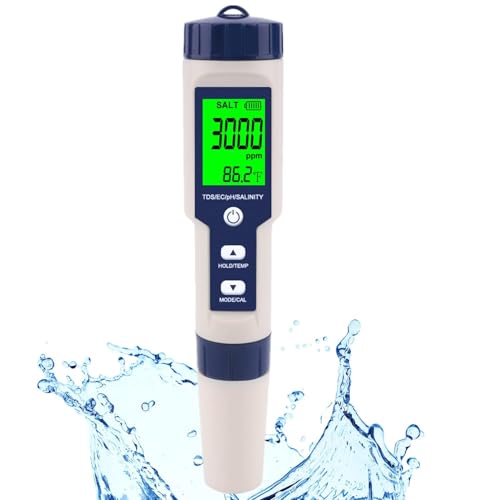
Best Multiparameter Pick – 5-in-1 Salinity and pH Meter
If you want salinity meters for home kitchens that can also handle broader water-quality tasks, this multiparameter unit offers five testing modes. It measures salinity, TDS, EC, pH, and temperature, and includes a food salinity range alongside pool and seawater ranges.
Best For: Users who want one meter for food salt checks, aquariums, pools, hot tubs, hydroponics, and general water testing.
Pros:
- Combines salinity, TDS, EC, pH, and temperature testing.
- Supports food salinity readings from 0.01–25%.
- Displays salinity in PPM, PPT, or percentage formats.
- Titanium-alloy probe and wide stated testing ranges.
Cons:
- Its many functions may be unnecessary for shoppers seeking only a kitchen salt meter.
- The supplied notes do not provide accuracy specifications.
This is the most flexible option of the three for households with mixed testing needs. The food mode is useful for kitchen measurements, while the additional water-quality functions add value for aquariums, pools, and hydroponics.
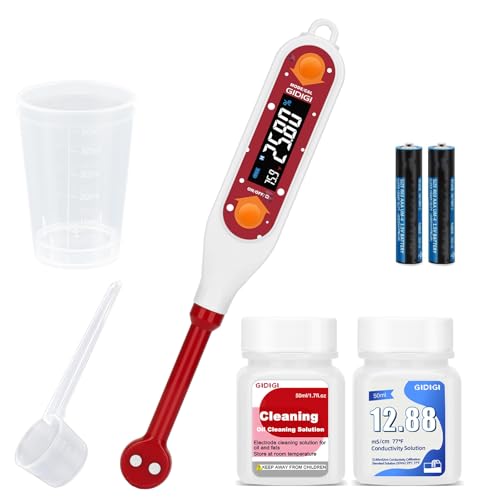
Most Versatile – GIDIGI Food Salinity Meter
For shoppers comparing salinity meters for home kitchens, the GIDIGI is a broad-use option for brines, soups, sauces, and fermented foods. It measures 0.01%–26.00% salinity and includes automatic temperature compensation, making it useful when you want repeatable readings across different liquid recipes.
Best For: Home cooks who also want one tester for fermentation projects, water-quality checks, or marine aquariums.
Pros:
- Measures salinity, EC, TDS, temperature, and seawater specific gravity.
- Useful for kimchi, sauerkraut, pickles, soups, sauces, and brines.
- Includes calibration solution, cleaning solution, and a measuring cup.
- Compact 85-gram design with a backlit display and lock-on reading.
Cons:
- Food measurements should be taken below 176°F, and oily soup liquid should be skimmed first.
- Its many measurement modes may be more than a kitchen-only user needs.
The wide salinity range and included maintenance accessories make this a flexible pick for households that prepare fermented foods or want a multipurpose tester. It reads in under 30 seconds, though it requires basic probe cleaning and calibration care.
Pool Specialist – SALT-3050 Waterproof Salt Meter
The SALT-3050 is not one of the general-purpose salinity meters for home kitchens. It is designed specifically for saltwater pools and koi ponds, with a 0–9,999 ppm or 0.0–1.0% salt range and a temperature display for water checks.
Best For: Homeowners testing salt levels in saltwater pools or koi ponds.
Pros:
- Precalibrated at 3,000 ppm NaCl at 77°F.
- Measures salt from 0–9,999 ppm or 0.0–1.0%.
- Includes an IP65 waterproof rating and temperature range of 32–130°F.
Cons:
- Does not work for food salt testing.
- Not suitable for sea, marine, or saltwater fish tanks.
- Its application is limited to saltwater pools and koi ponds.
Despite its compact digital format, this model should not be considered a kitchen instrument. Choose it only when pool or koi-pond testing is the goal; food cooks and marine-aquarium owners should select a different meter.
Best Kitchen-Focused Design – Digital Food Salinity Tester
This food-focused tester is a strong choice among salinity meters for home kitchens because its controls, ranges, and alerts are built around soups, brines, pasta, and everyday recipes. It reads salt concentration in about three seconds and uses a food-grade 304 stainless-steel probe rated for liquids up to 99°C.
Best For: Home cooks who want quick, straightforward readings for seasoning, low-sodium cooking, and hot recipes.
Pros:
- Measures 0–10% salt with 0.01% resolution below 5% and 0.02% resolution from 5–10%.
- Displays both % NaCl and mg/100 g sodium readings with automatic conversion.
- Three-second response, audio and LED completion alerts, and a large color display.
- IP66 splash-proof body, 304 stainless probe, and fold-out hanging hook.
Cons:
- The 0–10% range is narrower than models intended for higher-salinity applications.
- The body should be kept dry; only the probe should be rinsed.
- Supplied accuracy varies by concentration range.
Its simple one-key workflow and hot-liquid capability make it especially practical for routine cooking. The sodium readout is useful for low-sodium meal planning, while the limited maximum range keeps this model focused on food rather than aquarium or industrial testing.
How We Picked These Salinity Meters for Home Kitchens
We focused on meters that are practical for household use and evaluated the features most likely to affect everyday results: measurement range, resolution, reading speed, probe design, display readability, temperature capability, water resistance, and intended application. Food-specific models were prioritized for cooking and brining, while multipurpose testers were included for readers who also maintain aquariums, ponds, or saltwater pools.
Because product specifications vary, always confirm whether a meter is calibrated for food liquids, saltwater, or both. A pool or aquarium meter may not be the best choice for measuring recipes, even if it reports salinity accurately in its intended environment.
Quick Comparison
- Best for cooking and sauces: Choose a food salinity meter with a 0–10% range, a stainless-steel probe, and a clear digital display.
- Best for brining: Look for fine resolution and a probe that can be rinsed easily between measurements.
- Best multipurpose option: A 3-in-1 or 5-in-1 meter can measure salinity alongside temperature, pH, EC, or specific gravity.
- Best for saltwater systems: Select a dedicated water-quality meter with the appropriate salinity scale, calibration functions, and water-resistant housing.
Key Buying Factors for Salinity Meters for Home Kitchens
Measurement Range and Resolution
Most kitchen applications fall within a relatively modest salt-concentration range, so a 0–10% food scale is often more useful than a broad pool-oriented scale. Resolution matters when adjusting a recipe gradually; readings to 0.01% can make small changes easier to detect, although real-world accuracy also depends on calibration and sample consistency.
Probe Material and Cleaning
Stainless-steel probes are a practical choice for food liquids because they are durable and easy to rinse. Clean the probe after every use, avoid abrasive cleaners, and follow the manufacturer’s instructions for calibration and storage. Cross-contamination is especially important when testing brines, sauces, and ready-to-eat foods.
Temperature and Sample Conditions
Temperature can influence salinity readings. A built-in thermometer or automatic temperature compensation can improve consistency, but it does not eliminate the need to test samples at similar temperatures. Stir the liquid, allow bubbles to clear, and avoid measuring directly against the bottom or sides of a container.
Water Resistance and Usability
IP-rated housing, a backlit or high-contrast display, automatic shutoff, and simple calibration controls are valuable in a busy kitchen. A compact pen-style body is convenient, while a larger display may be easier to read during repeated testing.
Who Should Buy Which Salinity Meters for Home Kitchens?
Home cooks and meal preppers should choose a straightforward food salinity meter with a dedicated salt-concentration range. Pickle and fermentation enthusiasts should prioritize resolution, repeatability, and easy cleaning. Aquarium or pool owners will benefit more from a multiparameter water-quality meter designed for salinity and related measurements. If you want one device for occasional cooking and water testing, verify that its food-use instructions and measurement scales match both tasks before buying.