Reliable salinity data is essential when you are testing seawater, aquarium systems, ponds, or laboratory samples. The best instrument depends on more than range alone: resolution, temperature compensation, calibration, durability, and measurement method all affect useful results.
We selected 10 salinity meters and refractometers covering field checks, marine research, aquaculture, and multiparameter testing. Use the guide below to compare capabilities and match the instrument to your workflow.
Best 10 Salinity Meters for Research Picks for 2026
Best Digital Refractometer

- PSU, ppt, and specific gravity readings
- Automatic temperature compensation
- 1.5-second response time
Best For: Fast seawater salinity checks in aquariums and reef tanks
Best Ready-to-Use Tester

- Displays ppt, PSU, and specific gravity
- Includes solutions and batteries
- Suitable for field and industrial settings
Best For: Portable, flexible salinity testing with quick setup
Best Complete Meter Kit

- Digital readout with temperature compensation
- Includes probe and calibration fluid
- Conversion chart included
Best For: Basic probe-based aquarium salinity testing
Best Manual Refractometer
Agriculture Solutions 0-100 PPT

- Measures 0-100 ppt
- Automatic temperature compensation
- Includes case and cleaning accessories
Best For: Broad-range seawater and marine aquarium monitoring
Best Food-Liquid Tester
LOHAND LH-SA10 Digital Salinity Meter

- 0–10%/100 ppt measurement range
- Platinum-plated corrosion-resistant electrode
- Compact, battery-powered design
Best For: Brine, pickling, seafood, and food-processing checks
Best Multiparameter Pick
APERA PC60 5-in-1 Pocket Tester

- Measures salinity plus pH, EC, TDS, and temperature
- Replaceable multi-parameter probe
- Includes calibration supplies and carrying case
Best For: Portable, multi-reading water-quality testing
Best Optical Option
Aquarium Seawater Salinity Refractometer

- Reads specific gravity and 0–100 ppt
- Automatic temperature compensation
- Portable, battery-free optical design
Best For: Aquariums, seawater, marine monitoring, and saltwater pools
Pool-Specific Pick
SALT-3050 Waterproof Salinity Meter

- 0–9,999 ppm or 0.0–1.0% salinity range
- Precalibrated at 3,000 ppm and 25°C
- IP65 waterproof; pool and koi pond use only
Best For: Saltwater pool and koi pond testing
Best Heavy-Duty Pick
Hofun 5-in-1 Salinity and Water Meter
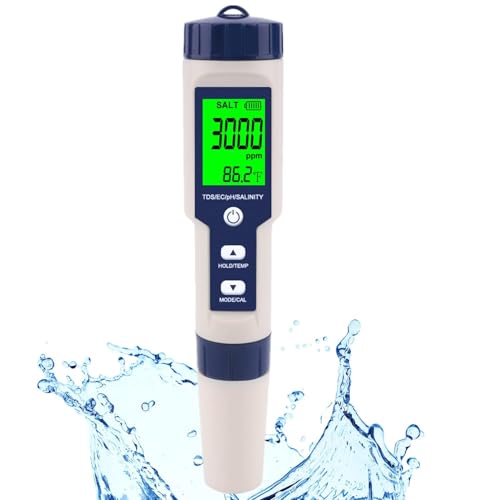
- Measures salinity, TDS, EC, pH, and temperature
- Covers pool and 10–200 ppt seawater testing
- Offers ppm, ppt, and percentage displays
Best For: Multi-variable aquarium, marine, pool, and water-quality checks
All-in-One Alternative
T TESTRUST 5-in-1 Pool Salt Tester

- Combines salinity, pH, TDS, EC, and temperature
- Supports pool and 10–200 ppt seawater ranges
- Simple LCD operation for aquatic monitoring
Best For: Routine pool, aquarium, spa, and seawater checks
Best Digital Refractometer – Milwaukee MA887
For researchers and aquarium professionals comparing salinity meters for research, the Milwaukee MA887 is a portable digital refractometer built for natural or artificial seawater. It reports PSU, ppt, and specific gravity readings, with automatic temperature compensation and a 1.5-second response time.
Best For: Fast, repeatable seawater salinity checks in aquariums and reef tanks.
Pros:
- Displays results in PSU, ppt, and specific gravity.
- Automatically compensates for temperature variation.
- Sealed glass prism and stainless steel well are easy to clean.
- Includes a pipette and instruction manual.
Cons:
- Designed specifically for seawater and aquarium applications.
- Requires wiping the sample well between measurements.
The MA887 is a practical choice when quick digital readings and multiple salinity units matter more than a broad range of unrelated measurement functions.
Best Ready-to-Use Tester – Hanna HI98319
The Hanna HI98319 is a compact option for anyone evaluating salinity meters for research across aquarium, field, or industrial settings. It displays salinity in ppt, PSU, or specific gravity and includes the solutions and battery needed to begin measuring.
Best For: Users who want a portable salinity tester with multiple readout formats and included startup supplies.
Pros:
- Provides ppt, PSU, and specific gravity results.
- Suitable for aquarium, field, and industrial testing.
- Includes necessary solutions and batteries.
Cons:
- Uses a CR2032 battery that requires replacement over time.
- The supplied notes do not specify response time or measurement accuracy.
Choose the HI98319 if convenient setup and flexible salinity-unit display are priorities for routine testing in different environments.
Best Complete Meter Kit – Pinpoint Salinity Meter
The Pinpoint Salinity Meter Kit is a straightforward candidate among salinity meters for research when a digital readout and basic supporting accessories are important. It includes the meter, probe, and calibration fluid, while its temperature compensation is designed to support consistent readings.
Best For: Aquarium users who want a complete digital meter kit with a probe and calibration fluid.
Pros:
- Provides a digital readout.
- Features full temperature compensation.
- Includes a meter, probe, and calibration fluid.
- Comes with a conversion chart.
Cons:
- The supplied notes do not identify the displayed salinity units.
- No accuracy or response-time specification is provided.
This kit makes sense for buyers who value included calibration supplies and a probe-based setup, although users needing clearly specified units may prefer another option.
Best Manual Refractometer – Agriculture Solutions 0-100 PPT
For buyers comparing salinity meters for research and marine monitoring, this Agriculture Solutions refractometer covers a 0-100 ppt range and uses automatic temperature compensation. It measures seawater on specific gravity and parts-per-thousand scales and includes a protective case and cleaning accessories.
Best For: Seawater, marine fishkeeping, and aquarium users who want a broad 0-100 ppt refractometer range.
Pros:
- Measures from 0 to 100 ppt.
- Displays specific gravity and parts per thousand.
- Includes automatic temperature compensation.
- Comes with a hard case, dropper, screwdriver, manual, and cleaning cloth.
Cons:
- Offers two measurement scales rather than a digital multi-unit display.
- Requires manual sample handling with the included dropper.
This is a useful fit for marine monitoring when range, portability, and included maintenance accessories are more important than a digital readout.
Best Food-Liquid Tester – LOHAND LH-SA10 Digital Salinity Meter
For buyers seeking salinity meters for research-adjacent food testing, the LOHAND LH-SA10 is a focused option for measuring brine, sauces, pickles, soups, and other salty liquids. Its 0–10%/100 ppt range, platinum-plated electrode, and value-locking measurement design support quick routine checks.
Best For: Kitchen, pickling, seafood, and food-processing applications involving low- to high-salinity liquids.
Pros:
- Measures across a 0–10%/100 ppt range.
- Platinum-plated electrode helps resist corrosion and impurity buildup.
- Compact design with automatic shutdown and included AAA batteries.
- Vibrates and locks the reading for easier viewing.
Cons:
- Its stated applications focus on food liquids rather than broad laboratory workflows.
- It does not provide the multi-parameter measurements offered by combination testers.
The LH-SA10 makes the most sense when salinity is the primary measurement and portability matters. Researchers needing pH, conductivity, or temperature data will likely want a more comprehensive instrument.
Best Multiparameter Pick – APERA PC60 5-in-1 Pocket Tester
For salinity meters for research that need more than a single reading, the APERA PC60 combines salinity with pH, conductivity, TDS, and temperature measurement. Its replaceable probe, calibration accessories, waterproof design, and clear multi-mode display make it suited to structured field or bench testing.
Best For: Users who need portable salinity testing alongside pH, EC, TDS, and temperature measurements.
Pros:
- Measures pH, EC, TDS, salinity, and temperature.
- Replaceable multi-parameter probe simplifies installation and maintenance.
- Large backlit LCD shows temperature alongside the selected measurement.
- Includes calibration and storage solutions, batteries, lanyard, and carrying case.
Cons:
- More involved than a dedicated salinity-only meter.
- The electrode has a shorter stated warranty period than the instrument.
The PC60 is the strongest all-around choice here for users whose work requires correlated water-quality readings. Its included calibration supplies and replaceable probe add practical value for repeated testing.
Best Optical Option – Aquarium Seawater Salinity Refractometer
This optical refractometer is a straightforward choice among salinity meters for research when testing aquarium water, seawater, or saltwater pools. It reads both specific gravity and parts per thousand, uses automatic temperature compensation, and requires only a few drops of sample.
Best For: Aquarium, marine fishkeeping, seawater monitoring, and saltwater-pool checks.
Pros:
- Provides specific-gravity and 0–100 ppt scales.
- Automatic temperature compensation supports faster readings.
- Needs only 2–3 drops of sample and requires no batteries.
- Includes a case, dropper, screwdriver, and cleaning cloth.
Cons:
- It is designed for salinity and specific gravity rather than broader water-quality measurements.
- Readings must be viewed optically through the eyepiece.
Choose this refractometer for simple, portable marine salinity checks and dual-unit readings. It is less suitable when digital data logging or additional parameters such as pH and conductivity are required.
Pool-Specific Pick – SALT-3050 Waterproof Salinity Meter
For buyers seeking salinity meters for research involving saltwater pools or koi ponds, the SALT-3050 is a focused, straightforward option. It measures salt from 0–9,999 ppm or 0.0–1.0%, along with temperature from 0–55°C (32–130°F), and has an IP65 waterproof rating.
Best For: Saltwater pool and koi pond salt-level checks where a dedicated meter is sufficient.
Pros:
- Precalibrated at 3,000 ppm NaCl and 25°C (77°F).
- Measures salinity in ppm or percentage format.
- IP65 waterproof construction.
Cons:
- Designed only for saltwater pools and koi ponds.
- Not suitable for marine or saltwater fish tanks, food testing, or other applications.
- Limited temperature range compared with broader laboratory instruments.
The SALT-3050 makes sense when your work matches its narrow application range. Its dedicated design and precalibration keep operation simple, but researchers needing marine, food, or multiparameter testing should choose a more versatile instrument.
Best Heavy-Duty Pick – Hofun 5-in-1 Salinity and Water Meter
For research workflows that require more than salinity alone, the Hofun combines salinity, TDS, EC, pH, and temperature testing in one handheld meter. It offers salinity displays in ppm, ppt, and percentage, with ranges covering pool water and seawater applications.
Best For: Aquarium, marine-monitoring, pool, spa, hydroponic, and RO/DI checks requiring multiple water-quality readings.
Pros:
- Combines salinity, TDS, EC, pH, and temperature functions.
- Supports 0–9,999 ppm pool testing and 10–200 ppt seawater testing.
- Uses a titanium alloy probe for quick water-quality measurements.
- Displays salinity in ppm, ppt, or percentage.
Cons:
- Its broad feature set may be unnecessary for single-purpose salt testing.
- The supplied notes do not specify a waterproof rating or battery details.
The Hofun is the most flexible option of the three for mixed water-quality work. Its multiple measurement modes can reduce the need for separate meters, while the stated seawater range makes it a stronger fit for marine-oriented testing than a pool-only device.
All-in-One Alternative – T TESTRUST 5-in-1 Pool Salt Tester
The T TESTRUST 5-in-1 tester is a practical candidate among salinity meters for research when you want salinity readings alongside pH and general water-quality measurements. It supports ppm, ppt, and percentage displays and is intended for pools, aquariums, hot tubs, spas, and seawater.
Best For: Users who want a simple multipurpose tester for aquatic environments and routine salt-level monitoring.
Pros:
- Combines salinity, pH, TDS, EC, and temperature testing.
- Supports 0–9,999 ppm pool testing and 10–200 ppt seawater testing.
- Provides ppm, ppt, and percentage salinity displays.
- Designed for straightforward operation with a clear LCD display.
Cons:
- The supplied notes do not provide accuracy specifications or a waterproof rating.
- Despite the food-testing reference, the recommended uses listed are pools, aquariums, hot tubs, and spas.
- Calibration details in the notes are limited to an included pH calibration item.
This model offers broad application coverage in a compact testing concept, making it useful for routine aquatic monitoring. For formal research, verify the instrument’s accuracy and calibration documentation before relying on its readings for critical measurements.
How We Picked These Salinity Meters for Research
We focused on instruments that measure salinity directly or provide salinity alongside related water-quality readings. The selection includes digital refractometers, dedicated conductivity-based meters, and multiparameter pocket testers. We considered practical research needs such as measurement range, stated resolution, automatic temperature compensation, calibration support, waterproofing, electrode design, portability, and the availability of replacement parts or accessories.
Because product specifications and included equipment can vary by seller, verify the current manual and package contents before purchase. For formal research, also confirm whether the meter’s accuracy, calibration procedure, and measurement units fit your protocol.
Quick Comparison
| Instrument type | Best suited to | Main advantage | Potential limitation |
|---|---|---|---|
| Digital refractometer | Fast marine-sample checks | Simple optical measurement and compact operation | Requires clean optics and appropriate sample handling |
| Dedicated salinity meter | Routine aquarium, aquaculture, or field monitoring | Direct readings with purpose-built controls | May measure fewer water-quality parameters |
| Multiparameter pocket meter | Research screens and field surveys | Combines salinity with pH, EC, TDS, and temperature | More calibration and maintenance responsibilities |
| Analog or basic refractometer | Low-cost comparative testing | Does not require batteries | Manual reading and typically less convenient data collection |
Key Buying Factors for Salinity Meters for Research
Range, Resolution, and Accuracy
Choose a range that covers your samples without sacrificing useful resolution. Marine work commonly uses parts per thousand, while pool and brine applications may use percentage, ppm, conductivity, or specific gravity. Do not treat a long range as proof of high accuracy; check the stated accuracy and resolution at the values you actually measure.
Temperature Compensation and Calibration
Salinity readings can shift with temperature, so automatic temperature compensation is valuable when samples are not held at a controlled temperature. Look for clear calibration instructions, suitable standards, and stable calibration points. A meter that is easy to calibrate correctly is usually more useful than one with extra functions that are difficult to maintain.
Sensor Design and Sample Handling
Conductivity meters need a clean, properly immersed electrode and sufficient sample volume. Refractometers require a clean prism and a representative drop of sample. Rinse between samples, avoid cross-contamination, and follow storage instructions for probes. Waterproof construction helps in field settings but does not eliminate routine care.
Data Workflow and Operating Environment
For repeated research measurements, consider readability, response time, battery life, automatic shutoff, logging, and connectivity. If results must be documented or audited, a meter with digital export or a clear manual recording workflow may be preferable to a basic handheld tester.
Who Should Buy Which Salinity Meters for Research?
Choose a digital refractometer when you need quick, repeatable seawater or aquarium checks with minimal setup. A dedicated salinity meter is a better fit for users who want direct readings and a focused workflow for regular monitoring. Select a multiparameter model when pH, conductivity, TDS, temperature, and salinity must be checked at the same sampling point. Basic refractometers and compact testers suit occasional screening or budget-conscious users, but confirm their accuracy before using them for critical research decisions.
For laboratory-grade work, treat any handheld instrument as part of a measurement system: establish a calibration schedule, use appropriate reference standards, record temperature and units, and periodically verify readings against a trusted method or reference instrument.