Choosing the right salinity meter can make aquarium maintenance, saltwater pool care, and koi pond testing faster and more consistent. The options in this roundup range from simple hydrometers and refractometers to multifunction digital testers.
Use the guide below to match measurement range, accuracy, temperature compensation, and extra functions to your water-testing routine.
Best 10 Salinity Meters Picks for 2026
Best Refractometer for Marine Monitoring
Agriculture Solutions Salinity Refractometer

- Reads specific gravity and parts per thousand
- Automatic temperature compensation
- Includes case and testing accessories
Best For: Marine aquariums and saltwater monitoring
Best Digital Salinity Meter Kit

- Digital readout for easy viewing
- Fully temperature compensated
- Includes probe, calibration fluid, and chart
Best For: Digital testing with a complete starter kit
Best Easy-Use Aquarium Refractometer

- Two scales for specific gravity and salinity
- Automatic temperature compensation
- Includes case and sampling accessories
Best For: Aquarium and marine fishkeeping tests
Best Saltwater Pool Meter

- Measures 0–9,999 ppm salt
- Displays salt level and temperature
- IP65 waterproof design
Best For: Saltwater pools and koi fish ponds
Simple Aquarium Monitoring

- Easy-read specific-gravity scale
- ±0.001 stated accuracy
- Calibrated for 68–85 °F aquariums
Best For: Straightforward aquarium salinity checks
Multiparameter Testing

- Tests salinity plus pH, EC, TDS, and temperature
- Backlit LCD with dual-display readings
- Includes calibration and storage supplies
Best For: Comprehensive portable water testing
Best All-in-One Pick

- Tests salinity, pH, TDS, EC, and temperature
- Displays PPM, PPT, and percentage readings
- Suitable for pools, aquariums, and hot tubs
Best For: Multi-parameter water testing
Best Dedicated Pool Pick

- Measures 0–9,990 ppm salt
- Includes temperature readings
- Precalibrated at 3,000 ppm
Best For: Saltwater pools and koi ponds
Best for Versatile Monitoring
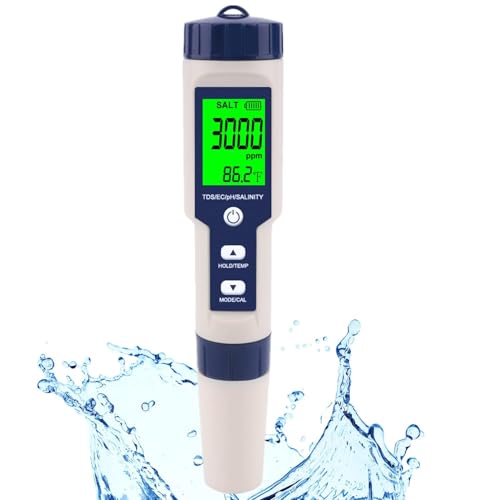
- Combines salinity, pH, TDS, EC, and temperature
- Covers up to 200 ppt for seawater testing
- Uses a titanium alloy probe for quick readings
Best For: Pools, aquariums, and marine monitoring
Best Refractometer for Marine Monitoring – Agriculture Solutions Salinity Refractometer
For aquarium owners comparing salinity meters, this refractometer provides readings on both specific gravity and parts per thousand scales. Automatic temperature compensation and a supplied hard case make it a practical choice for routine saltwater checks.
Best For: Marine aquariums, fishkeeping, and general saltwater monitoring.
Pros:
- Measures specific gravity and parts per thousand.
- Automatic temperature compensation helps simplify testing.
- Includes a hard case, dropper, screwdriver, manual, and cleaning cloth.
- Chromium construction is described as durable.
Cons:
- Requires manual sampling and viewing through a refractometer.
- Designed for liquid saltwater testing rather than a broad range of applications.
Its dual-scale readings and accessory kit make it a well-equipped manual option for hobbyists who want straightforward aquarium salinity checks.
Best Digital Salinity Meter Kit – Pinpoint Salinity Meter Kit
This digital salinity meter kit is aimed at buyers who prefer a displayed reading instead of interpreting an optical scale. It includes the meter, probe, calibration fluid, temperature compensation, and a conversion chart for a more complete testing setup.
Best For: Users seeking a digital salinity-testing kit with calibration supplies.
Pros:
- Provides a digital readout.
- Features full temperature compensation.
- Includes a probe, calibration fluid, and conversion chart.
Cons:
- The supplied notes do not specify the measurement range or intended water types.
- Requires calibration and probe handling.
The included calibration fluid and probe make this a convenient kit-style choice, particularly for shoppers who prioritize a digital display.
Best Easy-Use Aquarium Refractometer – Salinity Refractometer
Among salinity meters for aquarium use, this manual refractometer offers two measurement scales and a simple two-to-three-drop testing process. Its automatic temperature compensation, portable case, and corrosion-resistant aluminum and ABS construction suit regular marine fishkeeping checks.
Best For: Aquarium, marine fishkeeping, saltwater pool, and seawater testing.
Pros:
- Reads specific gravity from 1.000 to 1.070 and salinity from 0 to 100 parts per thousand.
- Automatic temperature compensation supports quicker readings.
- Simple prism-based testing requires only 2–3 drops of sample.
- Includes a case, screwdriver, dropper, and cleaning cloth.
Cons:
- Requires manual sample placement and optical reading.
- Supplied accessories are compact and may require careful handling.
With broad aquarium-focused scales and a straightforward operating method, this is a practical refractometer for hobbyists who want portable, repeatable saltwater checks.
Best Saltwater Pool Meter – SALT-3050 Waterproof Meter
This digital salinity meter is built for saltwater pools and koi fish ponds, with a 0–9,999 ppm range, temperature readings, and an IP65 waterproof rating. Buyers should note that it is specifically restricted to pool and koi-pond salt testing, not marine aquariums or food applications.
Best For: Saltwater pool and koi fish pond salt-level testing.
Pros:
- Measures from 0 to 9,999 ppm or 0.0 to 1.0%.
- Also displays temperature from 0–55°C or 32–130°F.
- IP65 waterproof construction.
- Precalibrated at 3,000 ppm salt at 25°C.
Cons:
- Will not work for marine or saltwater fish tanks.
- Will not work for food salt testing or other applications.
- Requires three LR44 batteries.
This is a focused tool rather than a general-purpose salinity meter. Its specified pool-and-pond compatibility and waterproof design make it suitable when those limits match your testing needs.
Simple Aquarium Monitoring – Deep Six Hydrometer
If you need a straightforward salinity meter for a warm aquarium, the Coralife Deep Six Hydrometer focuses on specific-gravity readings with an easy-to-read scale. Its bubble-resistant design is intended to support consistent readings without adding electronic controls or batteries.
Best For: Aquarium keepers who want a simple hydrometer for monitoring salinity in warm freshwater or saltwater aquarium setups.
Pros:
- Easy-to-read scale with clear, precise markings
- Rated accurate to ±0.001 specific gravity units
- Bubble-resistant design helps support reliable readings
- Calibrated for aquariums from 68–85 °F
Cons:
- Measures specific gravity rather than offering multiple water-quality parameters
- Designed for the stated warm-aquarium temperature range
The Deep Six is a practical choice when aquarium salinity is the main measurement you need. Its manual design is less versatile than a digital multiparameter tester, but it keeps routine monitoring simple.
Multiparameter Testing – Apera PC60 Pocket Tester
The Apera PC60 is a versatile digital salinity meter for users who also need pH, conductivity, TDS, and temperature readings. Its backlit LCD, dual display, replaceable probe, and included calibration supplies make it suited to more involved water-testing routines.
Best For: Aquarium, laboratory, and water-testing users who want salinity readings alongside several other parameters in one portable tester.
Pros:
- Measures pH, EC, TDS, salinity, and temperature
- Large backlit LCD provides dual displays and calibration indicators
- Replaceable multiparameter probe is designed for easy installation
- Complete kit includes calibration and storage solutions, batteries, and a carrying case
Cons:
- More equipment and setup than a dedicated salinity hydrometer
- Electrode warranty is listed as six months, shorter than the instrument’s two-year warranty
The PC60 makes sense when salinity is only one part of your testing workflow. Its broad measurement range and included accessories add convenience, although the multiparameter design may be more than needed for basic aquarium checks.
Wide-Range Digital Testing – ORAPXI Waterproof Salinity Tester
The ORAPXI digital salinity meter is built for saltwater applications requiring a broad measurement range and quick readings. Its IP67 waterproof design, automatic temperature compensation, and backlit display support use in aquariums, seawater, marine monitoring, and koi ponds.
Best For: Saltwater aquarium, seawater, pool, and koi-pond users who want a portable digital tester with multiple measurement modes.
Pros:
- Measures salinity, TDS, EC, and temperature
- Supports readings from 10–200 ppt, with additional ppm and percentage ranges
- Automatic temperature compensation covers 32–140 °F
- IP67 waterproof body and green backlit LCD support practical field use
Cons:
- May offer more functions than needed for users seeking only salinity readings
- Supplied notes do not specify a warranty or included calibration solutions
With its wide range and temperature compensation, the ORAPXI is a flexible option for varied saltwater environments. The simple dip-and-read operation also makes it convenient for routine checks, while the listed accessories and support details are less extensive than the Apera kit’s.
Best All-in-One Pick – 5-in-1 Pool Salt Tester
If you want more than salinity readings, this multifunctional meter combines salt, pH, TDS, EC, and temperature testing in one handheld unit. Its PPM, PPT, and percentage displays make it flexible for pools, aquariums, hot tubs, seawater, and food testing.
Best For: Pool, aquarium, hot tub, spa, and general water-quality monitoring.
Pros:
- Measures salinity, pH, TDS, EC, and temperature.
- Supports PPM, PPT, and percentage salinity displays.
- Clear LCD display and straightforward probe-based operation.
- Works across swimming pools, aquariums, hot tubs, and seawater applications.
Cons:
- Its broad feature set may be more than needed for simple pool salt checks.
- The supplied details do not specify a waterproof rating.
This is a versatile choice when one of the more capable salinity meters can replace several separate water-testing tools.
Best Dedicated Pool Pick – SALT-3000 Digital Meter
The SALT-3000 is a focused option for checking saltwater pool and koi pond levels. It measures from 0 to 9,990 ppm, includes temperature readings, and is precalibrated at 3,000 ppm salt, making it a straightforward choice for its intended applications.
Best For: Saltwater pools and koi fish ponds that need dedicated ppm testing.
Pros:
- Measures salt levels from 0 to 9,990 ppm.
- Also displays temperature from 0–55 °C or 32–130 °F.
- Precalibrated at 3,000 ppm salt and offers a 1 ppm readout accuracy.
- Includes a one-year manufacturer warranty.
Cons:
- Works only for saltwater pools and koi fish ponds.
- Not suitable for sea or marine fish tanks, food testing, or other applications.
- It is not waterproof.
Among salinity meters, this model makes the most sense when you want a dedicated pool or koi-pond tester and do not need broader water-quality functions.
Best for Versatile Monitoring – Hofun 5-in-1 Salinity Meter
Hofun’s multiparameter tester is designed for users who need flexible salinity and water-quality readings. It combines salinity, pH, temperature, EC, and TDS testing, while its PPM, PPT, and percentage displays support pool, seawater, aquarium, and food-related measurements.
Best For: Pools, aquariums, marine monitoring, koi water, hot tubs, hydroponics, and RO/DI systems.
Pros:
- Combines salinity, TDS, EC, pH, and temperature functions.
- Supports salinity readings in PPM, PPT, and percentage formats.
- Offers a 0–9,999 ppm and 0–200 ppt testing range.
- Titanium alloy probe is designed for quick and accurate measurements.
Cons:
- The wide range of functions may be unnecessary for basic salt testing.
- The supplied details do not state whether the meter is waterproof.
This is a strong fit if you want salinity meters that can also handle several routine water-quality checks across different aquatic environments.
How We Picked These Salinity Meters
We selected products across the main testing formats: analog hydrometers, optical refractometers, dedicated digital Salinity Meters, and multifunction meters that also measure pH, conductivity, TDS, or temperature. We considered the water types each device is intended for, stated salinity range, ease of calibration, waterproofing, readability, and whether automatic temperature compensation is included.
Because aquarium, pool, and pond requirements differ, no single tester is ideal for every user. A marine aquarium hobbyist may prioritize seawater-specific readings and repeatability, while a pool owner may prefer a broad-range digital tester with multiple water-quality functions.
Quick Comparison
| Tester type | Best suited to | Main advantage | Potential limitation |
|---|---|---|---|
| Hydrometer | Basic aquarium checks | Simple and inexpensive | More technique-sensitive and less precise |
| Refractometer | Marine aquariums and seawater | Fast optical readings and compact design | Requires careful calibration and a clean prism |
| Dedicated digital meter | Salt pools, ponds, and routine testing | Easy-to-read numerical results | Needs batteries and periodic calibration |
| Multifunction meter | Users testing several water parameters | Combines salinity with pH, EC, TDS, or temperature | More settings and maintenance to manage |
Key Buying Factors for Salinity Meters
Measurement Range and Units
Check whether the meter reports parts per thousand (ppt), parts per million (ppm), specific gravity, or another scale. Marine aquariums commonly use specific gravity or ppt, while salt pools often use ppm. The range should comfortably cover your expected readings without operating at the edge of the scale.
Accuracy, Calibration, and Temperature Compensation
Look for clear calibration instructions and suitable calibration solutions. Automatic temperature compensation, or ATC, helps reduce errors when sample temperature changes, but it does not replace proper calibration. Rinse the sensor or prism with clean water after every use and follow the manufacturer’s storage instructions.
Construction and Usability
Waterproof or water-resistant construction is useful around pools, ponds, and aquariums. A backlit display, hold function, low-battery warning, and automatic shutoff can make routine testing easier. For refractometers, a clear optical scale and a durable hinged cover are especially helpful.
Extra Measurement Functions
Multifunction models can be worthwhile if you also monitor pH, conductivity, TDS, or temperature. However, select a dedicated salinity tester if you want a simpler workflow or do not need additional readings.
Who Should Buy Which Salinity Meters?
- Marine aquarium owners: Choose a seawater refractometer or dedicated salinity meter with an appropriate marine range, ATC, and reliable calibration process.
- Saltwater pool owners: A waterproof digital tester with a broad ppm range is usually the most convenient choice; multifunction models are useful when pH and TDS checks are also part of your routine.
- Koi pond keepers: Select a rugged digital meter that clearly displays temperature and salinity, especially if frequent outdoor testing is required.
- Occasional aquarium testers: A basic hydrometer can be adequate for quick checks, provided you use it correctly and verify readings when livestock health depends on precise salinity.
- Water-quality hobbyists: A 5-in-1 meter offers broader monitoring in one device, but expect to spend more time calibrating, cleaning, and maintaining its probes.
Whichever of these Salinity Meters you choose, consistent testing technique matters as much as the device itself. Test at similar temperatures, calibrate on schedule, and confirm unusual readings before making major changes to your water.