Stable salinity is essential for marine fish, corals, and invertebrates, but choosing the right testing tool can be surprisingly difficult. Digital meters, refractometers, and hydrometers each offer different levels of precision, convenience, and maintenance.
This roundup compares 10 popular salinity meters for aquariums so you can match the testing method to your tank type, accuracy needs, and budget.
Best 10 Salinity Meters for Aquariums Picks for 2026
Best Digital Refractometer

- Measures PSU, ppt, and specific gravity
- Automatic temperature compensation
- 1.5-second response time
Best For: Saltwater and reef-tank monitoring
Best Manual Refractometer
Agriculture Solutions WL0020-ATC

- Measures 0–100 ppt salinity
- Reads specific gravity and ppt
- Includes case and testing accessories
Best For: Marine fishkeepers wanting a dedicated optical tester
Best for Koi Ponds
SALT-3050 Waterproof PPM Meter

- Measures 0–9,999 ppm salt
- IP65 waterproof housing
- Not suitable for marine aquariums
Best For: Saltwater pools and koi fish ponds
Best Analog Precision
Aquarium Salinity Refractometer

- Measures specific gravity and parts per thousand
- Automatic temperature compensation
- Includes case and testing accessories
Best For: Marine aquariums and saltwater monitoring
Best Multiparameter Value
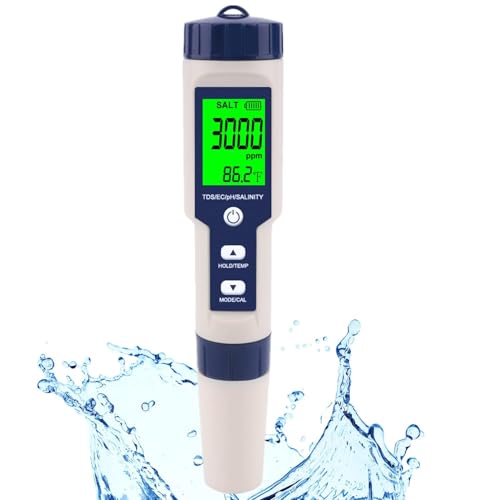
- Tests salinity, pH, temperature, EC, and TDS
- Shows ppm, ppt, and percentage salinity
- Supports aquarium, pool, and seawater testing
Best For: Multi-use water quality testing
Best Simple Hydrometer
Coralife Deep Six Aquarium Hydrometer

- Easy-to-read specific-gravity scale
- Accuracy rated to ±0.001
- Bubble-resistant and warm-water calibrated
Best For: Routine salinity checks in warm aquariums
Best Refractometer
SunGrow Aquarium Salinity Refractometer

- Seawater-specific testing algorithm
- Automatic temperature calibration from 50°F to 86°F
- Includes case, pipette, and calibration tool
Best For: Reef keepers who prefer optical readings
Best Simple Pick
hygger Marine Aquarium Hydrometer

- Reads salinity and specific gravity
- Temperature-corrected to ±0.001 accuracy
- Stable base with easy-read swing-arm pointer
Best For: Marine and brackish tanks needing simple routine checks
Best Digital Refractometer – Milwaukee MA887
For aquarists who want fast, repeatable readings, the Milwaukee MA887 is a strong choice among salinity meters for aquariums. This portable digital refractometer measures seawater salinity in PSU, ppt, and specific gravity, with automatic temperature compensation and a 1.5-second response time.
Best For: Saltwater aquariums and reef tanks where quick, multi-unit digital readings are useful.
Pros:
- Displays PSU, ppt, and specific gravity readings.
- Automatically compensates for temperature variations.
- Delivers results in approximately 1.5 seconds.
- Sealed glass prism and stainless steel well are easy to clean.
Cons:
- Designed specifically for natural or artificial seawater, rather than general water testing.
- Requires a sample and pipette instead of direct immersion.
The MA887 prioritizes convenience and consistent readings in a compact format. Its multiple measurement units and easy-clean sample well make it a practical upgrade for routine reef-tank salinity checks.
Best Multi-Parameter Tester – YINMIK YK-5
The YINMIK YK-5 stands out among salinity meters for aquariums because it combines salinity testing with pH, TDS, EC, and temperature measurements. Its broad seawater range and replaceable probe make it useful for aquarists who want one digital tool for several water-quality checks.
Best For: Aquarium keepers who also need pH, conductivity, TDS, and temperature testing.
Pros:
- Combines pH, EC, TDS, salinity, and temperature testing.
- Measures seawater salinity from 0.00 to 200.0 ppt.
- Includes calibration buffer packets.
- Uses a replaceable probe to extend the tester’s service life.
Cons:
- Requires calibration and uses three LR44 batteries.
- Its multi-function design may be more capability than needed for salinity-only testing.
- The notes cover broad water-testing applications, so users should follow the included instructions for aquarium use.
Choose the YK-5 if monitoring overall water quality matters as much as salinity. The replaceable probe and wide seawater range add flexibility, while the extra functions can reduce the need for separate meters.
Best Manual Refractometer – Agriculture Solutions WL0020-ATC
The Agriculture Solutions WL0020-ATC is a straightforward option among salinity meters for aquariums, using an optical refractometer to measure seawater from 0 to 100 ppt. Automatic temperature compensation helps support convenient testing, while the included case and accessories make storage and setup simple.
Best For: Marine fishkeepers who prefer a compact manual refractometer with specific gravity and ppt scales.
Pros:
- Measures salinity from 0 to 100 ppt.
- Shows both specific gravity and parts-per-thousand readings.
- Includes automatic temperature compensation.
- Comes with a hard case, dropper, screwdriver, manual, and cleaning cloth.
Cons:
- Requires visual reading rather than providing a digital display.
- Needs a sample drop and manual handling for each test.
This model is a sensible fit for hobbyists who want a dedicated seawater refractometer without extra water-quality functions. Its dual scales and included accessories cover the basics for marine aquarium monitoring.
Best for Koi Ponds – SALT-3050 Waterproof PPM Meter
The SALT-3050 is a compact waterproof digital meter for saltwater pools and koi fish ponds, but it is not suitable for marine or saltwater fish tanks. Its 0–9,999 ppm range, temperature display, and IP65 rating make it better suited to the applications specified by the manufacturer than to aquarium reef systems.
Best For: Saltwater pool and koi pond salt-level testing.
Pros:
- Measures from 0 to 9,999 ppm or 0.0 to 1.0%.
- Displays temperature from 0 to 55°C.
- IP65 waterproof construction.
- Precalibrated at 3,000 ppm salt at 25°C.
Cons:
- Will not work for sea, marine, or saltwater fish-tank testing.
- Not intended for food salt or other applications.
- Uses three LR44 batteries.
Although it appears in searches for salinity meters for aquariums, the SALT-3050 should not be selected for marine aquariums. Its clearly stated use case is saltwater pools and koi ponds, where its ppm-focused range and waterproof housing are appropriate.
Best Analog Precision – Aquarium Salinity Refractometer
For aquarists who want a straightforward optical option, this salinity refractometer is a practical choice among salinity meters for aquariums. It measures both specific gravity and parts per thousand, while automatic temperature compensation helps simplify routine testing.
Best For: Marine aquariums, saltwater monitoring, fishkeeping, and saltwater pools.
Pros:
- Reads specific gravity from 1.000–1.070 and salinity from 0–100‰.
- ATC helps provide faster, easier readings across temperature variations.
- Includes a case, dropper, mini screwdriver, and cleaning cloth.
- Durable aluminum and ABS construction is designed to resist rust, stains, and abrasion.
Cons:
- Requires placing two to three sample drops on the prism and reading through the eyepiece.
- Provides optical readings rather than the multiparameter functions of a digital meter.
This is a focused salinity tester for users who value dual-unit readings and a portable, reusable design without extra electronic measurement modes.
Best Multiparameter Value – 5-in-1 Digital Salinity Meter
This Hofun digital tester is designed for shoppers who want more than salinity readings from their salinity meters for aquariums. It combines salinity, pH, temperature, EC, and TDS testing in one device, with selectable displays for ppm, ppt, and percentage readings.
Best For: Aquariums, marine monitoring, koi ponds, pools, spas, hot tubs, and hydroponic or RO/DI water testing.
Pros:
- Combines salinity, TDS, EC, pH, and temperature functions.
- Displays salinity in ppm, ppt, or percentage formats.
- Offers a 0–9999 ppm pool range and 0–200 ppt range for seawater testing.
- Titanium alloy probe is designed for quick, accurate measurements.
Cons:
- Its broader feature set may be unnecessary if you only need salinity.
- Requires using the Mode button to select the salinity function.
Choose this model when consolidating several water-testing tasks matters more than having a dedicated single-purpose salinity instrument.
Best Simple Hydrometer – Coralife Deep Six Aquarium Hydrometer
The Coralife Deep Six offers a simple, dedicated approach for aquarists comparing salinity meters for aquariums. Its easy-to-read scale, bubble-resistant design, and warm-water calibration make it suited to routine specific-gravity checks.
Best For: Warm aquarium water and straightforward salinity tracking.
Pros:
- Clear scale is designed for easy reading.
- Rated accurate to ±0.001 specific gravity units.
- Bubble-resistant design supports more reliable readings.
- Calibrated for aquariums from 68–85 °F (20–30 °C).
Cons:
- Measures specific gravity rather than offering multiple salinity units or water parameters.
- Its stated calibration range is limited to warm aquarium temperatures.
This is a sensible pick for aquarists who want an uncomplicated hydrometer dedicated to tracking specific gravity in a warm fish tank.
Best Digital Pick – ORAPXI 4-in-1 Salinity Tester
For shoppers comparing salinity meters for aquariums, the ORAPXI is a versatile digital option with a broad measurement range and a quick, easy-to-read display. It measures salinity, TDS, EC, and temperature, while automatic temperature compensation helps reduce temperature-related reading errors.
Best For: Aquarium keepers who want one handheld tester for salinity and several other water parameters.
Pros:
- Measures salinity, TDS, EC, and temperature in one device.
- Supports readings from 10–200 ppt and includes a 0–9999 ppm range.
- Waterproof IP67 design and green backlit LCD suit routine testing.
- Automatic temperature compensation operates from 32°F to 140°F.
Cons:
- Requires batteries and electronic handling rather than a simple float-style reading.
- The wide range may offer more functionality than needed for basic aquarium checks.
Choose this model if you value digital convenience and multiparameter testing. Its backlight, wide range, and ATC make it a practical choice for regular aquarium, seawater, or marine-monitoring checks.
Best Refractometer – SunGrow Aquarium Salinity Refractometer
SunGrow Measure Salinity of Water with Aquarium Refractometer, Remarkable Accuracy, Easy Reading
Check Price On AmazonThe SunGrow is a dedicated refractometer for shoppers seeking salinity meters for aquariums and reef tanks. Its seawater-specific algorithm, focus-adjustable eyepiece, and automatic temperature calibration are designed to make saltwater readings clear and consistent.
Best For: Reef and saltwater aquarium owners who prefer an optical refractometer with a carrying case and calibration accessories.
Pros:
- Designed specifically for seawater and saltwater aquarium testing.
- Automatic temperature calibration covers ambient temperatures from 50°F to 86°F.
- Adjustable eyepiece helps produce a sharp, easy-to-read line.
- Includes a hard case, pipette, and calibration tool.
Cons:
- Requires a sample and optical reading rather than an instant digital display.
- Calibration should be performed with the instrument and room at 68°F.
This is a focused choice for saltwater and reef setups. The included accessories and seawater-specific calibration make it appealing to aquarists who want a compact, dedicated measurement tool rather than a multiparameter meter.
Best Simple Pick – hygger Marine Aquarium Hydrometer
The hygger offers a straightforward alternative for shoppers comparing salinity meters for aquariums. This acrylic swing-arm hydrometer measures both salinity and specific gravity: fill it with aquarium water, place it on a level surface, and read the pointer and scales.
Best For: Brackish and marine aquarium owners who want a simple, temperature-corrected hydrometer for routine checks.
Pros:
- Measures both salinity and specific gravity.
- Temperature-corrected accuracy is rated at ±0.001.
- Wide, stable base and swing-arm pointer support easy reading.
- Transparent acrylic construction includes clearly marked scales.
Cons:
- Must be filled and placed on a level surface for each reading.
- Cleaning requires a 30-minute vinegar soak, followed by rinsing and air drying.
- The stated specific-gravity range is 1.000–1.030, so it is less broad than some digital meters.
For aquarists who want an uncomplicated tool without multiple electronic modes, the hygger is easy to operate and provides both specific-gravity and salinity scales. Its stable base and temperature-corrected design suit regular marine or brackish-tank monitoring.
How We Picked the Best Salinity Meters for Aquariums
We focused on the factors that matter most during routine aquarium maintenance: measurement range, readability, temperature compensation, water resistance, calibration needs, and ease of cleaning. The selection includes digital salinity testers, seawater refractometers, multipurpose pH and conductivity meters, and traditional hydrometers.
Because product specifications and included accessories can vary, check the manufacturer’s current instructions before purchase. A meter’s accuracy also depends on proper calibration, clean sensors, and following the recommended sampling procedure.
Quick Comparison
| Type | Best For | Main Advantage | Typical Trade-Off |
|---|---|---|---|
| Digital salinity meter | Frequent testing | Fast, easy-to-read results | Needs batteries and calibration |
| Digital refractometer | Marine aquariums needing consistency | Simple sample-based testing | Usually costs more |
| Optical refractometer | Accurate routine checks | No batteries required | Requires light and visual reading |
| Hydrometer | Budget-conscious beginners | Simple and inexpensive | Less precise and sensitive to bubbles |
Key Buying Factors for Salinity Meters for Aquariums
Measurement Range and Resolution
Choose a range that covers your aquarium’s target salinity without sacrificing readability. Marine aquariums are commonly maintained around seawater salinity, while some fish-only systems, ponds, and quarantine setups may require different readings. Resolution matters when making small adjustments during water changes.
Accuracy and Calibration
Look for automatic temperature compensation when possible, especially if testing water at different temperatures. Digital meters and refractometers typically require calibration with the correct standard solution or calibration fluid. Follow the instructions rather than assuming freshwater calibration is suitable for seawater measurements.
Ease of Use and Maintenance
A clear display, quick stabilization, and simple sample cleanup make regular testing more likely. Rinse probes or prisms with clean water after use, dry them as directed, and avoid contaminating calibration solutions. Waterproof construction is helpful, but it does not eliminate the need for careful handling.
Salinity, Specific Gravity, and Extra Readings
Some tools display parts per thousand, while others show specific gravity or conductivity. Confirm that the scale matches the way you normally manage your aquarium. Multipurpose testers can also measure pH, temperature, TDS, or EC, but additional functions do not automatically mean better salinity accuracy.
Who Should Buy Which Salinity Meters for Aquariums?
Choose a digital salinity meter if you test often and want quick, highly visible readings. These are convenient for larger systems, salt mixing, and users who prefer numeric displays.
Choose a refractometer if dependable seawater readings are your priority and you are comfortable calibrating and visually reading an optical scale. Digital refractometers offer added convenience for users who want fewer visual-reading steps.
Choose a hydrometer if you are setting up a basic aquarium on a tight budget and can verify readings periodically with a more precise instrument. Whichever style you select, consistent testing and correct calibration are more important than choosing the most feature-packed model.