The best pressure canners make it easier to preserve low-acid foods such as vegetables, meats, poultry, and seafood safely at home. The right model depends on your batch size, cooktop, storage space, and comfort with manual or digital controls.
Our 2026 roundup compares stovetop and electric options, including compact designs, large-capacity aluminum canners, induction-compatible models, and digital pressure canners for simpler processing.
Best 10 Pressure Canners Picks for 2026
Classic Large-Batch Pick
Presto 01781 23-Quart Pressure Canner

- Large 23-quart capacity
- Pressure and water-bath canning
- 12-year limited warranty
Best For: Large home-canning batches on regular or smooth-top ranges
Beginner-Friendly Value
T-fal 22-Quart Aluminum Pressure Canner

- 22-quart large-batch capacity
- Includes two racks and canning guide
- Pressure and water-bath functions
Best For: Newer home canners using gas or electric coil cooktops
Induction-Ready Choice
Presto 01784 23-Quart Pressure Canner

- Compatible with induction ranges
- Fits up to 7 quarts or 20 pints
- 12-year limited warranty
Best For: Large-batch canners with induction or other compatible stovetops
Smart Electric Option
NESCO NPC-9 Electric Pressure Canner
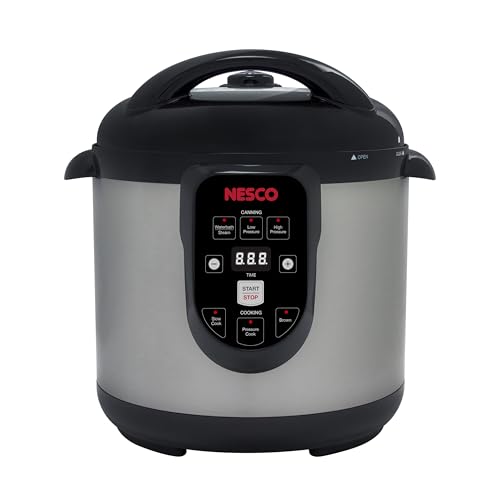
- Automatic digital pressure control
- Multiple cooking modes
- Includes canning and steam racks
Best For: Users seeking guided electric canning and everyday cooking functions
Best for Bulk Batches

- Large 24-quart capacity for batch processing
- Pressure gauge and multiple safety features
- Compatible with induction and other cooktops
Best For: Large seasonal harvests and pantry stocking
Best Digital Upgrade
Presto 23-Quart Digital Canner

- Guided digital controls and LED display
- Automatically maintains processing temperature
- Fits up to seven quart jars
Best For: Beginners seeking convenient automated canning
Best Complete Starter Kit

- 25-quart multipurpose pressure canner
- Includes a broad set of canning tools
- Compatible with induction and several stovetops
Best For: Beginners wanting an all-in-one canning setup
Best Automated Option
Presto 02152 Digital Pressure Canner

- Automatic pressure and water-bath canning
- 17-quart capacity for larger batches
- No high-altitude adjustments required
Best For: Hands-off home canning with guided controls
Best Manual Value
Presto 01755 16-Quart Aluminum Canner

- Manual 16-quart pressure canner
- Lightweight 10.5-pound aluminum build
- Includes air vent and cover lock
Best For: Traditional, hands-on pressure canning
Best Compact Digital Pick
Presto 02144 12-Quart Digital Canner

- Automated pressure and water-bath canning
- Digital guidance with ten safety features
- 12-quart format with no altitude adjustments
Best For: Guided canning in a smaller-capacity digital unit
Classic Large-Batch Pick – Presto 01781 23-Quart Pressure Canner
For shoppers comparing pressure canners, the Presto 01781 is a roomy stovetop model built for large preservation batches. Its heavy-gauge aluminum construction, pressure dial gauge, and dual pressure- and water-bath-canning functions make it a practical choice for preserving both low- and high-acid foods.
Best For: Large home-canning batches on regular or smooth-top ranges.
Pros:
- Accommodates up to 7 quarts, 20 pints, or 26 half-pints.
- Works as both a pressure canner and boiling-water canner.
- Includes a canning rack, recipe book, and extended 12-year limited warranty.
- Dial gauge provides pressure readings across the full processing range.
Cons:
- Manual stovetop operation requires monitoring during processing.
- Aluminum construction may not suit shoppers seeking stainless steel.
- Its large 23-quart size requires substantial storage space.
The Presto 01781 stands out when capacity and versatility matter most. It is a straightforward option for experienced home canners who want one large manual appliance for pressure canning, water-bath canning, and occasional cooking.
Beginner-Friendly Value – T-fal 22-Quart Aluminum Pressure Canner
The T-fal 22-quart model is a versatile choice among pressure canners, combining a large aluminum body with features aimed at straightforward home use. It supports pressure canning for low-acid foods and boiling-water canning for fruits, jams, pickles, and other high-acid foods.
Best For: Newer home canners who want racks, a guide, and simple stovetop operation.
Pros:
- Holds up to 7 quarts, 18 regular pints, 16 wide-mouth pints, or 24 half-pints.
- Includes two canning racks and a step-by-step canning guide.
- Works on gas and electric coil cooktops.
- Features a locking lid, steam release valve, and easy-to-read gauge.
Cons:
- Its listed stovetop compatibility does not include induction.
- One-year warranty is shorter than some competing models.
- Manual operation requires attention to pressure and processing steps.
With useful accessories and a clear focus on approachable operation, the T-fal is a well-rounded entry point. Consider it if you want generous capacity without moving to an electric, digitally controlled appliance.
Induction-Ready Choice – Presto 01784 23-Quart Pressure Canner
If you need pressure canners that work with induction, the Presto 01784 is designed for broad stovetop compatibility. Its heavy-gauge aluminum body has an induction-compatible stainless steel-clad base, while the large interior supports substantial canning and cooking batches.
Best For: Large-batch canners with induction, gas, electric, or smooth-top stoves.
Pros:
- Compatible with induction, gas, electric, and smooth-top ranges.
- Holds up to 7 quarts, 20 pints, or 26 half-pints.
- Functions as both a pressure canner and boiling-water canner.
- Includes an air vent/cover lock and a 12-year limited warranty.
Cons:
- Manual pressure control may require more attention than an electric model.
- Its full-size design can be bulky to store.
- The product is not a programmable appliance.
The 01784 is especially compelling for households that have switched to induction but still want a traditional, high-capacity canner. It preserves the familiar manual workflow while adding compatibility that many aluminum stovetop models lack.
Smart Electric Option – NESCO NPC-9 Electric Pressure Canner
For shoppers who prefer guided controls, the NESCO NPC-9 offers a digital alternative to traditional pressure canners. Its automatic pressure and temperature regulation, preset programs, and timer simplify processing, while additional cooking modes make it useful beyond food preservation.
Best For: Users who want automatic controls for canning and everyday cooking.
Pros:
- Digital controls and preset programs support repeatable processing cycles.
- Includes pressure cook, slow cook, steam, and water-bath modes.
- Safety lock lid, automatic float valve, and pressure regulation help reduce user error.
- Removable inner pot, canning rack, steam rack, and condensation catcher are included.
Cons:
- Its 9.5-quart format is smaller than the 22- and 23-quart stovetop models.
- At 22 pounds, it is relatively heavy for its capacity.
- It has a one-year warranty.
The NESCO is a strong fit when convenience matters more than maximum batch size. Its automatic operation and multipurpose modes make it easier to transition between preserving food and preparing everyday meals.
Best for Bulk Batches – 24-Quart Pressure Canner
This 24-quart pressure canner is built for large home-preservation batches rather than everyday cooking. Its aluminum body, pressure gauge, safety lock, and composite base make it a practical option for canning on gas, electric, flat-top, or induction cooktops, provided your induction zone is large enough.
Best For: Home canners processing large quantities of vegetables, meat, seafood, or other seasonal produce.
Pros:
- Large 24-quart capacity for batch canning and bulk cooking.
- Readable pressure gauge helps monitor processing conditions.
- Composite base is compatible with gas, electric, flat-top, and induction cooktops.
- Safety lock and two pressure-relief valves add useful safety features.
Cons:
- Its 32cm-wide design may be too large for smaller kitchens or cooktops.
- Runs at 14.5 PSI by default; alternate settings require a separately available regulator.
- Manual operation requires you to monitor the canner during processing.
Choose this model when capacity and stovetop flexibility matter most. Check your available storage and induction cooking-zone dimensions before ordering.
Best Digital Upgrade – Presto 23-Quart Digital Canner
The Presto 02153 brings guided digital operation to pressure canning. Its sensor technology is designed to maintain processing temperature automatically, while prompts, a timer, and altitude adjustment reduce the need for stovetop monitoring.
Best For: Beginners and busy home canners who want automated, step-by-step processing for large batches.
Pros:
- Digital controls and LED prompts simplify pressure and boiling-water canning.
- Automatic temperature maintenance eliminates constant burner adjustment.
- 23-quart capacity can hold up to seven quart jars.
- Built-in timer, automatic shut-off, locking lid, and altitude adjustment support convenient operation.
Cons:
- Requires a 120-volt electrical outlet and has a larger footprint than many stovetop models.
- At 16.1 pounds, it is heavier than some manual aluminum canners.
- Digital operation may be less appealing to shoppers who prefer simple stovetop controls.
This is a strong choice if you want pressure canners with more automation and less hands-on monitoring. Its size and electrical requirements are worth checking before purchase.
Best Complete Starter Kit – 25-Quart Canner and Cooker
This 25-quart pressure canner combines pressure canning, pressure cooking, and water-bath functionality with a broad accessory package. The induction-compatible base and included tools make it appealing to shoppers who want to begin canning without assembling equipment separately.
Best For: New or experienced home canners who want a large multipurpose pot and included jar-handling accessories.
Pros:
- 25-quart capacity supports large canning and cooking batches.
- Includes a rack, spare seal ring, funnel, tongs, jar wrench, jar lifter, bubble remover, and magnetic lid lifter.
- Compatible with induction, gas, open-flame, and electric ceramic cooktops.
- Pressure gauge, regulator, safety lock, and automatic pressure-release valve support controlled use.
Cons:
- The extensive accessory set may be unnecessary if you already own canning tools.
- Manual pressure monitoring and stovetop operation require more involvement than a digital canner.
- Its large capacity may be excessive for small kitchens or occasional users.
Consider this model if versatility and included accessories are priorities. It offers a generous capacity for canning and cooking, but confirm that its dimensions suit your storage and cooktop space.
Best Automated Option – Presto 02152 Digital Pressure Canner
If you want pressure canners with a guided, hands-off process, the Presto 02152 combines automatic controls with a 17-quart capacity. Its sensor maintains the required temperature, while the digital display and control knob guide you through the selected canning method and processing time.
Best For: Home canners who want automated operation, high-altitude convenience, and room for larger batches.
Pros:
- Automates pressure and boiling-water canning functions.
- 17-quart, extra-tall design accommodates quart jars and larger batches.
- Sensor automatically maintains the required temperature, with no altitude adjustments needed.
- LED display and push-button controls guide the process.
Cons:
- At 24.3 pounds, it is heavier than the manual aluminum option in this roundup.
- Its 14.5-by-17.25-by-18-inch footprint requires substantial storage space.
The 02152 is a strong choice when convenience matters more than compactness. Its larger capacity and automatic monitoring can make repeated canning sessions simpler, though the substantial size and weight are worth planning for.
Best Manual Value – Presto 01755 16-Quart Aluminum Canner
For shoppers comparing traditional pressure canners, the Presto 01755 offers a straightforward manual design with a 16-quart capacity. Its warp-resistant aluminum construction keeps the unit relatively light, while the air vent and cover lock support basic pressure-canning operation.
Best For: Canners who prefer manual controls, a lighter cooker, and a traditional aluminum pressure-canning setup.
Pros:
- 16-quart capacity suits pressure canning and cooking larger batches.
- Manual operation offers a simple, traditional approach.
- At 10.5 pounds, it is lighter than the digital models listed here.
- Warp-resistant aluminum construction and included air vent and cover lock.
Cons:
- Does not provide automated temperature control or a digital process guide.
- Its 100-volt specification may require careful compatibility checking.
- Manual operation requires more hands-on monitoring.
The 01755 is the practical pick for experienced users who do not need digital automation. Its lower weight and aluminum build make it easier to handle, but buyers seeking guided controls should consider one of the digital alternatives.
Best Compact Digital Pick – Presto 02144 12-Quart Digital Canner
The Presto 02144 is one of the more compact digital pressure canners for kitchens that still need automated processing. It handles both pressure and water-bath canning, with a digital interface, temperature sensor, and built-in safety features designed to guide each stage.
Best For: Home cooks who want digital guidance and dual-function canning in a smaller 12-quart format.
Pros:
- Automates both pressure canning and water-bath canning.
- USDA-approved pressure-canning design for low-acid foods, according to the supplied product notes.
- Digital display and control knob guide users through method and processing time.
- Includes ten built-in safety features and requires no high-altitude adjustments.
Cons:
- Its 12-quart capacity is smaller than the 16- and 17-quart options.
- At 20.5 pounds, it remains relatively heavy for a countertop appliance.
- Its 14-by-17-by-16-inch dimensions may still require dedicated storage.
The 02144 balances digital convenience with a somewhat smaller capacity than the other options. It is a sensible fit for users who want guided dual-function canning without choosing the largest model available.
How We Picked These Pressure Canners
We focused on Pressure Canners suited to home food preservation, comparing capacity, pressure-control features, construction, cooktop compatibility, and ease of use. The selection includes traditional stovetop models with gauges or pressure regulators alongside electric canners with programmed controls. We also considered rack systems, handling features, cleaning demands, and whether each design makes sense for small batches or larger harvests.
Always follow the manufacturer’s instructions and current USDA-tested processing guidance. Pressure canning requires accurate time, pressure, and altitude adjustments; it is not interchangeable with ordinary pressure cooking.
Quick Comparison
| Type | Best For | What to Consider |
|---|---|---|
| Large stovetop aluminum | Frequent canning and big batches | Needs compatible burner and manual monitoring |
| Induction-compatible stovetop | Modern smooth-top kitchens | Verify the base and burner size before buying |
| Digital electric | Guided operation and convenience | Requires counter space and electrical power |
| Compact stovetop or electric | Small households and limited storage | Lower batch capacity may mean more cycles |
Key Buying Factors for Pressure Canners
Capacity and Jar Configuration
Choose a size based on the number and type of jars you typically process. Larger 23- to 25-quart models can handle substantial batches, while 12- to 17-quart options are easier to store and may suit occasional canners. Check the rack arrangement and manufacturer’s stated jar capacity rather than relying only on the advertised quart measurement.
Heat-Source Compatibility
Traditional aluminum canners work on many gas and electric stoves, but not every model is suitable for glass or induction cooktops. If you use induction, select a model specifically designed for it and confirm the required burner diameter, base construction, and weight limits. Electric canners offer more flexibility in placement but need a stable, heat-safe outlet and sufficient counter space.
Pressure Monitoring and Controls
Dial gauges provide a visual pressure reading and may require periodic accuracy checks. Weighted regulators are simpler to use but still require correct altitude adjustments. Digital models can automate parts of the process and provide prompts, though they should still be operated according to tested instructions and kept clean around the lid and sensors.
Construction, Handling, and Storage
Aluminum is common because it heats efficiently and keeps these large appliances relatively manageable. Look for secure handles, a dependable locking lid, an easy-to-read gauge, and a rack that protects jars from direct contact with the bottom. Measure cabinet and sink space before purchasing; a full canner is heavy and awkward to move.
Who Should Buy Which Pressure Canners?
Choose a large stovetop model if you preserve garden harvests regularly or want to process several jars per batch. An induction-compatible option is the better fit for kitchens with induction ranges, while a compact stovetop canner suits occasional users with limited storage. Select a digital pressure canner if guided controls and repeatable operation matter more than portability. For mixed households, prioritize the jar capacity you will use most often rather than simply choosing the largest vessel.