Making smooth tomato sauce, applesauce, jam, or purées is easier when seeds and skins are separated efficiently. The best food strainer machines for home use can turn a labor-intensive task into a faster, cleaner kitchen process.
This roundup compares 10 options, from compact mesh strainers and manual sauce masters to high-capacity electric mills. Use the guide below to match power, capacity, cleanup, and versatility to your cooking routine.
Best 10 Food Strainer Machines for Home Use Picks for 2026
Best Batch-Friendly Pick
Weston Deluxe Electric Tomato Strainer

- 250-watt motor with forward and reverse speeds
- One-gallon hopper for larger batches
- Three stainless steel screens included
Best For: Home canning, sauces, purees, and salsa
Best Simple Sauce-Making Option
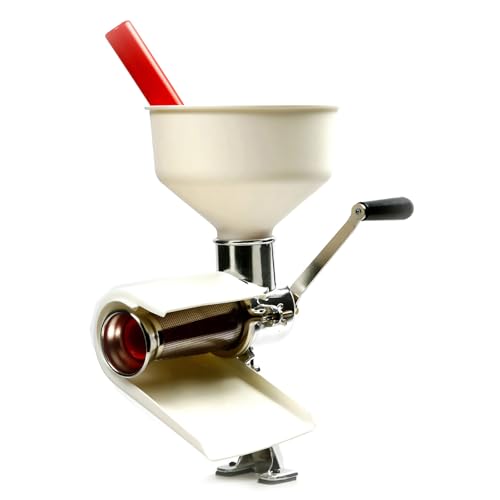
- 3-quart capacity for fruits, vegetables, and purees
- Separates juice and pulp in one operation
- Fine mesh screen and spiral included
Best For: Routine homemade sauces and purees
Best High-Capacity Stainless Steel Model

- 450-watt copper motor for high-output processing
- 304 stainless steel construction
- Five-year warranty and lifetime support
Best For: Large-batch canning and commercial-style home processing
Best Compact Everyday Strainer
Fine Mesh Stainless Steel Colander

- Fine mesh captures small particles
- 304 stainless steel with sturdy handle
- Useful for soups, oils, grains, and juices
Best For: Small-batch everyday straining and filtering
Best for Large-Batch Sauces
VEVOR Electric Tomato Strainer

- Separates peels and seeds in one pass
- Includes four screens for varied textures
- Steady motor for continuous sauce making
Best For: Harvest-season sauce, puree, and salsa processing
Best Everyday Value
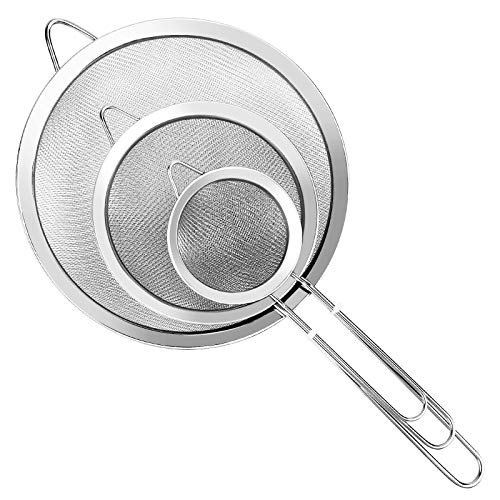
- Three sizes cover varied kitchen tasks
- 304 stainless steel construction
- Nests or hangs for convenient storage
Best For: Manual baking, rinsing, draining, and straining
Best Multi-Function Option
AIRMSEN Meat Grinder and Sauce Press

- Four functions in one appliance
- Includes a tomato strainer attachment
- Reverse function helps clear jams
Best For: Multi-purpose meal prep with tomato sauce processing
High-Volume Tomato Processing Pick
Large-Hopper Electric Tomato Strainer

- Separates peels and seeds for smoother sauce
- 370W motor and large hopper suit batch processing
- Tool-free disassembly supports easier cleaning
Best For: Harvest-season sauce making and home canning
Most Versatile Option
500W Tomato Strainer and Grinder

- Handles sauce, jam, meat, and sausage preparation
- Reverse function helps reduce clogging
- Includes three meat-grinding plates
Best For: Multifunctional home kitchen prep
Stainless-Steel Construction Pick

- 304 stainless-steel food-contact parts
- 370W pure-copper motor for sauce processing
- Nine-inch funnel and adjustable trough aid feeding
Best For: Frequent home sauce making and batch milling
Best Batch-Friendly Pick – Weston Deluxe Electric Tomato Strainer
For shoppers comparing food strainer machines for home use, the Weston Deluxe is a practical choice for processing garden produce into sauces, purees, jellies, and salsa. Its 250-watt motor, two speeds, and one-gallon hopper are designed for home canning and larger batches.
Best For: Home cooks preserving tomatoes, berries, and soft vegetables in moderate-to-large batches.
Pros:
- One-gallon hopper supports larger processing jobs.
- Forward and reverse motor speeds help with extraction and jam prevention.
- Includes 1.5mm, 3mm, and 6mm stainless steel screens for different textures.
- Stomper helps feed ingredients safely into the hopper.
Cons:
- Designed for soft fruits and vegetables rather than general-purpose food straining.
- Its 14-by-12-by-17-inch footprint may require dedicated storage space.
The Weston stands out when versatility and batch capacity matter. The interchangeable screens make it more adaptable than a single-purpose tomato press, while the reverse function adds convenience during longer sessions.
Best Simple Sauce-Making Option – Norpro 1951 Sauce Master
The Norpro 1951 Sauce Master is a straightforward option among food strainer machines for home use. It forces fruits, vegetables, and purees through a chrome-plated steel screen while separating juice and pulp in one operation.
Best For: Home cooks who want a simple manual-style sauce and puree strainer with a 3-quart capacity.
Pros:
- 3-quart, 95-ounce capacity handles everyday sauce-making tasks.
- Automatically separates juice and pulp during straining.
- Includes a standard fine mesh screen, standard spiral, recipe, and instruction booklet.
- Additional berry, pumpkin, and salsa screens are available separately.
Cons:
- Only the standard fine mesh screen and spiral are included.
- Optional specialty screens add cost if you need different textures.
- The listed dimensions are relatively large for a 3-quart strainer.
The Sauce Master is a sensible pick for cooks who value uncomplicated operation and do not need multiple screens out of the box. Its expandable screen system offers room to customize later.
Best High-Capacity Stainless Steel Model – ARINOO 450W Tomato Strainer
For demanding food strainer machines for home use, the ARINOO ETC-1C-2 offers a high-output design with a 450-watt copper motor and food-grade 304 stainless steel construction. It is intended for tomatoes and other fruits used in sauces, jams, and purees.
Best For: Large-batch home canning or users who want a commercial-style stainless steel machine.
Pros:
- Manufacturer lists processing capacity up to 330 pounds per hour.
- Dual-channel design separates skins and seeds from pulp without an extra filter.
- 304 stainless steel construction is rust-resistant and durable.
- Includes a food pusher, enclosed motor housing, five-year warranty, and lifetime support.
Cons:
- At 20.9 pounds, it is substantially heavier than smaller home models.
- Hand-wash-only care may make cleanup more involved.
- Requires cooling for five minutes after every 15 minutes of continuous use.
The ARINOO is best suited to users who regularly process substantial quantities and prioritize metal construction. Its output claims and warranty are attractive, but the heavier build and hand-washing requirement make it less convenient for occasional small batches.
Best Compact Everyday Strainer – Fine Mesh Stainless Steel Colander
Unlike powered food strainer machines for home use, this fine mesh stainless steel colander is a compact handheld tool for everyday kitchen jobs. Its micro holes are designed to separate small particles from liquids, making it useful for soups, oils, juices, grains, and more.
Best For: Everyday straining, skimming, draining, and filtering when you do not need an electric tomato-processing machine.
Pros:
- Fine mesh captures small particles while allowing liquids to drain.
- Food-grade 304 stainless steel frame resists bending and deformation.
- Long welded handle provides a secure grip and includes a hanging hole.
- Suitable for soups, tea, spices, flour, grains, pasta, fruits, and vegetables.
Cons:
- It is a handheld strainer, not a powered machine for processing large produce batches.
- Its listed dimensions indicate a narrow, compact tool rather than a high-capacity colander.
- It does not automatically separate tomato skins and seeds.
This colander makes sense as an affordable complement to a food strainer machine or as a standalone tool for small kitchen tasks. Choose it for flexibility and easy storage, not for high-volume sauce production.
Best for Large-Batch Sauces – VEVOR Electric Tomato Strainer
For shoppers comparing food strainer machines for home use, the VEVOR Electric Tomato Strainer is designed for turning tomatoes and other produce into smoother sauces, purees, juices, and salsas. Its 800W maximum output, 304 stainless steel components, and included screens make it especially suited to harvest-season processing and larger batches.
Best For: Home cooks making tomato sauce, puree, salsa, jam, or other produce-based recipes in larger quantities.
Pros:
- Separates peels and seeds in one pass for smoother results.
- Includes four screens with 1 mm, 1.5 mm, 3 mm, and 6 mm openings for different textures.
- Steady, relatively quiet DC motor supports continuous sauce making.
- Removable stainless steel parts and a cleaning brush simplify rinsing.
Cons:
- At 7.2 pounds, it is less convenient to move than a handheld strainer.
- Its specialized design is focused on produce processing rather than general kitchen straining.
Choose this model if throughput and smooth tomato processing matter more than compact storage. The guard cover also helps reduce splatter, which is useful when working through a sizable batch.
Best Everyday Value – Fine Mesh Strainer Set
This three-piece set is a practical choice for shoppers seeking food strainer machines for home use but who primarily need simple manual tools. The graduated stainless steel strainers cover fine sifting, draining, rinsing, and liquid-straining tasks without requiring a motor or countertop appliance.
Best For: Everyday baking, cooking, rinsing, and draining when different strainer sizes are useful.
Pros:
- Three graduated sizes handle fine, small, and larger kitchen tasks.
- Food-grade 304 stainless steel resists rust, with burr-free sealed rims.
- Long wire handles stay cool and can rest on pot rims.
- Nesting, hanging loops, and dishwasher-safe cleaning support easy storage and care.
Cons:
- This is a manual strainer set, not an electric food-processing machine.
- The smallest 3.15-inch strainer has limited capacity for larger batches.
For routine kitchen work, this set offers broader size flexibility than a single colander. It is the better fit when you need flour, egg, tea, rice, pasta, fruit, or sauce straining rather than powered tomato pressing.
Best Multi-Function Option – AIRMSEN Meat Grinder and Sauce Press
Among food strainer machines for home use, the AIRMSEN stands out for combining tomato pressing with several other food-preparation functions. The unit includes attachments for grinding meat, making sausage and kibbeh, and processing tomato sauce, making it useful for cooks who want one appliance for multiple recipes.
Best For: Home kitchens that need tomato sauce processing alongside meat grinding, sausage making, and kibbeh preparation.
Pros:
- Four-in-one design combines meat grinding, sausage making, kibbeh preparation, and tomato processing.
- Three grinding plates provide 5 mm, 7 mm, and 12 mm options.
- Reverse function helps clear jams, while rubber feet reduce slipping and vibration.
- Detachable parts and a safety-lock knob support straightforward assembly and cleaning.
Cons:
- Parts should be hand-washed and are not dishwasher safe.
- Its larger multi-function design may be more appliance than needed for tomato straining alone.
- Maintenance includes applying a small amount of vegetable oil to help prevent rust.
This model makes the most sense when versatility is a priority. It can replace several specialized tools, but shoppers wanting only a tomato strainer may prefer a simpler dedicated press.
High-Volume Tomato Processing Pick – Large-Hopper Electric Tomato Strainer
For shoppers comparing food strainer machines for home use, the VEVOR Electric Tomato Strainer is geared toward turning large batches of tomatoes into smoother sauce, puree, or juice. Its 370W motor, stainless-steel food-contact components, and large hopper make it especially practical for harvest-season processing and canning.
Best For: Home preservers processing large tomato batches, sauces, purees, and fruit jams.
Pros:
- Stainless-steel screen separates peels and seeds in one pass.
- Large hopper and 370W motor support high-volume processing.
- Core parts disassemble without tools for easier rinsing.
- Stainless-steel components are designed to withstand fruit acids and frequent use.
Cons:
- At 21.7 pounds, it is relatively heavy for occasional kitchen use.
- Tomatoes should be cut into smaller pieces to help reduce clogging.
This is a strong choice when batch capacity and durable construction matter more than compact storage. It is particularly well suited to regular sauce-making and canning routines.
Most Versatile Option – 500W Tomato Strainer and Grinder
Among food strainer machines for home use, this 500W tabletop model stands out for doing more than tomato sauce. It can also support jam making, meat grinding, and sausage preparation, while its reverse function is designed to help clear clogs during processing.
Best For: Home cooks who want one compact machine for tomato sauce, jams, meat grinding, and sausage stuffing.
Pros:
- 500W motor processes ingredients at up to 3.3 pounds per minute according to the supplied specifications.
- Reverse function helps address clogging during larger grinding jobs.
- Three cutting plates support different meat-grinding textures.
- Overheat protection and bottom ventilation support safer operation.
Cons:
- Its ABS-and-iron construction is less focused on stainless-steel food-contact durability than the other listed models.
- Its multifunction design may be unnecessary if you only make tomato sauce.
This model offers the broadest range of uses in the group. Choose it when versatility is more valuable than a dedicated, tomato-only setup.
Stainless-Steel Construction Pick – Commercial-Style Tomato Press
For buyers seeking food strainer machines for home use with a more commercial-style build, the VBENLEM 110V model combines a 370W pure-copper motor with stainless-steel food-contact parts. Its wide funnel and adjustable trough are designed to make feeding and sauce discharge more convenient.
Best For: Home sauce makers who prioritize stainless-steel construction, steady batch processing, and easy cleanup.
Pros:
- 304 stainless steel is used for parts that contact food.
- 370W pure-copper motor supports tomato and fruit-sauce processing.
- Nine-inch funnel accommodates sufficient fruit feeding.
- Adjustable trough and splash-preventing brace improve sauce discharge.
Cons:
- At 22 pounds, it is one of the heavier options for home storage.
- The 110V AC design requires a suitable household power connection.
- The supplied specifications focus on milling and sauce making rather than broader kitchen functions.
This is a sensible pick for frequent sauce preparation when durable food-contact materials and a spacious feed funnel are priorities. Its larger commercial-style design is best suited to a dedicated counter or work area.
How We Picked the Best Food Strainer Machines for Home Use
We evaluated these products by focusing on the features that matter most during real kitchen use: straining performance, motor power or manual leverage, hopper and output capacity, construction materials, ease of assembly, cleanup, versatility, and storage. We also considered whether each model is best suited to occasional batches, regular preserving, or heavier seasonal processing.
Because this list includes both machines and handheld strainers, the right choice depends on what you prepare. Electric tomato mills are generally faster for large quantities, while manual models offer simpler operation without a motor. Fine-mesh colanders and sieve sets are better for small portions, finishing sauces, filtering oil, or general kitchen tasks.
Quick Comparison
| Type | Best for | Main advantage | Potential trade-off |
|---|---|---|---|
| Electric tomato strainer | Large sauce batches | Fast processing with powered augers | Requires counter space and cleanup |
| Manual sauce maker | Small to medium batches | Simple, quiet, and easy to control | Requires hand cranking |
| Fine-mesh strainer | Small portions and finishing | Inexpensive and highly versatile | Slower for whole harvests |
| Multi-function grinder and press | Users needing multiple food-processing tasks | Combines grinding and straining | More parts to clean and store |
Key Buying Factors
Capacity and Processing Speed
For garden tomatoes or frequent canning, prioritize a stable electric machine with a generous hopper and a stated throughput that matches your batch size. Smaller households may save money and storage space with a manual press or mesh strainer.
Motor Power and Feed Design
Higher wattage can help with dense or continuous loads, but wattage alone does not determine performance. Look for a durable feed system, effective auger design, reverse functionality, and overload guidance. A reverse feature is especially useful when skins or pulp cause a jam.
Materials and Stability
Stainless steel components are desirable for food contact, durability, and easier maintenance. Check the base, clamps, suction feet, or other stabilizing features; a machine that shifts during use is frustrating and potentially unsafe.
Cleanup and Versatility
Removable screens, funnels, augers, and splash guards make cleanup easier. Confirm which parts are dishwasher-safe before buying. If you want to process berries, grapes, apples, or cooked vegetables, verify that the included screen and instructions support those foods.
Who Should Buy Which Food Strainer Machines for Home Use?
Choose an electric tomato strainer if you regularly process garden produce, make large sauce batches, or value speed. Choose a manual sauce master if you want dependable results with fewer electrical parts and do not mind hand operation.
Choose a fine-mesh colander or strainer set for everyday kitchen tasks, small quantities, oil filtering, or occasional purée work. Choose a grinder-and-press combination if you want one appliance to handle meat grinding alongside tomato or fruit processing.
Before ordering, confirm voltage, included screens, replacement-part availability, countertop clearance, and the manufacturer’s capacity guidance. Those details often matter more than headline power ratings when selecting among Food Strainer Machines for Home Use.