Processing a large tomato harvest is faster and easier with the right electric tomato press. These machines separate skins and seeds from the pulp while reducing the hand cranking and cleanup associated with manual food mills.
Our 2026 roundup compares 10 electric models across power, capacity, construction, output, and ease of use so you can choose a press that fits occasional preserving, frequent batch cooking, or heavier home processing.
Best 10 Electric Tomato Presses Picks for 2026
Compact Italian Masticating Press

- Separates puree from skins and seeds
- Processes up to 330 lb/h
- Requires 220-volt power
Best For: Portable home tomato and fruit processing
Flexible Batch Strainer
Weston Deluxe Electric Tomato Strainer

- Includes three stainless steel screens
- One-gallon hopper for batch work
- Forward and reverse motor speeds
Best For: Home canning, sauces, salsa, and preserves
Heavy-Duty Italian Workhorse

- 650W induction motor
- Output up to 772 lb/h
- Cast iron and stainless steel construction
Best For: High-volume sauce and preserve production
Commercial-Style Stainless Steel Mill
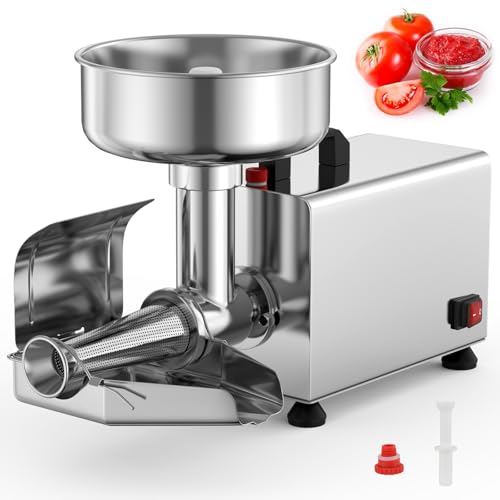
- 450W motor with 8.5-inch feed chute
- Processes 200–350 lb/h
- 304 stainless steel and tool-free disassembly
Best For: Frequent high-volume home or commercial-style preserving
Best All-Around Choice

- Four screens support different sauce textures
- Separates pulp, peels, and seeds in one pass
- Stainless steel parts and splash-reducing guard
Best For: Versatile home sauce making and canning
Best for High-Volume Processing

- Rated for up to 330 pounds per hour
- Copper motor and automatic skin-seed separation
- Five-year warranty plus lifetime support
Best For: Commercial kitchens, farms, and large harvests
Best for Bulk Canning Value

- Rated for 200 pounds per hour
- Large hopper reduces refill frequency
- Tool-free disassembly supports quick cleaning
Best For: Frequent home canning and harvest-season batches
High-Capacity Pick
Newhai Electric Tomato Strainer

- 450W motor with claimed 110-pound-per-hour capacity
- Wide 8.4-inch stainless-steel funnel
- Disassembles for hand cleaning and handles fruit jams
Best For: High-volume sauce and puree batches
Commercial Stainless-Steel Pick
VBENLEM Electric Tomato Strainer
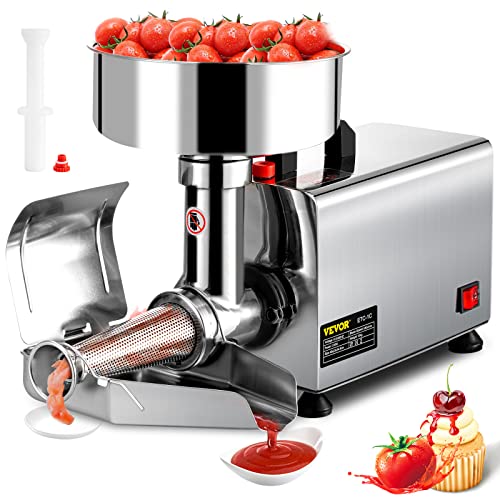
- 304 stainless-steel food-contact components
- 370W pure-copper motor with protective casing
- 9-inch funnel and adjustable discharge trough
Best For: Large-batch tomato milling and fruit sauces
Multifunction Home Pick

- Combines tomato pressing with three other food-prep functions
- Includes three grinding plates and a reverse function
- Compact design with detachable, hand-wash parts
Best For: Home cooks wanting one versatile appliance
Compact Italian Masticating Press – OMRA Spremy Model 850
The OMRA Spremy Model 850 is a compact option among electric tomato presses for cooks who want fresh or cooked tomatoes separated from skins and seeds. Its 1/4 HP motor and masticating-style 110 RPM auger are designed for steady puree production while helping preserve enzymes.
Best For: Home preserving and sauce making when a portable, Italian-made machine with a metal build is preferred.
Pros:
- Separates tomato puree from seeds and skins automatically.
- Processes up to 330 pounds of tomatoes per hour, according to the supplied specifications.
- Uses a die-cast metal housing, stainless steel hopper, and food-grade nylon auger.
- Includes a cooling fan and operates at a relatively gentle 110 RPM.
Cons:
- Its 220-volt power requirement may not suit every kitchen setup.
- The specifications list a compact capacity and portable design rather than a large commercial work area.
The Model 850 stands out for its compact footprint, low-speed auger, and durable materials. Confirm that your electrical setup supports 220 volts before choosing it for home processing.
Flexible Batch Strainer – Weston Deluxe Electric Tomato Strainer
The Weston Deluxe is one of the more flexible electric tomato presses for making sauces, purees, jellies, and salsa. Its 250-watt, two-speed motor works with a one-gallon hopper and three stainless steel screens for different textures and ingredients.
Best For: Home canners who want screen options and reverse operation for processing tomatoes, berries, vegetables, and chunky salsa.
Pros:
- Separates skins and seeds without requiring coring.
- Includes 1.5mm, 3mm, and 6mm stainless steel screens.
- The one-gallon hopper supports larger preserving batches.
- Two speeds include reverse operation to help prevent jamming.
Cons:
- Its 120-volt design is intended for compatible AC power.
- The supplied specifications identify a plastic and stainless steel construction rather than an all-metal body.
With three screens, a stomper, and a generous hopper, the Weston is a practical choice for households making several types of preserves. It offers useful versatility without requiring separate machines for smooth and chunky preparations.
Heavy-Duty Italian Workhorse – Reber N.5 Electric Strainer
The Reber N.5 is built for high-volume processing and ranks among the most powerful electric tomato presses in this group. Its 650-watt induction motor, oil-bath gearbox, and stated output of up to 772 pounds per hour are suited to demanding sauce, preserve, jam, and fruit-juice production.
Best For: Serious home preservers, farm kitchens, and users who need continuous-duty performance and a robust Italian-made machine.
Pros:
- 650-watt induction motor is designed for heavy-duty, continuous operation.
- Stated production capacity reaches up to 772 pounds per hour.
- Uses all-metal gears and a cast-iron body with food-grade epoxy coating.
- Stainless steel filter cone, hopper, drip tray, and splash guard support food-contact use.
Cons:
- Its 20.5-inch width and substantial construction require dedicated workspace.
- Removable parts are specified for hand washing only.
- Additional attachments, such as a pasta press or meat grinder, are optional.
The Reber N.5 is the clear capacity-focused choice here, combining an induction motor with durable metal components. Its size and hand-wash care requirements make it better suited to a dedicated processing area than casual countertop use.
Commercial-Style Stainless Steel Mill – COSTWAY 450W Tomato Strainer
The COSTWAY 450W machine is a commercial-style option among electric tomato presses, combining a full-copper motor with a large 8.5-inch feed chute. It is designed to process tomatoes and other fruits for sauces, jams, and preserves at a stated rate of 200 to 350 pounds per hour.
Best For: Users who want a high-throughput stainless steel strainer with safety features and tool-free cleaning.
Pros:
- 450-watt full-copper motor and large feed chute support efficient processing.
- Stated output ranges from 200 to 350 pounds per hour.
- Food-grade 304 stainless steel construction provides a durable food-contact surface.
- Detachable parts are dishwasher-safe, and tool-free disassembly simplifies cleaning.
Cons:
- The supplied care instructions also specify hand washing, so cleaning guidance should be reviewed carefully.
- At 22 pounds, it is less convenient to move than a compact portable model.
- Its 110-120V specification requires compatible household power.
The COSTWAY balances substantial throughput with practical features such as a safety pusher, enclosed motor guard, anti-slip feet, and removable components. It is a strong fit for frequent batch processing when countertop space and storage weight are manageable.
Best All-Around Choice – VEVOR 800W Tomato Strainer
If you want versatile electric tomato presses for sauces, purees, salsa, and jam, this VEVOR model offers multiple texture options and a stainless steel build. Its steady DC motor is designed for continuous sauce making, while the guard cover helps limit splatter.
Best For: Home gardeners and canners who want one machine for several sauce and puree textures.
Pros:
- Separates tomato skins and seeds in one pass.
- Includes four screens for textures from 1 mm to 6 mm.
- 304 stainless steel components resist fruit acids and wear.
- Removable core parts and a cleaning brush simplify cleanup.
Cons:
- The listed 800W maximum differs from the 300W rated-power specification.
- Its 40 kg capacity and 7.2-pound weight may not suit every storage setup.
This is a flexible pick when varied recipes matter more than maximum commercial throughput. The supplied accessories and quieter, high-torque motor make it practical for recurring harvest-season batches.
Best for High-Volume Processing – ARINOO 450W Tomato Strainer
For shoppers comparing electric tomato presses for large harvests or commercial-style work, this ARINOO machine emphasizes throughput and continuous-use support. Its copper motor is rated to process up to 330 pounds per hour, with automatic separation and a safety-focused enclosed design.
Best For: Restaurants, farms, commercial kitchens, and serious home canners needing high stated processing capacity.
Pros:
- Processes up to 330 pounds per hour according to the supplied specifications.
- Dual-channel design separates seeds and skins without an extra filter step.
- Food-grade 304 stainless steel construction is rust-resistant.
- Includes a food pusher, detachable parts, and a five-year warranty with lifetime support.
Cons:
- At 20.9 pounds, it is substantially heavier than many home-use machines.
- Continuous operation requires a five-minute cool-down after every 15 minutes.
- Hand-wash-only care may add cleanup time.
The high capacity and warranty make this the most business-oriented option in the group. Just plan for its larger footprint, heavier body, and required cooling intervals during long processing sessions.
Best for Bulk Canning Value – VEVOR 370W Food Mill
These electric tomato presses are especially useful during harvest season, and this VEVOR model focuses on efficient bulk processing without repeated hand straining. Its large hopper reduces refills, while the stainless steel screen separates skins and seeds for smooth sauce, puree, or juice.
Best For: Home canners and frequent processors who prioritize a large hopper and straightforward cleanup.
Pros:
- Processes up to 200 pounds per hour according to the product listing.
- Large hopper helps reduce frequent refilling.
- Stainless steel hopper, screen, tray, and guard are built for repeated use.
- Core components disassemble without tools for quick rinsing.
Cons:
- Tomatoes should be cut into small pieces to help reduce clogging.
- At 21.7 pounds, it is relatively heavy for a home appliance.
- The supplied notes do not specify multiple screen sizes.
This model is a practical middle ground for recurring canning projects: it offers substantial stated capacity and a roomy hopper while keeping maintenance simple. It is less suited to shoppers seeking several precisely adjustable textures.
High-Capacity Pick – Newhai Electric Tomato Strainer
For shoppers comparing electric tomato presses, the Newhai stands out for its 450W motor, wide 8.4-inch funnel, and stated capacity of up to 110 pounds of jam per hour. Its stainless-steel construction and commercial-oriented design make it suited to larger batches of sauce and fruit preparations.
Best For: High-volume tomato sauce, puree, and fruit-jam preparation.
Pros:
- 450W motor and claimed output of up to 110 pounds per hour.
- Wide 8.4-inch stainless-steel funnel helps accommodate substantial batches.
- Motor protection casing and included pestle provide added operating convenience.
- Parts disassemble for hand washing, while the machine supports tomato and other fruit preparations.
Cons:
- Hand wash only; the motor must not be rinsed.
- Its commercial-style capacity may be more than needed for occasional small batches.
The Newhai is a practical choice when throughput matters more than compactness. The protected motor, simple assembly, and broad fruit-processing capability add versatility for frequent sauce-making sessions.
Commercial Stainless-Steel Pick – VBENLEM Electric Tomato Strainer
The VBENLEM is one of the more commercial-focused electric tomato presses, pairing a 370W pure-copper motor with food-contact 304 stainless steel. Its 9-inch funnel, adjustable trough, and stated 90–160 kg/h processing range are useful features for preparing sauces in larger quantities.
Best For: Commercial-style tomato milling and versatile fruit-sauce production.
Pros:
- Food-contact components use 304 stainless steel.
- 370W pure-copper motor is enclosed in a stainless-steel casing.
- Large 9-inch funnel and adjustable trough support smoother feeding and discharge.
- Designed for tomato sauce, ketchup, strawberry sauce, blueberry sauce, and other jams.
Cons:
- At 22 pounds, it is less convenient to move than a lightweight countertop appliance.
- The supplied specifications list aluminum as the overall material type despite stainless-steel food-contact parts.
- Its commercial capacity may be unnecessary for small household batches.
Choose the VBENLEM if durable food-contact materials and high-volume processing are priorities. The adjustable discharge setup and low-noise operation add useful refinements for repeated sauce-making work.
Multifunction Home Pick – AIRMSEN Tomato Sauce Press
Unlike dedicated electric tomato presses, the AIRMSEN combines tomato straining with meat grinding, sausage making, and kibbeh preparation. Its compact design, reverse function, multiple grinding plates, and included tomato strainer kit make it a flexible option for home cooks who want one appliance for several tasks.
Best For: Home kitchens that need tomato pressing alongside meat and sausage preparation.
Pros:
- Four-in-one functionality covers meat grinding, sausage, kibbeh, and tomato sauce preparation.
- Includes 5 mm, 7 mm, and 12 mm grinding plates for different textures.
- Reverse function helps clear jams, while rubber feet improve stability.
- Detachable parts and a safety-lock knob support straightforward operation.
Cons:
- Not dishwasher safe; hand washing is recommended.
- It is a multifunction meat grinder rather than a dedicated high-volume tomato press.
- The listed wattage is 300 watts, so its tomato-processing capacity is not specified like the commercial models.
The AIRMSEN makes the most sense when versatility is more valuable than specialized throughput. It can cover several kitchen-preparation jobs while keeping a relatively compact 12.6-by-6.3-by-12.6-inch footprint.
How We Picked the Best Electric Tomato Presses
We focused on the features that matter when processing real batches: motor power, stated throughput, hopper and chute design, material quality, auger and screen construction, stability, cleaning requirements, and replacement-part availability. We also considered whether each machine is better suited to occasional home use, seasonal preserving, or higher-volume processing.
Published capacity figures are not directly comparable across brands. Actual output depends on tomato variety, ripeness, preparation, screen size, feeding speed, and how often the machine needs to be cleared. Treat commercial-grade claims as useful guidance rather than guaranteed results in every kitchen.
Quick Comparison
| Best For | What to Prioritize | Typical Advantage |
|---|---|---|
| Occasional sauce making | Simple controls and easy cleanup | Lower cost and less storage space |
| Large garden harvests | Higher throughput and durable components | Faster processing of bulk tomatoes |
| Frequent preserving | Metal or reinforced food-contact parts | Better long-term durability |
| Mixed kitchen tasks | Interchangeable screens or attachments | More versatility beyond tomato sauce |
Key Buying Factors for Electric Tomato Presses
Motor Power and Throughput
Wattage is only one part of performance. Look at the manufacturer’s rated output, but also check whether that figure is based on ideal conditions. A stronger motor can help with sustained batches, while thermal protection and a dependable drive system may matter more than peak wattage.
Materials and Stability
Stainless steel food-contact components are generally easier to sanitize and more resistant to staining than lower-cost plastics. A wide base, clamps, suction feet, or another secure mounting method helps prevent movement when feeding tomatoes quickly.
Screen Design and Yield
The screen determines how finely the machine separates pulp from skins and seeds. Confirm which screens are included and whether replacements are available. A well-designed auger and screen should produce a smooth puree without requiring excessive pressure or repeated passes.
Cleaning and Maintenance
Choose a model that disassembles without specialized tools and has accessible food-contact parts. Do not assume the motor housing is washable; follow the manufacturer’s instructions and keep electrical components dry. Replacement screens, augers, gaskets, and belts can significantly extend the machine’s useful life.
Who Should Buy Which Electric Tomato Presses?
Choose a compact, simpler model if you process tomatoes only a few times per year and value easy storage over maximum speed. Choose a higher-output commercial-style press if you regularly preserve garden harvests, make large batches of sauce, or want to reduce processing time.
Prioritize stainless construction and available parts for frequent use. If versatility matters, consider a machine that also supports food milling or compatible grinding attachments, but verify exactly what is included before buying. For any model, check the voltage, counter space, mounting method, warranty, and cleaning instructions before placing an order.