When you need to close hundreds or thousands of bags, a dependable sealer can improve throughput, consistency, and product protection. The right machine depends on your packaging material, bag size, production rate, and available workspace.
We compared 10 commercial and heavy-duty options, from compact impulse sealers to automatic continuous band machines with conveyors, digital controls, and date printing. Use the guide below to narrow your choice by workload and packaging requirements.
Best 10 Bag Sealing Machines for Large Batches Picks for 2026
Best High-Throughput Pick
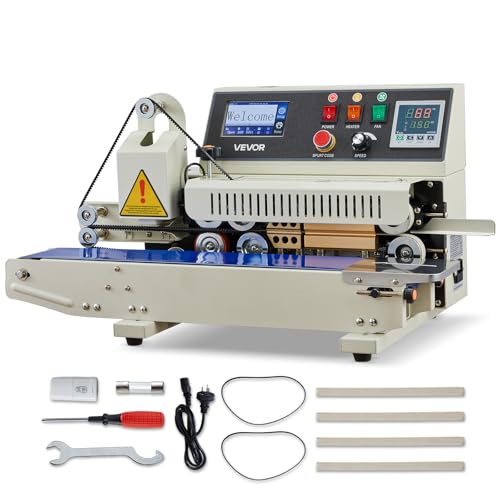
- Up to 52.5 ft/min sealing speed
- Adjustable 0.24–0.47-inch seal width
- Printing and bag-counting functions
Best For: Organized production lines needing fast sealing and package marking
Best Compact Conveyor Model

- 650W heating power
- 0–300°C adjustable temperature
- Compact 16.3-pound desktop design
Best For: Countertop food packaging and smaller commercial workspaces
Best Manual Heavy-Duty Option

- 3–5-second sealing cycle
- Eight adjustable temperature settings
- Seal-and-cut functionality with replacement elements
Best For: Small businesses and light commercial manual packaging
Best Value Continuous Sealer
Frifreego Commercial Band Sealer

- 0–12 m/min adjustable speed
- 6–12mm adjustable sealing width
- 600W power with 0–300°C temperature control
Best For: Small food-packaging operations using varied bag materials
Versatile Manual Pick

- 16-inch sealing length
- Eight adjustable timer levels
- Includes replacement and cutting wires
Best For: Flexible manual sealing at retail, kitchen, and grocery workstations
Production Line Choice
VONPACK FR-900 Continuous Sealer

- Automatic speeds up to 12 m/min
- 0–300°C temperature range
- Extended conveyor platform for batch work
Best For: Continuous sealing in production, warehouse, and food-packaging workflows
Feature-Rich Band Sealer
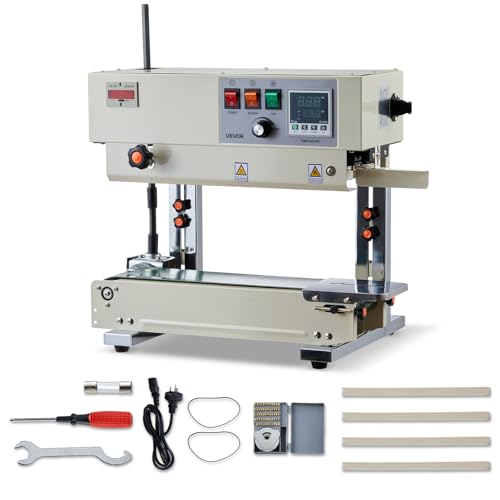
- Speeds up to 52.5 ft/min
- Optional roller printing and bag counter
- Adjustable seal width and temperature
Best For: Continuous packaging that benefits from quantity tracking and printed markings
Best Overall
12 M/Min Continuous Band Sealer

- 0–300°C adjustable temperature
- Up to 12 m/min continuous sealing
- Transfer table and spare parts included
Best For: Small commercial packaging operations
Fastest Throughput

- Up to 16 m/min sealing speed
- Digital 0–300°C temperature control
- 6-inch conveyor belt for smooth feeding
Best For: Higher-volume commercial packaging
Best for Control
650W Digital Continuous Sealer
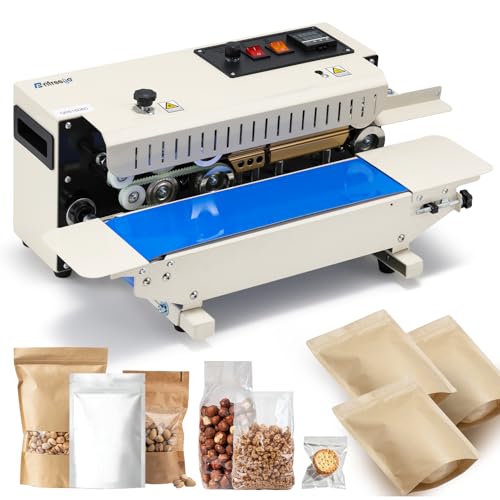
- Digital 0–300°C temperature control
- Adjustable 0–12 m/min speed
- Includes belts, Teflon belt, and fuses
Best For: Flexible food and small-product packaging
Best High-Throughput Pick – VEVOR Continuous Band Sealer
For bag sealing machines for large batches, the VEVOR continuous band sealer stands out with automatic operation, a 600W motor, and speeds up to 52.5 ft/min. Its adjustable sealing width and built-in printing and counting functions make it suited to organized production workflows.
Best For: Warehouses, shops, bakeries, and small production lines that need fast, repeatable sealing with optional date, logo, barcode, or QR-code printing.
Pros:
- Continuous operation reaches speeds up to 52.5 ft/min.
- Adjustable 0.24–0.47-inch sealing width accommodates different bags.
- Prints text, dates, numbers, logos, barcodes, and QR codes; ink is sold separately.
- Built-in counter and included spare belts and PTFE-coated conveyor belts support production tracking and maintenance.
Cons:
- At 29.2 pounds, it is less portable than compact desktop sealers.
- Printing requires a separate HP 2590 W3T10 ink cartridge.
- Its 120V AC setup may not suit every workspace.
Choose this model when throughput, repeatability, and packaging identification matter more than minimal size. The temperature range from 32–572°F also gives you flexibility across compatible plastic bag materials.
Best Compact Conveyor Model – VONPACK FR-400 Heat Sealer
The VONPACK FR-400 is a practical option among bag sealing machines for large batches when you want continuous sealing in a smaller desktop format. Its 650W heating system, adjustable temperature, and speed control support consistent packaging without taking up as much room as a heavier industrial unit.
Best For: Countertop food packaging of candy, coffee, tea, nuts, snacks, and other products in small commercial workspaces.
Pros:
- Temperature adjusts from 0–300°C for different bag materials.
- Compact 16.3-pound design is easy to place or move between workstations.
- Conveyor platform and motor support steady continuous use.
- Adjustable speed and quiet operation help produce even seals.
Cons:
- It is semi-automatic rather than fully automatic.
- The supplied notes do not specify a maximum sealing speed.
- The compact format may be less suitable for very high-volume production than a larger continuous sealer.
This FR-400 balances batch capability with portability. It is a sensible fit for food businesses that need steady daily output but still want a machine that can share counter space or move between packaging stations.
Best Manual Heavy-Duty Option – 18-Inch Impulse Bag Sealer
This 18-inch impulse sealer is a straightforward choice for operators who prefer manual control over automated conveyors. For bag sealing machines for large batches, it is best suited to lighter production runs where a 3–5-second sealing cycle, adjustable heat, and a sturdy metal body provide dependable hands-on workflow.
Best For: Small businesses, bakeries, coffee shops, fulfillment workstations, and craft sellers sealing PE, PP, Mylar, or foil bags.
Pros:
- 18-inch sealing length handles larger bags than many compact impulse sealers.
- Seals in approximately 3–5 seconds with no warm-up time.
- Eight temperature settings accommodate different plastic bag materials.
- Can seal and cut when the heating wire is swapped; three replacement elements are included.
Cons:
- Manual operation requires the operator to press the handle for every seal.
- It is intended for small-batch and light commercial use rather than continuous conveyor production.
- The supplied notes do not identify the exact sealing width.
This model makes sense when flexibility and low setup time are more important than automation. Its all-metal steel construction, fuse protection, and heat-dissipation plate add useful durability for recurring packaging tasks.
Best Value Continuous Sealer – Frifreego Commercial Band Sealer
The Frifreego commercial heat sealer offers continuous band sealing with adjustable speed from 0–12 m/min and 600W heating power. For bag sealing machines for large batches, its 6–12mm sealing width and broad food-bag compatibility make it a flexible choice for routine packaging work.
Best For: Food packaging tasks involving aluminum foil, kraft paper, CPP, and other compatible sealing bags in kitchens or small production settings.
Pros:
- Adjustable 0–12 m/min speed helps match production volume.
- 6–12mm sealing width supports both larger and smaller bags.
- 600W power provides fast heating for regular packaging work.
- Temperature adjusts from 0–300°C and the horizontal design is relatively compact.
Cons:
- It is semi-automatic, so bags still require operator handling.
- The displayed temperature may be lower than the actual heating temperature, requiring practical adjustment.
- The supplied notes do not specify a printing or counting function.
This is a practical middle ground for users who want continuous sealing and adjustable controls without moving to a more feature-rich printing model. Confirm your bag material and tune the heat based on actual sealing results before starting a large run.
Versatile Manual Pick – 16-Inch Impulse Sealer
For smaller production runs or workstations that need flexibility, this 16-inch impulse sealer is a practical option among bag sealing machines for large batches. Its adjustable timer supports different bag materials and thicknesses, while the included replacement wires help reduce maintenance interruptions.
Best For: Retail counters, kitchens, grocery operations, and batch sealing of mylar, foil, PE, and PP bags.
Pros:
- 16-inch sealing length accommodates a range of bag sizes.
- Eight timer settings support bags up to 0.8mm thick.
- Includes flat replacement wires and round cutting wires.
- Iron housing is more durable than a typical plastic sealer body.
Cons:
- Manual operation requires pressing the handle for every seal.
- Its 1–3.5-second cycle is less automated than a continuous band sealer.
- Designed for 110V power only.
This model is a good fit when seal-length flexibility and straightforward operation matter more than conveyorized throughput. It can support repeated batch work, but higher-volume lines may benefit from an automatic continuous machine.
Production Line Choice – VONPACK FR-900 Continuous Sealer
The VONPACK FR-900 is built for repeatable workflow, making it a strong candidate among bag sealing machines for large batches. Its automatic conveyor-fed design, adjustable speed, and extended work platform are suited to operations that need continuous sealing rather than one-bag-at-a-time handling.
Best For: High-volume food, snack, ingredient, and aluminum-foil bag sealing in production or warehouse settings.
Pros:
- Automatic sealing runs at adjustable speeds up to 12 meters per minute.
- Temperature adjusts from 0 to 300°C for varied bag materials.
- Handles bags from 0.02 to 0.80mm thick.
- Extended conveyor platform supports larger-volume items, with up to 5kg conveying capacity.
Cons:
- At 17 pounds and over 32 inches long, it needs dedicated workspace.
- Its 110V, 600W setup may require planning for available power.
- Offers a 6–12mm sealing width range rather than a single wide impulse seal.
Choose the FR-900 when throughput and consistent automated handling are priorities. Its conveyor and speed controls make it better suited to ongoing batch production than occasional household sealing.
Feature-Rich Band Sealer – VEVOR 900M Vertical Sealer
For businesses that want continuous operation plus packaging records, the VEVOR 900M combines adjustable sealing with optional roller printing and a built-in counter. It is a capable choice among bag sealing machines for large batches, particularly when tracking quantities or marking dates and batches is part of the workflow.
Best For: Warehouses, bakeries, shops, and small workshops needing continuous sealing with counting and marking features.
Pros:
- 600W motor reaches speeds up to 52.5 feet per minute.
- Adjustable 0.24–0.47-inch seal width accommodates varied bags.
- Optional type-wheel printing can mark dates, batches, or specifications.
- Built-in counter tracks sealed bag quantity in real time.
Cons:
- At 28 pounds, it is less portable than a manual impulse sealer.
- Its 19.69-by-12.6-by-21.65-inch footprint requires substantial bench space.
- Designed for plastic bags from 0.001 to 0.03 inches thick.
The 900M stands out when speed alone is not enough and operators also need production counting or printed information. Its supplied belts, tools, and spare fuse help support ongoing operation, though the larger footprint suits a permanent packaging station.
Best Overall – 12 M/Min Continuous Band Sealer
For shoppers comparing bag sealing machines for large batches, this continuous band sealer offers automatic feeding, a sealing speed of up to 12 m/min, and adjustable heat for compatible packaging bags and films. Its included transfer table and replacement parts make it a practical choice for recurring packaging work.
Best For: Kitchens, bakeries, shops, and small production areas handling repetitive food or general packaging tasks.
Pros:
- Adjustable 0–300°C temperature range.
- Continuous sealing speeds up to 12 m/min.
- Supports approximately 6–12 mm seal widths.
- Includes a transfer table, spare sealing belt, and replacement fuse.
Cons:
- It is limited to compatible heat-sealable bags and films.
- The stated sealing speed is lower than some faster options in this roundup.
Choose this model if you want a capable continuous sealer with useful maintenance accessories and broad compatibility with aluminum foil, kraft paper, and CPP heat-sealable bags.
Fastest Throughput – 16 M/Min Automatic Bag Sealer
Among bag sealing machines for large batches, this automatic FRC-520 stands out with a listed speed of up to 16 m/min. Digital temperature control, adjustable sealing speed, and a 6-inch conveyor belt support fast, consistent feeding for commercial packaging workflows.
Best For: Commercial users who prioritize higher throughput and need a desktop sealer for varied bags and pouches.
Pros:
- Reaches speeds up to 16 m/min.
- Offers a 0–300°C temperature range with digital control.
- Creates 6–12 mm wide seals.
- Handles listed bag thicknesses of 0.02–0.16 mm on both sides.
Cons:
- The product is specified for 110V/60Hz operation.
- The supplied notes identify the FRC-520 as the included component, with no additional accessory set listed.
If speed is the deciding factor, this is the strongest throughput option here. Its conveyor and digital controls are well suited to repetitive sealing, provided your bags and electrical setup match the specifications.
Best for Control – 650W Digital Continuous Sealer
For large-batch packaging that benefits from repeatable settings, this 650W continuous band sealer combines digital 0–300°C temperature control with adjustable speed from 0 to 12 m/min. Its steel construction, discharge support plate, and included replacement belts are useful for regular operation.
Best For: Food sellers, bakeries, and workspaces needing adjustable speed and temperature for plastic, kraft paper, and foil bags.
Pros:
- Digital temperature control from 0–300°C.
- Adjustable sealing speed from 0–12 m/min.
- 650W power and durable steel construction.
- Includes toothed belts, a Teflon belt, and backup fuses.
Cons:
- Its maximum listed speed is below the 16 m/min option.
- The supplied notes do not specify a conveyor belt width.
This model is a balanced choice when control and maintainability matter as much as speed. The digital panel and accessory package can help support consistent sealing while reducing potential maintenance downtime.
How We Picked the Best Bag Sealing Machines for Large Batches
We focused on features that matter in repeated production rather than occasional household use. Our selection includes continuous band sealers for ongoing workflows, manual impulse models for flexible bag sizes, and machines with conveyors or printers for more specialized packaging lines.
We also considered sealing width, temperature and speed adjustment, control layout, portability, printing capability, and compatibility with common materials such as PE, PP, laminated films, foil, and Mylar. Because listings can vary by configuration, confirm the manufacturer’s supported materials, maximum bag thickness, and electrical requirements before ordering.
Quick Comparison
| Machine type | Best for | Main advantage | Trade-off |
|---|---|---|---|
| Manual impulse sealer | Variable bag sizes and lower-volume batches | Simple, flexible operation | Requires an operator for every seal |
| Horizontal band sealer | Flat bags and tabletop production | Continuous sealing with compact setup | Less suitable for liquid-heavy products |
| Vertical band sealer | Filled bags and granular products | Helps keep contents below the seal | Uses more floor or stand space |
| Band sealer with conveyor | Heavier bags or line-style workflows | Supports repeatable product handling | Higher cost and larger footprint |
Key Buying Factors for Bag Sealing Machines for Large Batches
Throughput and Operating Style
For a steady stream of bags, choose a continuous band sealer with adjustable belt speed. Manual impulse sealers are better when bag dimensions change frequently or production is intermittent. A conveyor can reduce handling effort when packages are heavy or numerous.
Bag Material and Seal Width
Verify that the machine supports your film type and thickness. Wider seals can provide additional closure area, while adjustable heat helps prevent weak seals or melted packaging. Never assume a machine rated for PE will perform equally well with multilayer foil or thick Mylar.
Orientation and Product Handling
Horizontal units work well for relatively stable contents and flat bags. Vertical models are often more practical for powders, grains, snacks, and other products that could spill into the sealing path. Check the maximum bag weight and conveyor or support capacity.
Controls, Printing, and Maintenance
Digital temperature and speed controls make repeatable settings easier across shifts. Integrated printing is useful for dates, batch codes, or shelf-life information, but it adds setup and maintenance requirements. Look for accessible heating elements, replaceable belts, clear instructions, and readily available wear parts.
Who Should Buy Which Bag Sealing Machines for Large Batches?
Choose a manual impulse model if you need the lowest-cost, most adaptable option for mixed bag sizes or modest production. Select a horizontal continuous band sealer for tabletop food, retail, or workshop packaging where bags can be fed consistently. A vertical band sealer is the better fit for filled pouches containing powders, grains, or liquids that need upright handling.
For the most demanding workflows, choose a continuous machine with adjustable speed, digital temperature control, or a conveyor. If traceability matters, prioritize a model with compatible ink printing. Before buying, compare power requirements, workspace dimensions, service support, and the machine’s rated duty cycle with your actual batch size.