A dull blade is slower, less precise, and often harder to use safely. The best compact knife sharpeners restore an edge without taking up much room in a drawer, tackle box, workshop, or pack.
This roundup compares 10 portable options, including preset pull-through sharpeners, guided systems, diamond stones, and multi-tools, so you can match sharpening control and portability to your knives.
Best 10 Compact Knife Sharpeners Picks for 2026
Best Pocket Pick

- Two-stage carbide and ceramic sharpening
- Fold-out diamond rod for serrations and hooks
- About 1 ounce with a lanyard hole
Best For: Portable outdoor sharpening
Best for Controlled Edges

- Pivoting design follows blade curves
- Carbide, ceramic, and diamond sharpening surfaces
- Compact 1.2-ounce portable format
Best For: Controlled everyday edge maintenance
Best for Fast Touch-Ups

- Designed for sharpening in about 10 seconds
- Works on straight and serrated knives
- Ergonomic handle with full-length finger guard
Best For: Quick household and kitchen sharpening
Best Multi-Tool Value
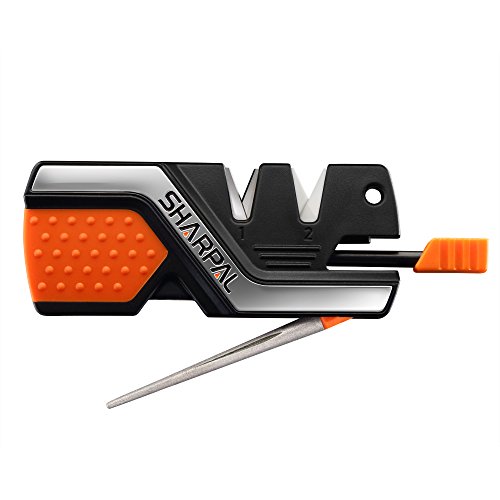
- Six functions including sharpening and fire starting
- Diamond rods handle serrations and fish hooks
- Pocket-sized body with lanyard hole
Best For: Outdoor and survival-focused carry
Best Space-Saving Pick
KitchenIQ Edge Grip 2-Stage Sharpener

- Compact drawer-friendly design
- Coarse and fine sharpening stages
- Edge grip and non-slip base
Best For: Home cooks maintaining straight and serrated kitchen knives
Best Portable System
Work Sharp Guided Field Sharpener

- Five sharpening and honing surfaces
- Built-in 20° and 25° angle guides
- Lightweight field-ready design
Best For: Outdoor users sharpening knives, serrations, and hooks
Best Multi-Tool Stability
SHARPAL 191H Knife Scissors Sharpener

- Three-stage knife and scissors sharpening
- Strong suction base for stability
- Compact design for kitchen storage
Best For: Home cooks sharpening knives and scissors on smooth counters
Pocket-Ready Pick

- Coarse and fine preset slots
- Under 2 ounces and pocket-sized
- Floats and includes a lanyard hole
Best For: Portable outdoor sharpening for pocket, hunting, fishing, and fillet knives
Guided Precision Pick
Work Sharp Portable Pocket Sharpener

- 20- and 25-degree angle guides
- 320-grit diamond plate and ceramic rod
- Self-contained, 1.6-ounce design
Best For: Portable, guided sharpening for field, home, or shop use
Versatile Field Stone
Smith's DCS4 Diamond Sharpener

- Double-sided coarse and fine diamond surfaces
- Micro-sharpening features for hooks and pointed tools
- Handle protects and stores the stone
Best For: Outdoor users needing versatile knife and pointed-tool sharpening
Best Pocket Pick – Smith's Pocket Pal
For shoppers comparing compact knife sharpeners, Smith’s Pocket Pal is a lightweight two-stage option with preset pull-through slots and a fold-out diamond rod. Its small format makes it practical for outdoor kits, keychains, and quick blade maintenance on the go.
Best For: Campers, hikers, hunters, anglers, and anyone who wants a pocket-sized sharpener for straight, serrated, and specialty edges.
Pros:
- Combines coarse carbide, fine ceramic, and a tapered diamond rod.
- Preset angles simplify pull-through sharpening.
- Handles serrations, gut hooks, and fish hooks with the diamond rod.
- Measures about 3.5 inches long and weighs roughly 1 ounce.
Cons:
- The coarse carbide slot is intended for straight edges only.
- Its small body may offer less grip than a full-size sharpener.
The Pocket Pal stands out when portability and versatility matter most. Reversible, replaceable carbide and ceramic stones add practical longevity for regular field use.
Best for Controlled Edges – Work Sharp Portable Pivot
Among compact knife sharpeners, the Work Sharp Portable Pivot adds a pivoting design that follows a blade’s curve. It pairs a convex-carbide edge setter with ceramic honing and a diamond plate for convenient maintenance away from home.
Best For: Everyday-carry users who want guided, controlled sharpening for curved knife blades and occasional fish-hook or edge-tool maintenance.
Pros:
- Pivot response follows the curve of the knife for consistent contact.
- Convex-carbide insert quickly creates a durable cutting edge.
- Ceramic hone supports quick resharpening across blade steels.
- Diamond plate can sharpen fish hooks and other edge tools.
Cons:
- At 2.75 by 0.75 by 2.35 inches, its shape is compact but not the smallest listed.
- The supplied specifications identify a fine grit type, so coarse-to-fine staging is less clearly defined than on multi-stage models.
The Pivot is a strong choice when consistent tracking over a curved blade is more important than having several built-in survival functions. Its lifetime warranty is an added benefit for long-term ownership.
Best for Fast Touch-Ups – AccuSharp Knife Sharpener
AccuSharp is a straightforward choice among compact knife sharpeners for fast, repeatable touch-ups. Its ergonomic handle, full-length finger guard, and diamond-honed tungsten-carbide blades are designed to restore many straight and serrated knives in about ten seconds.
Best For: Home cooks and general users who prioritize quick sharpening, a comfortable ambidextrous grip, and simple cleanup.
Pros:
- Designed to sharpen most blades in around ten seconds.
- Diamond-honed tungsten-carbide blades can be reversed to extend service life.
- Works with straight and serrated knives, including chef’s knives and cleavers.
- Ergonomic handle and full-length guard support safer handling.
Cons:
- Its 9-inch length makes it less pocket-friendly than dedicated field sharpeners.
- The supplied grit specification lists coarse, without a separate fine honing stage.
This model favors speed and ease over a multi-stage sharpening setup. Its reversible inserts, washable construction, and comfortable handle make it a practical everyday kitchen option.
Best Multi-Tool Value – SHARPAL 101N 6-in-1
The SHARPAL 101N expands the compact knife sharpener concept into a six-function field tool. It includes coarse carbide and fine ceramic slots, diamond rods for serrations and hooks, plus a ferro rod and emergency whistle for outdoor preparedness.
Best For: Campers, hunters, and survival-oriented users who want sharpening capability combined with basic emergency tools in one pocket-sized device.
Pros:
- Provides coarse sharpening, fine honing, serration and hook sharpening.
- Includes a ferro rod fire starter and high-pitched emergency whistle.
- Preset sharpening angles support consistent use.
- Compact body has a lanyard hole for packs, pockets, or toolboxes.
Cons:
- At 2.4 ounces, it is heavier than simpler pocket sharpeners.
- Its many functions may be unnecessary for users seeking only a basic kitchen sharpener.
The 101N is the most feature-rich option here for outdoor carry. Choose it when emergency functions and specialty-edge sharpening are useful, rather than paying for a minimalist sharpener.
Best Space-Saving Pick – KitchenIQ Edge Grip 2-Stage Sharpener
If drawer space is limited, this compact knife sharpener offers a straightforward two-stage setup for everyday kitchen maintenance. Its coarse carbide sharpener handles dull or damaged edges, while the ceramic stage is intended for polishing and quick touch-ups.
Best For: Home cooks who want an easy-to-store sharpener for straight and serrated kitchen knives.
Pros:
- Compact 1.75-by-1-by-3.75-inch design fits easily in a utensil or knife drawer.
- Two preset stages cover coarse sharpening and fine honing.
- Edge-grip design helps keep larger knife tips from dragging across the counter.
- Non-slip base and soft-grip handle support stable, comfortable use.
Cons:
- Manual two-stage design may be less suitable for users seeking a broader sharpening system.
- Made from plastic, so it may not have the feel of a heavier-duty sharpener.
The Edge Grip is a practical choice when compact storage and simple operation matter most. Its preset angles and two sharpening surfaces make routine knife upkeep approachable without adding much bulk to a kitchen drawer.
Best Portable System – Work Sharp Guided Field Sharpener
For users who need compact knife sharpeners beyond the kitchen, the Work Sharp Guided Field Sharpener packs multiple abrasive surfaces into a portable manual tool. Diamond plates, ceramic rods, and a leather strop support edge repair, honing, serration work, and polishing.
Best For: Hunters, anglers, campers, and everyday-carry users who want a full-service sharpener for field use.
Pros:
- Five-surface system includes coarse 220- and fine 600-grit diamond plates, ceramic rods, and a leather strop.
- Built-in 20° and 25° guides help maintain a consistent bevel.
- Lightweight 4.6-ounce design fits in a pack or tackle box.
- Includes a hook groove, broadhead wrench, and lanyard hole for field utility.
Cons:
- Its many functions may take more time to learn than a basic pull-through sharpener.
- It is less focused on quick countertop use than compact kitchen models.
- Abrasives are covered differently under the warranty because they are wear components.
This is the most capable portable option of the three for outdoor maintenance. Choose it when versatility, guided angles, and packability are more important than the simplest possible sharpening routine.
Best Multi-Tool Stability – SHARPAL 191H Knife Scissors Sharpener
The SHARPAL 191H is one of the more versatile compact knife sharpeners for a kitchen workspace, combining knife sharpening with a dedicated scissors slot. Its suction base is designed to hold the tool on a smooth, flat surface while you work.
Best For: Home cooks who want a compact sharpener for straight and serrated knives, plus occasional scissors sharpening.
Pros:
- Three-stage design uses tungsten carbide for edge setting, ceramic for honing, and a separate carbide blade for scissors.
- Enhanced suction base is designed for hands-free stability on smooth, flat surfaces.
- Small 2.76-by-2.36-by-2.76-inch footprint is easy to store.
- Usable by both right- and left-handed users.
Cons:
- The suction feature requires a smooth, flat surface to work properly.
- Its compact body may provide less storage flexibility than a slim drawer-style model.
- It is intended for non-industrial or non-commercial use.
The 191H makes sense for buyers who value stability and added scissors functionality in a small package. Its three-stage layout gives it broader household utility than a basic knife-only sharpener.
Pocket-Ready Pick – Smith's CCKS 2-Step Sharpener
For shoppers comparing compact knife sharpeners, the Smith’s CCKS stands out as a lightweight pull-through option with separate coarse and fine stages. Its preset slots make it especially practical for quick maintenance of pocket, hunting, fishing, and fillet knives.
Best For: Outdoor users who want a tiny, easy-to-carry sharpener for restoring and maintaining knife edges.
Pros:
- Two preset stages combine crossed tungsten carbide blades with crossed ceramic rods.
- Measures 2.33 by 2.71 inches and weighs under 2 ounces.
- Non-slip rubber feet, a lanyard hole, and a floating design suit outdoor use.
Cons:
- Pull-through slots offer less sharpening flexibility than a freehand stone.
- Its compact format is geared toward smaller field and pocket knives rather than broad sharpening tasks.
The CCKS is a convenient choice when portability matters most. It delivers a straightforward coarse-to-fine process in a pocket-sized body, making it well suited to tackle boxes, hunting packs, and keychains.
Guided Precision Pick – Work Sharp Portable Pocket Sharpener
The Work Sharp Portable Pocket and Hunting Knife Sharpener is a strong option among compact knife sharpeners for users who prefer guided angles. Its self-contained design combines a diamond plate and ceramic rod without requiring assembly in the field.
Best For: Hunters, field users, and home sharpeners who want a compact tool with built-in angle guidance.
Pros:
- Includes a 320-grit diamond plate with a 20-degree angle guide.
- Fine ceramic rod uses a 25-degree angle guide for edge finishing.
- Self-contained construction requires no setup or assembly.
- Lightweight 1.6-ounce design is easy to carry.
Cons:
- Its 6.5-inch length is slim but less pocket-short than some compact pull-through sharpeners.
- The supplied notes identify the grit as fine, so it provides less explicitly described grit-stage variety than a coarse-and-fine sharpener.
Choose this model if repeatable sharpening angles are more important than the smallest possible footprint. The diamond plate and ceramic rod provide a practical field sharpening setup in one portable tool.
Versatile Field Stone – Smith's DCS4 Diamond Sharpener
For buyers seeking compact knife sharpeners with more freehand control, the Smith’s DCS4 uses a double-sided diamond stone with coarse and fine surfaces. Its micro-sharpening features also make it useful for fish hooks and other pointed tools.
Best For: Campers, anglers, and hunters who want a two-sided diamond sharpener with added tool-sharpening capability.
Pros:
- Double-sided stone provides clearly labeled coarse and fine grits.
- Micro-sharpening pads and grooves accommodate fish hooks and pointed tools.
- Protective handle stores the stone for compact carrying.
- Rubber grip and thumb guard support steadier, safer use.
Cons:
- Its listed dimensions are 9 by 2 by 1 inch, so it is longer than ultra-mini sharpeners.
- Freehand stone sharpening may require more technique than preset pull-through slots.
The DCS4 is a practical middle ground: portable enough for outdoor kits but more versatile than a basic pocket slot sharpener. Its two diamond surfaces and pointed-tool grooves broaden its usefulness around camp or on the water.
How We Picked These Compact Knife Sharpeners
We focused on sharpeners that are genuinely portable and useful for common straight-edge or serrated knives. The selection includes simple two-stage models for quick maintenance, guided sharpeners for more consistent results, and field-oriented tools with diamond surfaces or extra functions. We also considered ease of use, storage, grip, sharpening-stage versatility, and suitability for outdoor tasks such as hunting, fishing, and camping.
Because sharpening systems work differently, there is no single best choice for every user. Preset slots are usually fastest for beginners, while guided rods and diamond stones offer more control over pressure, angle, and specialized edges.
Quick Comparison
| Type | Best for | Main advantage | Trade-off |
|---|---|---|---|
| Preset two-stage sharpener | Routine kitchen and utility knives | Fast, simple angle control | Less flexibility |
| Guided field sharpener | Outdoor and hunting knives | More sharpening control | Requires practice |
| Diamond stone or rod | Field repairs and pointed tools | Versatile and durable | Technique matters |
| Multi-function pocket tool | Emergency kits and EDC | Several functions in one tool | May be less specialized |
Key Buying Factors for Compact Knife Sharpeners
Sharpening Method
Pull-through carbide and ceramic slots are convenient for quick edge repair, but they remove material quickly and may not suit delicate or unusual blade geometries. Guided systems and stones take longer but allow better control. Diamond surfaces are particularly useful for harder steels and field maintenance.
Blade Compatibility
Check whether the sharpener supports straight, serrated, or both edge types. Serrated blades generally need a tapered rod or a dedicated sharpening surface rather than a standard flat slot. Avoid forcing thick blades into narrow openings.
Portability and Stability
For a pocket or pack, look for a compact body, protective cover, folding parts, or a lanyard point. For home use, a non-slip base and comfortable handle can matter more than the smallest dimensions. A secure grip helps you maintain consistent pressure.
Ease of Use and Edge Control
Beginners will usually prefer clearly labeled coarse and fine stages. Experienced users may value adjustable angles, multiple abrasive surfaces, or tools that can sharpen hooks and pointed implements. Use light pressure and follow the manufacturer’s direction to avoid damaging the edge.
Who Should Buy Which Compact Knife Sharpeners?
Choose a preset two-stage model if you want the quickest learning curve for ordinary kitchen, camping, or utility knives. Pick a guided field sharpener if you hunt, fish, or carry several blade types and want more control over the finished edge. A diamond combination sharpener suits users who are comfortable with manual technique and need a durable, compact abrasive for field repairs.
If emergency versatility is the priority, a pocket multi-tool sharpener can earn its space in an EDC kit or survival pack. For households with both straight and serrated knives, select a model that explicitly supports both rather than assuming every sharpening slot is universal. Whichever style you choose, clean the abrasive surfaces as directed and sharpen regularly instead of waiting until the blade is completely dull.