A dull knife is harder to control, less efficient, and often more frustrating to use. The best knife sharpeners make restoring an edge simpler while matching your preferred level of speed, precision, and hands-on control.
This roundup compares 10 knife sharpeners spanning electric systems, guided sharpeners, pull-through tools, rolling designs, and traditional whetstone kits.
Best 10 Knife Sharpeners Picks for 2026
Best Electric Pick

- Three-stage electric sharpening system
- 100% diamond abrasives and flexible guides
- Handles straight and serrated knives
Best For: Fast, consistent countertop sharpening
Best Field Sharpener
Work Sharp Guided Field Sharpener

- Five sharpening surfaces in one tool
- Built-in 20° and 25° angle guides
- Only 4.6 ounces and needs no power
Best For: Portable sharpening for outdoor use
Best Budget Kitchen Pick
Kitchellence 3-Stage Sharpener
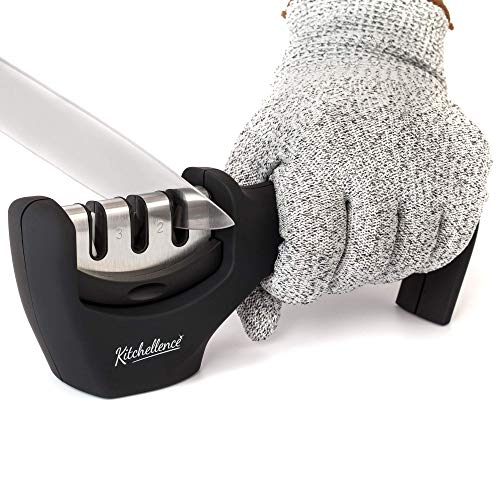
- Three slots repair, sharpen, and polish
- Non-slip base with ergonomic handle
- Includes a cut-resistant glove
Best For: Simple everyday kitchen maintenance
Best Precision System
Work Sharp Precision Adjust Elite

- Adjustable sharpening angles from 15° to 30°
- Includes diamond, ceramic, serration, and strop tools
- Supports kitchen, hunting, curved, and EDC blades
Best For: Controlled sharpening across multiple blade types
Fast Edge Restoration

- Sharpens many straight and serrated blades
- Produces an edge in about 10 seconds
- Ambidextrous handle with finger guard
Best For: Quick everyday sharpening at home
Precision Angle Control
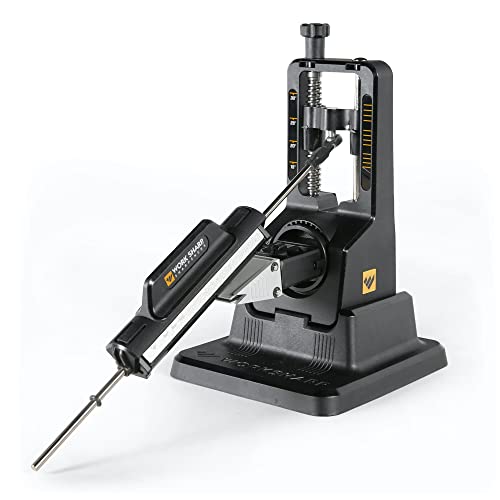
- Adjusts from 15 to 30 degrees
- Guided system delivers repeatable edges
- Includes coarse, fine, and ceramic abrasives
Best For: Controlled sharpening across a knife collection
Stable Multi-Tool Sharpening
SHARPAL 191H Knife Scissors Sharpener

- Three stages cover knives and scissors
- Suction base improves countertop stability
- Compact design with three-year warranty
Best For: Compact kitchen sharpening for knives and scissors
Best Complete Kit

- Includes four sharpening grits from 400 to 8000
- Adds flattening stone, angle guide, bases, and strop
- Suitable for kitchen, pocket, outdoor, and specialty blades
Best For: Hands-on users who want a comprehensive manual sharpening setup
Best Premium Rolling Design
Original Tumbler Rolling Sharpener

- Diamond-plated disc supports durable sharpening
- Magnetic support offers fixed 15- and 20-degree angles
- No wetstone soaking or complicated setup
Best For: Convenient, repeatable sharpening of kitchen and utility knives
Best Rolling Value
Diamond and Ceramic Knife Sharpener

- Combines #400 diamond and #3000 ceramic discs
- Provides 15- and 20-degree magnetic angle settings
- Includes a leather strop for final edge polishing
Best For: Users wanting guided rolling sharpening with a ceramic finishing stage
Best Electric Pick – Chef’sChoice 15XV EdgeSelect
For shoppers seeking powerful knife sharpeners, the Chef’sChoice 15XV uses a three-stage electric system to convert traditional 20-degree edges into sharp 15-degree Trizor XV edges. Diamond abrasives, flexible angle guides, and compatibility with both straight-edge and serrated knives make it a versatile countertop option.
Best For: Home cooks who want fast, repeatable sharpening with minimal manual technique.
Pros:
- Three-stage system sharpens, hones, and polishes blades.
- 100-percent diamond abrasives support edge repair and refinement.
- Flexible guides automatically help control the sharpening angle.
- Designed for straight-edge and serrated knives.
Cons:
- Requires access to an electrical outlet.
- At 4.2 pounds, it is less portable than manual sharpeners.
- The 15-degree edge conversion may not suit every knife preference.
The 15XV is a strong choice when speed and consistency matter most. Its approximately one-minute initial sharpening time and roughly 10-second resharpening time make it especially practical for regular kitchen use.
Best Field Sharpener – Work Sharp Guided Field Sharpener
Among portable knife sharpeners, the Work Sharp Guided Field Sharpener packs five sharpening surfaces into a compact manual tool. Coarse and fine diamond plates, ceramic rods, and a leather strop let you repair, refine, hone, and polish blades without batteries or cords.
Best For: Hunters, anglers, campers, and everyday-carry users who sharpen knives away from home.
Pros:
- Five-surface system covers repair through polishing.
- Built-in 20- and 25-degree guides help maintain a consistent bevel.
- Weighs only 4.6 ounces for easy packing.
- Includes a hook groove, broadhead wrench, and lanyard hole.
Cons:
- Manual sharpening requires more hands-on effort than an electric model.
- Its compact format may be less convenient for extensive kitchen sharpening.
- Abrasives are excluded from the stated limited lifetime warranty.
This is a practical all-around field sharpener for users who value portability and versatility. Its angle guides and multiple abrasive surfaces make it capable of maintaining several types of outdoor and everyday blades.
Best Budget Kitchen Pick – Kitchellence 3-Stage Sharpener
For straightforward kitchen knife sharpeners, this Kitchellence model uses three guided slots to repair, restore, and polish blades. Its non-slip base, ergonomic handle, and included cut-resistant glove make it a convenient starter kit for routine kitchen maintenance.
Best For: Home cooks who want a simple manual sharpener with an added safety accessory.
Pros:
- Three stages address damaged edges, sharpening, and polishing.
- Non-slip base and ergonomic handle support controlled use.
- Designed for both right- and left-handed users.
- Includes a cut-resistant glove.
Cons:
- The supplied notes do not specify compatibility with serrated knives.
- Its plastic construction may feel less substantial than metal sharpening systems.
- Manual pull-through sharpening offers less angle customization.
This compact sharpener is geared toward convenience rather than advanced edge control. It is a sensible choice for basic kitchen upkeep, particularly for users who appreciate the included glove and simple slot-based operation.
Best Precision System – Work Sharp Precision Adjust Elite
The Work Sharp Precision Adjust Elite is one of the more configurable manual knife sharpeners in this lineup. Its guided system adjusts from 15 to 30 degrees and includes diamond plates, ceramic rods, a serration rod, leather strop, and tri-brasive attachment for a broad range of blades.
Best For: Home cooks, hunters, and knife enthusiasts who want guided angle control and a comprehensive sharpening kit.
Pros:
- Adjustable angles from 15 to 30 degrees suit different knife styles.
- Includes coarse and fine diamond plates plus ceramic finishing tools.
- Dedicated rod sharpens serrated blades.
- Tri-brasive attachment supports curved blades, and a leather strop is included.
Cons:
- At 3 pounds and up to 14 inches long, it is less portable than field sharpeners.
- Manual clamping and angle adjustment take more setup than an electric sharpener.
- The broad feature set may be more than casual users need.
This system is a strong fit for shoppers who prioritize control over speed. Its guided design reduces guesswork while the included attachments expand its usefulness across kitchen, hunting, pocket, serrated, and curved blades.
Fast Edge Restoration – AccuSharp Knife Sharpener
For shoppers comparing knife sharpeners, the AccuSharp stands out as a simple manual option for quickly restoring many household blades. Its ergonomic, ambidextrous design and full-length finger guard make it straightforward to use, while the sharpening process takes about 10 seconds for many knives.
Best For: Home cooks and general-purpose users who want a compact sharpener for straight and serrated knives.
Pros:
- Sharpens many blade types, including chef’s, paring, filet, serrated knives, and cleavers.
- Diamond-honed tungsten carbide blades can produce an edge in about 10 seconds.
- Reversible sharpening blades help extend the sharpener’s service life.
- Ergonomic handle, full-length finger guard, and dishwasher-safe construction.
Cons:
- Its coarse sharpening setup may be less suited to users seeking a fine polishing stage.
- Manual pull-through sharpening provides less angle control than a guided system.
The AccuSharp is a practical pick when speed and ease of use matter more than adjustable sharpening angles or a polished finish. Its durable construction and broad blade compatibility make it a useful everyday kitchen tool.
Precision Angle Control – Work Sharp Precision Adjust
Among knife sharpeners, the Work Sharp Precision Adjust is designed for users who want repeatable results rather than a quick freehand pass. Its guided fixed-angle system adjusts from 15 to 30 degrees and includes coarse, fine, and ceramic abrasives for repairing and refining a range of blades.
Best For: Knife owners who want controlled, consistent sharpening for kitchen, pocket, hunting, and fillet knives.
Pros:
- Adjustable 15–30-degree angle range helps match different blade grinds.
- Guided sharpening system keeps the sharpening angle consistent from stroke to stroke.
- Includes 320- and 600-grit diamond abrasives plus fine ceramic honing.
- Manual, compact design works without power and includes a benchtop base and knife clamp.
Cons:
- Its multi-part guided setup is less immediate than a simple pull-through sharpener.
- The listed dimensions and components require more storage space than compact handheld models.
This kit is the strongest choice of the three for shoppers prioritizing angle accuracy and a staged sharpening process. It offers the control needed to reprofile a chipped blade and then refine the edge, though it takes more setup and practice than a basic sharpener.
Stable Multi-Tool Sharpening – SHARPAL 191H Knife Scissors Sharpener
The SHARPAL 191H is a versatile choice for shoppers seeking compact knife sharpeners with added scissor capability. It combines tungsten carbide sharpening for quick edge setting, ceramic honing for refinement, and a dedicated scissor slot, while its suction base helps keep the tool stable on a smooth, flat surface.
Best For: Home cooks who want one small tool for straight knives, serrated knives, kitchen blades, and scissors.
Pros:
- Three-stage design includes coarse tungsten carbide, ceramic honing, and scissor sharpening.
- Enhanced suction base is designed to provide stability without holding the sharpener by hand.
- Compact footprint stores easily in a kitchen drawer.
- Suitable for right- and left-handed users and backed by a three-year warranty.
Cons:
- Suction performance depends on using a smooth, flat surface.
- It does not offer the adjustable angle control of a guided sharpening system.
The SHARPAL 191H offers a useful balance of versatility, stability, and compact storage. It is especially appealing when scissors and multiple kitchen knife types need attention, although users seeking precise bevel adjustment should consider a guided kit instead.
Best Complete Kit – Dual-Grit Whetstone Set
This complete knife sharpener set is suited to buyers who want hands-on control over the sharpening process. It includes coarse and fine whetstone grits, a flattening stone, angle guide, bamboo base, rubber bases, and leather strop for sharpening, polishing, and maintaining a range of blades.
Best For: Home cooks, knife owners who want a comprehensive whetstone setup, and users maintaining kitchen, outdoor, or specialty blades.
Pros:
- Includes 400/1000 and 3000/8000 grit stones for sharpening and polishing.
- Comes with a flattening stone to help maintain the whetstone surface.
- Includes an angle guide, bamboo base, rubber bases, instruction manual, and leather strop.
- Works with many blade types, including kitchen knives, pocket knives, scissors, and straight razors.
Cons:
- Whetstone sharpening requires more setup and technique than a rolling sharpener.
- The listed 5-pound weight makes it less convenient to move or store than smaller sharpeners.
This is the most versatile option of the three, but it is best for buyers willing to learn a manual sharpening method and manage soaking, angle control, and stone maintenance.
Best Premium Rolling Design – Original Tumbler Rolling Sharpener
The Original Tumbler is a convenient rolling knife sharpener for buyers who prefer controlled edge maintenance without a wetstone setup. Its diamond-plated disc, magnetic angle support, and fixed 15- and 20-degree options are designed to simplify sharpening kitchen, utility, and field knives.
Best For: Home cooks, chefs, outdoor enthusiasts, and knife owners who want a compact, repeatable sharpening method.
Pros:
- Uses a diamond-plated disc and stainless steel helix disc for sharpening and honing.
- Fixed 15- and 20-degree angles support consistent sharpening.
- Magnetic support helps hold the knife in position during rolling.
- Avoids the messy setup associated with whetstones.
Cons:
- Offers only 15- and 20-degree angle choices.
- The supplied notes do not indicate compatibility with serrated knives or scissors.
Choose this model if convenience and controlled positioning matter more than the broad grit range and hands-on flexibility of a whetstone kit.
Best Rolling Value – Diamond and Ceramic Knife Sharpener
This rolling knife sharpener combines a #400 diamond disc with a #3000 ceramic disc, giving buyers a two-step approach for sharpening and refining an edge. Its magnetic support provides 15- and 20-degree settings, while the included leather strop helps polish the edge after sharpening.
Best For: Home kitchens, chefs, and outdoor users who want a rolling sharpener with diamond, ceramic, and stropping stages.
Pros:
- Uses a #400 diamond disc for sharpening and a #3000 ceramic disc for polishing.
- Offers 15- and 20-degree magnetic angle supports.
- Four N42 magnets are designed to hold the knife firmly to the base.
- Includes a leather strop and gift-box packaging.
Cons:
- The supplied notes exclude serrated knives and scissors.
- It provides fewer sharpening stages than the four-grit whetstone set.
This is a practical middle ground for shoppers who want guided rolling control and a finer finishing stage without committing to a full whetstone system.
How We Picked the Best Knife Sharpeners
We selected Knife Sharpeners across several sharpening methods and use cases rather than treating one design as universally best. The lineup includes fast electric models, guided-angle systems for repeatable results, compact sharpeners for travel or field use, manual pull-through tools, rolling sharpeners, and whetstone sets.
Our evaluation focuses on sharpening control, included abrasives, angle guidance, compatibility with straight and serrated edges, portability, maintenance, and the learning curve. A good sharpener should remove only as much metal as necessary and make it reasonably easy to create a consistent edge.
Quick Comparison
| Sharpener type | Best for | Main advantage | Potential drawback |
|---|---|---|---|
| Electric | Fast kitchen maintenance | Quick, guided sharpening | Less hands-on control |
| Guided fixed-angle | Precision-minded users | Repeatable bevel angles | Slower setup and sharpening |
| Field or pull-through | Convenience and portability | Compact, simple operation | Limited adjustment |
| Rolling | Easy countertop sharpening | Intuitive motion and angle control | Requires a stable surface |
| Whetstone | Experienced sharpeners | Maximum control and versatility | Needs technique and maintenance |
Key Buying Factors for Knife Sharpeners
Sharpening Method and Control
Electric and pull-through sharpeners are convenient for routine kitchen use, while guided systems help users maintain a more consistent angle. Whetstones offer the greatest control but require practice, correct pressure, and a suitable sharpening technique.
Angle Compatibility
Check whether the sharpener supports the bevel angle used by your knives. Some systems offer fixed angles, while adjustable models accommodate more blades and sharpening preferences. Avoid forcing a blade through a system that does not match its geometry.
Abrasive Stages and Blade Type
Coarse abrasives repair damaged or very dull edges; medium stages reshape and sharpen; fine abrasives hone and polish. If you own serrated knives, confirm that the tool is designed for serrations rather than assuming a standard slot will work.
Safety, Size, and Upkeep
Look for a secure base or comfortable handle, especially with manual tools. Consider storage space and portability, then check whether stones need flattening or whether abrasive components are replaceable. Use light pressure and follow the manufacturer’s instructions to reduce unnecessary blade wear.
Who Should Buy Which Knife Sharpeners?
- Choose an electric sharpener if you want fast, repeatable maintenance for common kitchen knives.
- Choose a guided-angle system if edge consistency and sharpening precision matter more than speed.
- Choose a field or compact sharpener for hunting, fishing, camping, travel, or quick touch-ups.
- Choose a rolling sharpener if you want an approachable countertop tool with a straightforward sharpening motion.
- Choose a whetstone set if you are willing to learn the technique and want maximum control over the edge.
For most buyers, the best choice is the system they can use correctly and regularly. Match the sharpener to your knives, sharpening experience, and patience rather than choosing solely by the number of stages or accessories.