Accurate salinity readings help protect saltwater pools, aquariums, ponds, and marine systems from poor water balance. The best digital salinity meters make routine checks faster and easier than relying on test strips or manual charts.
This roundup compares 10 options ranging from simple salt testers to multiparameter meters and app-connected devices, so you can match features, range, accuracy, and price to your water-testing routine.
Best 10 Digital Salinity Meters Picks for 2026
Premium Multi-Parameter Choice

- Measures five water parameters
- Replaceable probe and color backlit LCD
- Includes calibration and storage supplies
Best For: Portable professional-style water testing
Fast Aquarium Refractometer
Milwaukee MA887 Digital Refractometer

- Reads PSU, ppt, and specific gravity
- Automatic temperature compensation
- 1.5-second response and easy-clean sample well
Best For: Saltwater aquariums and reef tanks
Pool Maintenance Pick
ORAPXI 5-in-1 Salt and pH Meter

- Measures salt, pH, TDS, EC, and temperature
- Designed for saltwater pools and hot tubs
- Includes brush, battery, and calibration powder
Best For: Pool and spa salt-system maintenance
Pool-Focused Pick
SALT-3050 Waterproof Salinity Meter

- 0–9,999 ppm and 0.0–1.0% salt range
- Temperature readings to 55°C/130°F
- IP65 waterproof design
Best For: Saltwater pools and koi ponds
Most Versatile Pick
Hofun 5-in-1 Salinity and pH Meter
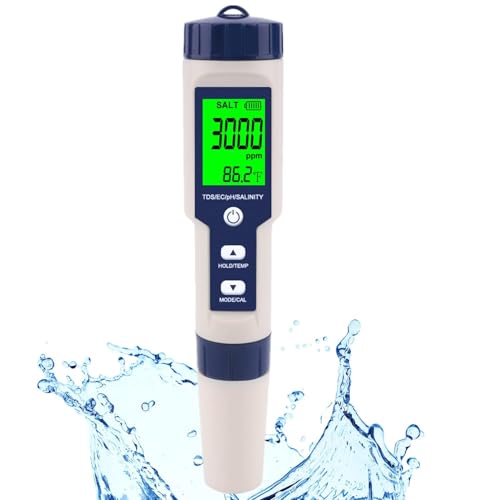
- Tests salinity, pH, EC, TDS, and temperature
- Displays ppm, ppt, and percent salinity
- Supports pools, seawater, aquariums, and spas
Best For: Multi-parameter water-quality testing
Simple Pool Pick
SALT-3000 Digital Salinity Meter

- 0–9,990 ppm measurement range
- Temperature readings to 55°C/130°F
- 1 ppm readout accuracy
Best For: Basic saltwater pool and koi pond checks
Best All-Around Pool Tester

- Measures salinity, pH, TDS, EC, and temperature
- Offers PPM, PPT, and percentage salinity displays
- IP67 waterproof with backlit LCD and hold function
Best For: Pool owners seeking versatile daily water testing
Best Smart Option
App-Connected 7-in-1 Salinity Meter

- Measures seven water-quality parameters
- Bluetooth app tracks trends and exports reports
- Rechargeable battery supports over 100 tests per charge
Best For: Users who want connected testing and measurement history
Best for Multiple Salinity Formats

- Measures salinity, pH, TDS, EC, and temperature
- Supports PPM, PPT, and percentage displays
- Suitable for pools, seawater, aquariums, and hot tubs
Best For: Users needing flexible salinity units across aquatic settings
Versatile Waterproof Pick – ORAPXI 4-in-1 Salinity Tester
For shoppers comparing digital salinity meters, the ORAPXI tester offers a broad measurement range and several useful water-quality readings in one waterproof device. It measures salinity, TDS, EC, and temperature, with automatic temperature compensation for readings across 32°F to 140°F.
Best For: Aquariums, seawater, marine monitoring, saltwater pools, and koi ponds.
Pros:
- Measures salinity from 0–9999 ppm, 10–200 ppt, or 0.0–25%.
- IP67 waterproof design and backlit LCD support convenient use in dim conditions.
- Automatic temperature compensation helps reduce temperature-related measurement error.
- Simple dip-and-read operation provides results in seconds.
Cons:
- The multi-function design may be more than needed for users who only measure salinity.
- The supplied notes do not specify a warranty or included calibration solution.
This is a practical all-around choice when you want one compact meter for multiple water parameters and varied saltwater applications.
Premium Multi-Parameter Choice – Apera PC60 Pocket Tester
The Apera PC60 is a premium option among digital salinity meters, combining salinity measurement with pH, EC, TDS, and temperature testing. Its replaceable probe, backlit color LCD, and included calibration supplies make it suited to users who want a more complete testing kit.
Best For: Users who need professional-style, multi-parameter testing in a portable kit.
Pros:
- Measures pH, EC, TDS, salinity, and temperature.
- Replaceable multi-parameter probe supports easier long-term maintenance.
- Large backlit display shows readings, temperature, calibration icons, and stability status.
- Includes calibration solutions, storage solutions, batteries, bottles, lanyard, and carrying case.
Cons:
- Its broader feature set may be unnecessary for basic salinity-only checks.
- The electrode has a shorter stated warranty than the instrument.
Choose the PC60 if calibration readiness, replaceable components, and a clear multi-reading display matter more than the simplest possible setup.
Fast Aquarium Refractometer – Milwaukee MA887 Digital Refractometer
The Milwaukee MA887 takes a different approach to digital salinity meters: it is a dedicated digital refractometer for natural or artificial seawater. It reports PSU, ppt, and specific gravity, while automatic temperature compensation and a 1.5-second response help streamline aquarium checks.
Best For: Saltwater aquariums and reef tanks where salinity readings in multiple units are useful.
Pros:
- Displays salinity in PSU, ppt, and specific gravity.
- Automatically compensates for temperature variations.
- Provides readings within approximately 1.5 seconds.
- Sealed glass prism and stainless steel sample well are easy to clean.
Cons:
- It is designed specifically for seawater salinity rather than multi-parameter water testing.
- The supplied package includes a pipette and manual but does not list calibration solutions.
For reef keepers who want quick, repeatable seawater readings and do not need pH or TDS functions, the MA887 is a focused and convenient option.
Pool Maintenance Pick – ORAPXI 5-in-1 Salt and pH Meter
For pool owners comparing digital salinity meters, this ORAPXI model combines salt testing with pH, TDS, EC, and temperature measurements. Its salt range of 0–9990 ppm or 10–100 ppt is aimed at saltwater pools and hot tubs using salt chlorine generators.
Best For: Swimming pools, saltwater hot tubs, spas, and pool owners monitoring both salt and pH.
Pros:
- Measures salinity, pH, TDS, EC, and temperature.
- Supports salt readings from 0–9990 ppm or 10–100 ppt.
- Provides a digital alternative to estimating values from test-strip colors.
- Includes a battery, brush, user manual, and calibration powder.
Cons:
- Its stated salt range is narrower than some meters intended for broader marine applications.
- The supplied notes do not identify a waterproof rating or warranty.
This model is especially practical when maintaining a salt chlorine system requires regular checks of both salinity and pH rather than salt measurement alone.
Pool-Focused Pick – SALT-3050 Waterproof Salinity Meter
The SALT-3050 is a specialized choice among digital salinity meters for saltwater pools and koi ponds. It measures salt from 0–9,999 ppm or 0.0–1.0%, includes temperature readings, and has an IP65 waterproof rating.
Best For: Saltwater pool and koi pond owners who want a dedicated salt tester with a waterproof design.
Pros:
- Measures 0–9,999 ppm or 0.0–1.0% salt.
- Displays temperature from 0–55°C (32–130°F).
- Precalibrated at 3,000 ppm NaCl at 25°C/77°F.
- IP65 waterproof rating.
Cons:
- Designed only for saltwater pools and koi ponds.
- Not suitable for marine aquariums, food salt testing, or other applications.
- Requires three LR44 batteries.
This is a focused, practical meter rather than a multipurpose water tester. Its waterproof construction and broad pool-oriented ppm range make it a strong fit when saltwater pool or koi pond testing is your only requirement.
Most Versatile Pick – Hofun 5-in-1 Salinity and pH Meter
The Hofun stands out among digital salinity meters by combining salinity, pH, temperature, EC, and TDS testing in one handheld device. It supports pool, seawater, aquarium, spa, hot tub, hydroponic, and selected food-testing applications with multiple salinity display formats.
Best For: Users who need salinity testing alongside broader water-quality measurements for pools, aquariums, spas, or hydroponics.
Pros:
- Combines salinity, TDS, EC, pH, and temperature functions.
- Displays salinity in ppm, ppt, and percent.
- Supports pool readings up to 9,999 ppm and seawater readings up to 200 ppt.
- Titanium alloy probe is designed for quick, accurate measurements.
Cons:
- Its many modes may be more than needed for simple pool salt checks.
- Food salinity testing is listed at a separate 0.01–25% range.
Choose the Hofun when flexibility matters more than a single-purpose design. The automatic shift from ppm to ppt above 9,999 ppm can also make higher-salinity readings easier to interpret.
Simple Pool Pick – SALT-3000 Digital Salinity Meter
The SALT-3000 is a straightforward option among digital salinity meters for saltwater pools and koi ponds. It measures 0–9,990 ppm, provides temperature readings, and offers a 1 ppm readout accuracy for focused salt-level checks.
Best For: Pool or koi pond owners who want a basic handheld ppm tester without multiparameter functions.
Pros:
- Measures salt levels from 0–9,990 ppm.
- Provides temperature readings from 0–55°C (32–130°F).
- Precalibrated at 3,000 ppm NaCl.
- Specified 1 ppm readout accuracy and a one-year warranty.
Cons:
- Not waterproof.
- Limited to saltwater pool and koi pond testing.
- Not intended for marine aquariums, food salt testing, or other applications.
The SALT-3000 keeps the task simple with dedicated ppm and temperature measurements. It is best suited to controlled pool or koi pond use where waterproofing and broader water-quality functions are not priorities.
Best All-Around Pool Tester – 5-in-1 Digital Salinity Meter
For routine saltwater pool care, this digital salinity meter combines salinity, pH, TDS, EC, and temperature testing in one compact device. It provides readings in about three seconds, supports multiple salinity units, and includes features such as automatic temperature compensation and a backlit display.
Best For: Pool owners who want one portable tester for salt levels, pH, and broader water-quality checks.
Pros:
- Measures salinity, pH, TDS, EC, and temperature.
- Displays salinity in PPM, PPT, or percentage formats.
- IP67 waterproof design with a protective probe cap.
- Hold function, auto shutoff, and backlit LCD support convenient use.
Cons:
- Regular calibration is recommended for long-term stability.
- Its pool-focused design may offer more functions than users who only need salinity testing require.
This is a practical choice for daily maintenance and quick checks after adding water or making adjustments. Its five testing modes and compact waterproof build make it especially versatile for pools, hot tubs, aquariums, and hydroponic setups.
Best Smart Option – App-Connected 7-in-1 Salinity Meter
This app-connected digital salinity meter is designed for users who want more than an on-screen reading. It measures seven water parameters, syncs with iOS and Android devices over Bluetooth, and lets you review trends, organize measurements, and export reports.
Best For: Pool, spa, aquarium, and hydroponic users who value measurement history and smartphone-based water tracking.
Pros:
- Tests pH, ORP, EC, TDS, salinity, SG, and temperature.
- Bluetooth app supports charts, saved measurements, and report exports.
- Rechargeable battery provides over 100 tests per charge.
- Includes pH calibration powders and automatic temperature compensation.
Cons:
- App connectivity adds setup and device-management steps compared with a basic meter.
- More advanced features may be unnecessary for users seeking only salt readings.
Choose this model if you want a more complete record of water conditions instead of isolated spot checks. Its rechargeable design and broad parameter range make it the most feature-rich option in this selection.
Best for Multiple Salinity Formats – Multifunctional 5-in-1 Tester
This digital salinity meter is a straightforward 5-in-1 testing kit for pools, aquariums, hot tubs, and spas. Along with pH, TDS, EC, and temperature, it provides salinity readings in PPM, PPT, and percentage formats, including a higher-range PPT mode for seawater testing.
Best For: Users who need flexible salinity units for swimming pools, seawater, aquariums, or related water-testing tasks.
Pros:
- Combines salinity, pH, TDS, EC, and temperature measurement.
- Supports PPM, PPT, and percentage salinity displays.
- Designed for pools, seawater, aquariums, hot tubs, and spas.
- Simple interface provides readings on a clear LCD display.
Cons:
- The supplied notes do not mention a rechargeable battery or app connectivity.
- Only one pH calibration item is listed in the package details.
This model suits buyers who prefer a simple multifunction tester and need more than one salinity scale. Its broad application range is useful when testing different aquatic environments, while the uncomplicated interface keeps routine checks accessible.
How We Picked the Best Digital Salinity Meters
We focused on the features that matter during regular water testing: salinity range, measurement units, stated accuracy, waterproofing, automatic temperature compensation, calibration options, display readability, and probe design. We also considered whether each meter is designed primarily for saltwater pools, aquariums, ponds, or broader water-quality testing.
Because these products serve different users, the list includes dedicated salinity testers, combination pH and salt meters, multiparameter instruments, and a digital refractometer. A device with more functions is not automatically better; it may require more calibration and maintenance than a purpose-built tester.
Quick Comparison
- Basic pool or pond testing: Choose a dedicated salinity and temperature meter with a clear display and simple controls.
- Saltwater aquariums: Consider a device with a suitable ppt range, temperature compensation, and dependable calibration support.
- Multiple water parameters: A 5-in-1 or 7-in-1 meter can measure pH, EC, TDS, salinity, and temperature in one tool.
- High repeatability: A digital refractometer may suit aquarium owners who want a focused instrument and an easy-to-read result.
- Remote monitoring: An app-connected model is useful when you want to record readings or review trends on a phone.
Key Buying Factors for Digital Salinity Meters
Measurement Range and Units
Check that the meter covers your expected salinity level and displays the units you use, such as ppt, ppm, specific gravity, or percent. Pool and marine applications can require different ranges, so avoid choosing solely by the product name.
Accuracy, Calibration, and Temperature Compensation
Look for clear accuracy specifications and a practical calibration process. Automatic temperature compensation, often abbreviated ATC, helps readings remain more consistent when water temperature changes, but it does not eliminate the need for proper calibration.
Probe Care and Waterproof Construction
Waterproof ratings such as IP65 or IP67 can help protect the meter during splashes or accidental immersion, but they do not replace careful cleaning. Rinse the probe after use, follow the manufacturer’s storage instructions, and use the recommended calibration solution.
Extra Parameters and Usability
pH, EC, TDS, ORP, and temperature readings can be valuable if you manage several aspects of water chemistry. However, combination meters may involve more settings and probe maintenance. A large backlit display, automatic shutoff, rechargeable battery, and replaceable probe can make frequent testing more convenient.
Who Should Buy Which Digital Salinity Meters?
Pool owners should prioritize a salt range suited to their chlorinator, fast readings, and a durable waterproof body. Aquarium keepers should look for stable ppt or specific-gravity measurements, ATC, calibration support, and a probe suitable for repeated small-volume tests.
Pond owners may prefer a straightforward, rugged tester that also reports temperature. Advanced hobbyists and technicians can benefit from multiparameter models or app connectivity, especially when tracking pH, conductivity, TDS, ORP, and salinity over time.
Before buying, confirm the stated range, required calibration solutions, battery type, replacement-probe availability, and intended water type. The best choice is the meter that provides the measurements you actually need while remaining simple enough to use and maintain consistently.