Fermentation crocks make it easier to preserve vegetables with a stable, low-oxygen environment for consistent batches of sauerkraut, kimchi, pickles, and other cultured foods.
These 10 options cover compact one-gallon designs, family-size crocks, water-seal models, ceramic weights, and larger vessels for regular food preservation.
Best 10 Fermentation Crocks for Food Preservation Picks for 2026
Large Waterlock Pickling Crock

- 7L ceramic capacity for large batches
- Wide waterlock helps exclude air
- Includes weights and wooden tamper
Best For: Large-batch sauerkraut, kimchi, pickles, and kombucha
German-Made Ceramic Crock
K&K Keramik 5L Fermenting Crock

- 5L ceramic capacity
- Fired at 1260°C and lead-free
- Includes beechwood cabbage tamper
Best For: Traditional mid-size sauerkraut and vegetable fermentation
Lightweight Airtight Fermentation Container
12L Kimchi and Sauerkraut Container

- 12L capacity for large batches
- Lightweight polypropylene construction
- Airtight snap closure and dishwasher-safe care
Best For: High-volume vegetable fermentation with easy handling
Compact Stoneware Fermentation Set

- 1-gallon capacity for smaller batches
- Stoneware and clay construction
- Round canister with broad food uses
Best For: Small-batch fermentation and traditional stoneware storage
Best Traditional-Style Pick
1.3-Gallon Seeutek Fermentation Crock

- Includes lid, weights, and tamper
- Water-sealed design vents fermentation gases
- Food-safe glazed ceramic construction
Best For: Small-to-medium batches of sauerkraut, kimchi, and pickles
Best Large-Batch Pick

- Large five-gallon fermentation capacity
- Includes lid, pressing stones, and starter recipes
- Lead-free, food-safe materials made in the USA
Best For: Large household batches and serious food preservation
Best Premium Design

- Water seal supports consistent anaerobic fermentation
- Includes weights, tamper, and care guide
- High-fired white porcelain looks countertop-ready
Best For: Beginners and families making regular vegetable ferments
Best with Extra Features

- 2-gallon stoneware vessel for large batches
- Food-grade, lead-free, and flavor-resistant
- Microwave, oven, and dishwasher safe
Best For: Making large batches of sauerkraut and pickles
Best Complete Starter Kit

- Includes lid, weights, pounder, recipes, and guide
- Water seal helps manage fermentation gases
- Food-grade ceramic with large handles
Best For: Beginners making sauerkraut or kimchi
Best Sealed 1-Gallon Value
Glazed Stoneware Fermentation Crock
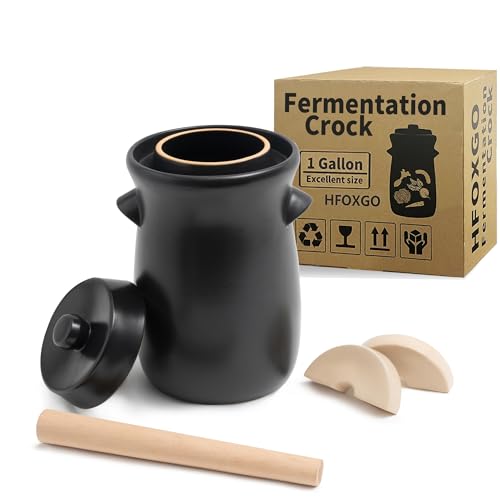
- Water-seal lid supports anaerobic fermentation
- Includes weights, lid, and pickle tamper
- Glazed ceramic suits vegetables and kombucha
Best For: Home fermenters making sauerkraut, kimchi, and pickles
Large Waterlock Pickling Crock – TOMO 7L Fermentation Crock
For shoppers comparing fermentation crocks for food preservation, the TOMO 7L offers generous capacity and a waterlock design for making sauerkraut, kimchi, pickled vegetables, or kombucha. Its fully glazed interior and included accessories make it a practical all-in-one setup for larger batches.
Best For: Families and batch fermenters who want a large ceramic crock with weights and a tamper included.
Pros:
- 7L capacity can hold approximately 5–7 cabbages and make about 12 mason jars of sauerkraut.
- Wide waterlock helps keep air out while allowing fermentation gases to escape.
- Includes two weights and a wooden tamper.
- Fully glazed, non-porous interior is designed to resist odors and clean easily.
Cons:
- At 10.28 pounds before filling, it is a substantial vessel to move.
- The large capacity may be more than needed for occasional or small-batch users.
The TOMO is a strong choice when capacity, an oxygen-reducing waterlock, and a complete accessory set matter more than compact storage.
German-Made Ceramic Crock – K&K Keramik 5L Fermenting Crock
5L K&K Keramik German Made Fermenting Crock Pot , Kerazo F2, Plus Beechwood Tamper
Check Price On AmazonThe K&K Keramik 5L is a traditional option for fermentation crocks for food preservation, combining thick ceramic construction with a deep gully intended to release gas while limiting outside air. It also includes a beechwood cabbage tamper for preparing sauerkraut.
Best For: Shoppers seeking a handmade German ceramic crock with a classic water-gully design.
Pros:
- Handmade ceramic is fired at 1260°C and stated to be free of lead and cadmium.
- Deep gully is designed to expel gas and help prevent outside air from entering.
- Thick base and walls provide a substantial ceramic build.
- Includes a beechwood tamper to extract cabbage juices.
Cons:
- At 5L, it offers less capacity than the larger 7L and 12L options in this roundup.
- Small variations in the brown, copper, and speckled finish are normal.
This crock suits buyers who value German-made ceramic construction and a traditional fermenting-gully design in a mid-size format.
Lightweight Airtight Fermentation Container – 12L Kimchi and Sauerkraut Container
Those comparing fermentation crocks for food preservation may prefer this 12L polypropylene container for its lighter construction and airtight closure. It is designed for vegetables such as kimchi and sauerkraut, with an inner vacuum lid and dishwasher-safe care instructions.
Best For: Users who want a high-capacity, lightweight plastic container for vegetable fermentation.
Pros:
- 12L capacity accommodates large vegetable-fermentation batches.
- Polypropylene construction weighs 2.6 pounds, lighter than the ceramic crocks listed here.
- Product is described as BPA- and lead-free.
- Dishwasher-safe care instructions simplify cleanup.
Cons:
- It is polypropylene rather than stoneware or ceramic.
- The supplied dimensions are listed as 4 x 4 x 11 inches, so shoppers should verify fit and storage space.
- As a global-store item, terms, labeling, or version details may differ by market.
This is a practical capacity-focused alternative for buyers who prioritize low weight, airtight storage, and easy cleaning over traditional crock construction.
Compact Stoneware Fermentation Set – 1-Gallon Stoneware Crock
For smaller batches of fermentation crocks for food preservation, this 1-gallon stoneware set offers a compact clay-and-stone construction. Its round canister format is intended for foods including vegetables, fruit, bread, cheese, and other pantry items.
Best For: Home cooks who want a compact 1-gallon stoneware fermentation kit for modest batches.
Pros:
- 1-gallon capacity is suitable for smaller-scale use.
- Stoneware construction provides a traditional ceramic-style vessel.
- Listed as a fermentation kit with clay and stone construction.
- Round canister design is also recommended for a broad range of food-storage uses.
Cons:
- The supplied notes do not specify included weights, a tamper, or a waterlock.
- At 12.4 pounds, it is relatively heavy for its 1-gallon capacity.
- Specific fermentation features beyond the kit designation are limited in the provided details.
This set is worth considering when a compact stoneware format is the priority, but buyers wanting clearly documented weights or waterlock features may prefer another option.
Best Traditional-Style Pick – 1.3-Gallon Seeutek Fermentation Crock
For shoppers comparing fermentation crocks for food preservation, this 1.3-gallon ceramic model offers a practical setup for homemade sauerkraut, kimchi, pickles, and other fermented vegetables. Its glazed, food-safe ceramic body includes a water-sealed lid, weights, and a tamper.
Best For: Home cooks who want a medium-capacity crock for seasonal vegetable fermentation.
Pros:
- Includes a lid, weighting stones, and pickle tamper.
- Water-sealed design allows fermentation gases to escape while helping limit oxidation and odors.
- Lead- and cadmium-free glazed ceramic is designed for food use.
- Smooth interior and wide opening make cleaning more convenient.
Cons:
- At 1.3 gallons, it offers less capacity than the larger crocks in this roundup.
- The 10.6-pound ceramic construction may be cumbersome to move when filled.
This is a well-equipped choice for regular small-to-medium batches, especially if you value a traditional glazed ceramic crock with the main fermentation accessories included.
Best Large-Batch Pick – Ohio Stoneware 5-Gallon Crock
Ohio Stoneware 5 Gallon Fermentation & Preservation Crock - Crock, Lid, Stones
Check Price On AmazonIf you need fermentation crocks for food preservation in substantial quantities, this 5-gallon Ohio Stoneware model is built for large batches. The set includes the ceramic crock, a full-width lid, two pressing stones, and starter recipes.
Best For: Families, serious home preservers, and anyone fermenting large quantities of vegetables or fruit.
Pros:
- Five-gallon capacity supports large fermentation and preservation projects.
- Includes two pressing stones and a full-width lid.
- Made in the USA with lead-free, food-safe materials and glazes.
- Listed as dishwasher, microwave, refrigerator, and conventional-oven safe.
Cons:
- The 28-pound crock and heavy lid and stones make this a substantial setup.
- Its size may be excessive for occasional or small-batch fermenting.
- The sealed lid style does not use a water channel.
Choose this crock when capacity is the priority. Its large footprint and weight are trade-offs for preserving bigger harvests in fewer batches.
Best Premium Design – 7L Porcelain Water-Seal Crock
Among fermentation crocks for food preservation, this 7-liter porcelain model stands out for its water seal, included accessories, and polished white finish. Its opaque, high-fired ceramic body is designed for sauerkraut, kimchi, pickles, and other vegetable ferments.
Best For: Beginners and regular home fermenters who want a countertop-friendly, water-sealed crock for family-size batches.
Pros:
- Water moat helps create an anaerobic environment while allowing carbon dioxide to escape.
- Includes two ceramic weights, a wooden tamper, and a care and use guide.
- 7-liter capacity is described as holding five to seven cabbage heads and yielding up to 12 jars.
- High-fired porcelain is non-porous, opaque, and designed to buffer light and temperature changes.
Cons:
- Hand-wash-only care requires more effort than dishwasher-safe alternatives.
- The 1.8-gallon capacity is smaller than the five-gallon Ohio Stoneware crock.
- Its substantial ceramic construction is intended to remain in place rather than be moved frequently.
This is a strong fit for users who want a refined-looking crock with a guided, beginner-friendly setup. The water seal and included tools reduce the need to assemble accessories separately.
Best with Extra Features – Ohio Stoneware 2-Gallon Crock
For shoppers comparing fermentation crocks for food preservation, this handmade Ohio Stoneware model stands out for its roomy 2-gallon capacity. Its lead-free, food-grade stoneware is suited to sauerkraut and pickles, while the hunter-green finish also lets it work as kitchen storage or decor.
Best For: Making large batches of sauerkraut and pickles.
Pros:
- Large 2-gallon capacity for batch fermentation
- Food-grade, lead-free, non-toxic stoneware
- Won’t retain food flavors
- Microwave-, oven-, and dishwasher-safe
Cons:
- Open-top design has no included lid
- At 12 pounds, it is relatively heavy to move
This is a practical choice when capacity and easy-care stoneware matter most. The lack of a lid makes it less turnkey than a sealed crock, but its USA-made construction and multipurpose design add flexibility.
Best Complete Starter Kit – HomeBuddy 1-Gallon Crock
This HomeBuddy model is a well-equipped option among fermentation crocks for food preservation. The 1-gallon ceramic crock includes a lid, ceramic weights, an acacia wood pounder, recipes, and a user guide, making it approachable for both first-time and experienced fermenters.
Best For: Beginners who want a complete sauerkraut or kimchi setup.
Pros:
- Includes ceramic weights, lid, pounder, recipes, and guide
- Water-seal design allows gases to escape while limiting outside air
- Food-grade, lead-free double-glazed ceramic resists unwanted smells and tastes
- Large handles improve lifting and maneuverability
Cons:
- Hand wash only
- One-gallon capacity is smaller than the 2-gallon Ohio Stoneware option
With its included accessories and water-seal lid, this crock reduces the need to purchase a separate fermentation setup. It is especially convenient for vegetable fermentation, though hand washing adds a little maintenance.
Best Sealed 1-Gallon Value – Glazed Stoneware Fermentation Crock
For a traditional setup with useful accessories, this 3.8-liter stoneware crock is a strong contender among fermentation crocks for food preservation. It includes stone weights, a lid, and a pickle tamper, and its water-seal design is intended to let gases escape while keeping outside air out.
Best For: Home fermenters making sauerkraut, kimchi, pickles, vegetables, or kombucha.
Pros:
- 1-gallon capacity reportedly fits 2–5 cabbages and about four jars of sauerkraut
- Includes stone weights, lid, and pickle tamper
- Glazed ceramic is described as non-porous and resistant to retaining smells or tastes
- Lead- and cadmium-free glaze is smooth and designed for convenient washing
Cons:
- The supplied notes do not specify dishwasher safety
- Its 1-gallon size may be limiting for very large batches
This crock balances a manageable capacity with the core tools needed for traditional vegetable fermentation. Its sealed design and glazed interior make it versatile, while the included tamper is useful for preparing dense vegetables such as cabbage.
How We Picked the Best Fermentation Crocks for Food Preservation
We focused on the features that have the greatest effect on safe, convenient fermentation: food-contact materials, usable capacity, included weights, lid design, seal style, cleaning requirements, and likely countertop or storage needs. The lineup includes glazed stoneware and ceramic options in several sizes, from approximately one gallon to five gallons.
Because product specifications and included accessories can vary by seller, confirm the stated capacity, dimensions, weight set, and care instructions before ordering. A crock should be free from chips, cracks, and questionable interior coatings, and its lid should fit securely without making the vessel difficult to monitor or clean.
Quick Comparison
| Best for | Look for | Typical size |
|---|---|---|
| First-time fermenters | Complete kit with weights and lid | 1 gallon |
| Small households | Compact footprint and easy cleaning | 3–7 liters |
| Frequent batch makers | Durable stoneware and water-seal lid | 1–2 gallons |
| Large harvests | High capacity, sturdy handles, and strong weights | 2–5 gallons |
Key Buying Factors for Fermentation Crocks for Food Preservation
Capacity and Batch Size
Choose a crock based on the amount you will ferment, not just its advertised volume. Vegetables, brine, weights, and headspace all occupy room. A one-gallon crock is often practical for household batches, while larger crocks suit gardens, families, or regular entertaining but become heavier and harder to refrigerate or move.
Seal and Lid Design
Water-seal crocks can help limit oxygen exposure while allowing fermentation gases to escape through the moat. Simpler lids may cost less and work well when paired with an appropriate brine and weights, but they generally require more attention to the surface during fermentation. Check whether the lid, moat, and replacement parts are easy to clean.
Weights and Food-Safe Construction
Submerged vegetables are less exposed to air, so included ceramic or stoneware weights are a useful advantage. Look for evenly matched weights that are easy to lift and sanitize. Glazed, food-safe stoneware is common because it resists odors and staining; inspect all surfaces for cracks, crazing, or damaged glaze.
Handling and Maintenance
A full crock can be surprisingly heavy. Handles, a stable base, manageable lid, and clear care instructions matter as much as capacity. Avoid assuming a ceramic crock is dishwasher- or stovetop-safe unless the manufacturer specifically says so.
Who Should Buy Which Fermentation Crocks for Food Preservation?
New fermenters: Choose a roughly one-gallon kit that includes weights and a lid, reducing the need to source compatible accessories.
Small kitchens: A three- to seven-liter crock offers a useful balance of batch size, storage, and countertop space.
Dedicated home preservers: Select a water-seal model with sturdy stoneware, reliable weights, and a capacity that matches your regular harvest.
Large-batch makers: A two- to five-gallon crock is suitable for substantial vegetable quantities, provided you have a strong, level storage area and can safely move the filled vessel.