Making bread at home is easier when mixing, kneading, and proofing happen in one controlled appliance. The best electric dough kneading machines can reduce hands-on work while delivering more consistent results for loaves, pizza, rolls, and other yeast doughs.
We selected 10 models across household and commercial-style capacities, comparing bowl size, fermentation support, controls, construction, and practical countertop usability. Use the guide below to narrow the right machine for your recipes, batch size, and available space.
Best 10 Electric Dough Kneading Machines Picks for 2026
Best Large Versatility Pick

- 9.5-quart bowl for substantial batches
- MIX and BLEND functions
- Winter and summer fermentation modes
Best For: Large-batch baking and mixing fillings
Best Heavy-Duty Pick

- 750W motor with seven speeds
- 10-liter bowl for large flour batches
- Safety guard with automatic power cutoff
Best For: High-volume dough mixing and commercial-style workloads
Best Straightforward Fermentation Pick

- 250W continuous mixing at 150 RPM
- Kneading and constant-temperature proofing
- Detachable chute for adding ingredients
Best For: Everyday family baking with integrated proofing
Family-Batch Pick
7.4Qt Dough Maker with Fermentation

- 7.4-quart bowl for family-size batches
- Kneads and ferments in one bowl
- Intermittent kneading and suction feet
Best For: Families baking bread, pizza, sourdough, and dumplings
Beginner-Friendly Pick
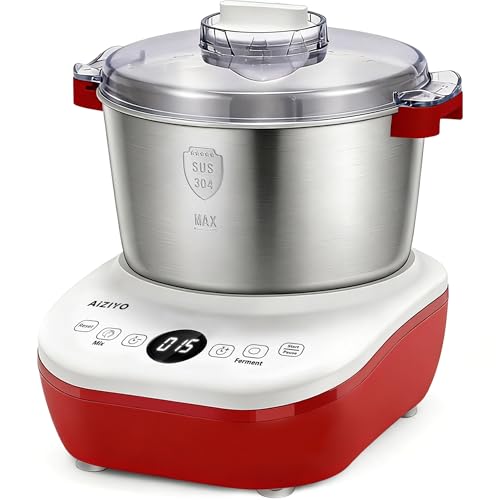
- Mix-pause-mix program with S-shaped blade
- Constant-temperature fermentation mode
- Touch panel and ingredient access opening
Best For: Home bakers wanting simple kneading and proofing
High-Capacity Pick

- Large bowl for up to 14.88 pounds of dough
- 500-watt motor rated below 60 dB
- Timer, fermentation, and removable bowl
Best For: Commercial kitchens and very large household batches
Quiet Weighing Pick

- Integrated weighing function
- Countdown timing and fermentation
- Quieter DC motor operation
Best For: Everyday home baking with less noise
Stable Knob-Control Pick
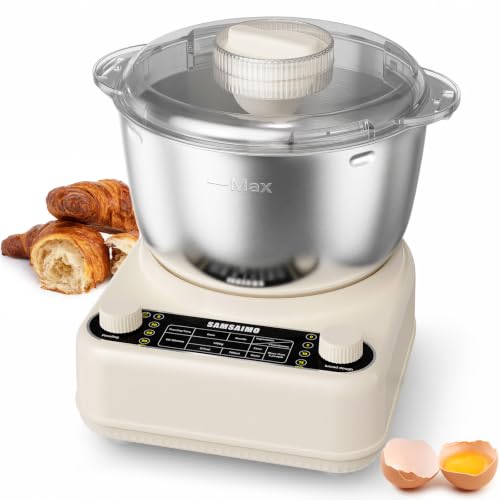
- 6.5-quart 304 stainless steel bowl
- Timed mix-pause-mix kneading
- Stable, low-noise countertop design
Best For: Hands-on control and medium-to-large batches
Best Smart Compact Pick – Joydeem 7.4Qt Dough Maker
For shoppers comparing electric dough kneading machines, the Joydeem JD-HMJ7L combines preset controls, intermittent kneading, and fermentation in a space-conscious vertical design. Its 250W motor can knead dough in about 15 minutes or knead and proof it in about 45 minutes.
Best For: Families wanting automated bread, pizza, bun, or dumpling dough preparation with fermentation.
Pros:
- Microcomputer controls provide time setting and program selection.
- 6.6-quart/7-liter capacity suits larger household batches.
- Removable stainless steel bowl, blade, and top cover simplify cleanup.
- Suction cups and a weighted body help reduce operating noise.
Cons:
- Only one speed is listed, so speed adjustment is unavailable.
- The base is not dishwasher safe.
- Its listed noise level is 70 dB.
Choose this model if simple automation and a compact footprint matter more than variable-speed control. The included one-year warranty and removable components add practical value for routine home baking.
Best Large Versatility Pick – Joydeem 9.5Qt Dough Maker
The Joydeem HMJ-A901 is one of the more flexible electric dough kneading machines for cooks who also prepare fillings. Its 9.5-quart bowl, intermittent MIX mode, continuous BLEND mode, and seasonal fermentation settings support a broad range of baking and cooking tasks.
Best For: Larger households and frequent bakers making bread, pizza, sourdough, roti, dumplings, steamed buns, or mixed fillings.
Pros:
- 300W motor and four modes cover mixing, fermenting, combined preparation, and blending.
- Winter and summer fermentation modes provide adjustable temperature ranges.
- Mixing time adjusts from 5 to 30 minutes, while fermentation adjusts from 5 to 120 minutes.
- Durable 304 stainless steel bowl and blade are designed for easier cleaning.
Cons:
- It is larger than the smaller 6.5- to 7-liter alternatives.
- The stated maximum fermented-dough flour weight is 2,500g, below the bowl’s 2,800g general flour range.
- The design lists a small top window rather than a fully open top.
This is a strong choice when batch capacity and cooking versatility are priorities. Its adjustable timing and dual fermentation options offer more control than a basic kneader, while BLEND mode expands its usefulness beyond dough.
Best Heavy-Duty Pick – 12Qt Commercial Food Mixer
For demanding kitchen workloads, this 12-quart commercial machine stands apart from household-focused electric dough kneading machines with its 750W motor, spiral stirring bar, and heavy-duty stainless steel construction. Its large bowl is rated for roughly 2.2 to 11 pounds of flour.
Best For: High-volume home kitchens, bakeries, pizzerias, and other settings needing large dough batches.
Pros:
- 750W copper-core motor provides substantially more power than the household models listed here.
- 10-liter bowl supports approximately 2.2 to 11 pounds of flour.
- Seven speeds offer more adjustment than single-speed dough makers.
- Safety guard cuts power when it is not closed securely.
Cons:
- At 21.7 inches wide and 18.9 inches tall, it requires considerable counter space.
- Its stainless steel is listed as grade 201 rather than 304.
- The notes focus on mixing and safety features, not an integrated fermentation function.
Consider this mixer when power, capacity, and speed selection outweigh compactness. It is better suited to substantial workloads than to small kitchens or buyers primarily seeking automated proofing.
Best Straightforward Fermentation Pick – VEVOR 6.9Qt Dough Mixer
The VEVOR 6.9-quart model is a practical option among electric dough kneading machines for home cooks who want continuous mixing and constant-temperature proofing in one appliance. Its digital panel, detachable ingredient chute, and 6.5-liter stainless steel bowl keep the process straightforward.
Best For: Families preparing everyday bread, pizza, sourdough, steamed buns, stuffed buns, or dumpling wrappers.
Pros:
- 250W motor runs at 150 RPM for continuous dough mixing.
- Integrated kneading and fermentation support multiple dough-based foods.
- Bowl capacity handles up to 1,600g of flour and is sized for families of six to seven.
- Detachable ingredient chute allows additions without stopping the machine.
Cons:
- Its capacity is smaller than the 9.5-quart and 12-quart alternatives.
- The notes do not specify multiple speeds or separate mixing modes.
- The ABS body is paired with a stainless steel bowl rather than an all-metal exterior.
This model fits buyers who want a simple home appliance that handles both kneading and proofing without a commercial footprint. It offers useful ingredient access and digital timing while staying focused on everyday dough preparation.
Family-Batch Pick – 7.4Qt Dough Maker with Fermentation
For shoppers comparing electric dough kneading machines, this 7.4-quart model focuses on practical home baking. It combines mixing, kneading, and fermentation in one stainless steel bowl, while intermittent kneading and suction feet support steadier dough handling.
Best For: Families making large batches of bread, pizza dough, sourdough, rolls, or dumplings.
Pros:
- 7.4-quart capacity suits larger homemade dough batches.
- Combines kneading and fermentation in one bowl.
- Intermittent kneading allows resting between cycles.
- 304 stainless steel bowl and suction feet support easier cleanup and stability.
Cons:
- Its 250-watt motor is intended for home use rather than commercial-scale production.
- White finish may show flour and dough residue more readily.
This is a straightforward choice when batch size and integrated proofing matter more than advanced controls. Its stable base and stainless steel bowl make it especially practical for regular family baking.
Beginner-Friendly Pick – DoughChief 7.4Qt Mixer
Among electric dough kneading machines, the AIZIYO DoughChief stands out for its mix-and-ferment workflow. Its S-shaped blade, mix-pause-mix program, touch controls, and constant-temperature fermentation function are designed to simplify bread and pizza preparation.
Best For: Home bakers who want guided kneading and proofing with a touch-panel interface.
Pros:
- 7.4-quart 304 stainless steel bowl supports substantial home batches.
- Mix-pause-mix programming is designed to simulate hand kneading.
- Fermentation mode maintains a stated 77–100°F range.
- Wide top opening allows flour or water adjustments during mixing.
Cons:
- It has one listed speed, limiting speed customization.
- At 75 dB, it may be noticeable during operation.
- Fermentation requires yeast or fermentation powder.
The DoughChief is a useful fit for beginners who value an integrated process and simple touch controls. It offers helpful fermentation features, though users seeking multiple mixing speeds may prefer a more adjustable machine.
High-Capacity Pick – 13.8Qt Commercial Dough Mixer
For high-volume baking, this commercial model offers more capacity than typical electric dough kneading machines. Its 13.8-quart stainless steel bowl, 500-watt motor, spiral hook, timer, fermentation function, and removable components are geared toward large batches and frequent use.
Best For: Bakeries, food-service settings, and households that regularly prepare very large dough batches.
Pros:
- Handles up to 14.88 pounds of dough or 9.92 pounds of flour per batch, according to the supplied specifications.
- 500-watt motor is rated below 60 dB.
- 5–120 minute timer and LED touch controls support scheduled mixing.
- Removable bowl and spiral hook simplify disassembly and cleaning.
Cons:
- Its 19.7-inch width and 17.3-inch height require substantial counter space.
- The large commercial design may be excessive for occasional small batches.
- The supplied notes do not specify the number of speed settings.
This is the strongest option in the group for capacity and commercial-style workflow. Choose it when batch volume, timer control, and removable components justify its larger countertop footprint.
Large-Batch Fermentation Pick – 7.4QT Dough Mixer
For shoppers comparing electric dough kneading machines, this 7.4-quart model emphasizes capacity, fermentation control, and convenient ingredient additions. Its stainless steel construction, digital controls, and 250-watt motor suit frequent bread, pizza, and pastry preparation.
Best For: Large families and bakers preparing multiple batches at once.
Pros:
- Large 7.4-quart capacity for family-size batches and gatherings.
- Constant-temperature fermentation supports consistent proofing.
- Top window allows water, seasoning, or other ingredients to be added during mixing.
- Stainless steel bowl and blade offer a durable, rust-resistant design.
Cons:
- Only one speed is listed.
- Its larger capacity may be more than needed for small households.
- At 250 watts, it has less stated power than some larger stand mixers.
This is a practical choice when batch size and built-in fermentation matter most. The intermittent kneading design is also intended to help limit overheating and premature rising.
Quiet Weighing Pick – 5.2QT Dough Maker
This 5.2-quart machine stands out among electric dough kneading machines by combining kneading, fermentation, and weighing functions. Its countdown timing, touch panel, and quieter DC motor make it a convenience-focused option for everyday bread, pizza, and dumpling dough.
Best For: Home bakers who value integrated weighing and quieter operation.
Pros:
- Built-in weighing function helps streamline ingredient preparation.
- Adjustable kneading time and countdown settings can complete dough preparation in about 15 minutes.
- DC motor is designed to reduce operating noise.
- Stainless steel liner, removable cover, and removable blade simplify maintenance.
Cons:
- Its 5.2-quart capacity is smaller than the largest models in this roundup.
- The listed 200-watt output may be less suitable for consistently heavy workloads.
- The touch-panel design may be less convenient than knob controls when hands are covered in flour.
Choose this model if weighing and quieter mixing are higher priorities than maximum capacity. The dishwasher-safe care specification further supports routine household use.
Stable Knob-Control Pick – 6.5QT Dough Maker
For buyers seeking electric dough kneading machines with hands-on controls, this 6.5-quart model pairs a 304 stainless steel bowl with a removable lid, timed kneading, and constant-temperature fermentation. Its suction-cup base and low-noise design are aimed at stable countertop use.
Best For: Bakers who want a mid-to-large capacity machine with manual knob control.
Pros:
- 6.5-quart bowl handles approximately 300 to 1,400 grams of dough.
- S-shaped blade and mix-pause-mix operation are designed to develop dough evenly.
- Fermentation temperature can be maintained from 77–95°F.
- Removable blade, suction-cup base, lid buckles, and knob controls support practical use.
Cons:
- The mixing bowl is not recommended for dishwasher cleaning.
- Mechanical knob controls offer fewer automated controls than a digital interface.
- Fermentation requires yeast or baking powder, according to the product notes.
This model is a strong fit for users who prefer tactile controls and a stable machine during kneading. Its 304 stainless steel parts and intermittent operation also support durability and temperature management.
How We Picked the Best Electric Dough Kneading Machines
We focused on the features that matter most during everyday dough preparation: usable bowl capacity, kneading performance, fermentation control, timer functions, materials, cleaning convenience, and operating flexibility. The selection includes compact household machines, larger-capacity makers, and heavy-duty commercial-style mixers so different baking routines are represented.
Fermentation settings received special attention because they can simplify proofing by helping maintain a more consistent environment. We also considered whether controls are easy to understand, whether the bowl and lid are practical to handle, and whether the machine appears suited to occasional baking or frequent larger batches.
Quick Comparison
| Best For | What to Look For |
|---|---|
| Small households | About 5.2 to 6.5 quarts, simple controls, and a compact footprint |
| Regular bread and pizza baking | About 7.4 quarts, fermentation support, and stainless-steel construction |
| Large family batches | 9.5 to 12 quarts, stronger mixing capacity, and timing controls |
| Frequent or commercial-style use | 13.8-quart capacity, durable components, and a heavy-duty motor design |
Key Buying Factors for Electric Dough Kneading Machines
Capacity and Minimum Batch Size
A larger bowl is useful for multiple loaves or pizza bases, but it may be inefficient for very small batches. Match capacity to the amount of flour and dough you typically prepare rather than choosing the biggest model automatically.
Kneading and Mixing Functions
Look for dedicated dough-kneading programs and, when useful, separate mixing or blending modes. A machine designed specifically for dough should handle heavier mixtures without excessive movement, overheating, or frequent scraping.
Fermentation and Timing
Built-in fermentation can make proofing more convenient, especially in cool kitchens. Adjustable timers and seasonal or temperature-related settings offer more control, but they do not replace checking dough volume and readiness.
Construction and Cleanup
Stainless-steel bowls are durable and generally straightforward to clean. Check whether the bowl, lid, and attachments are removable, and allow enough clearance around the appliance for ventilation and access.
Controls, Noise, and Footprint
Touch panels and digital displays can simplify programming, while basic controls may be quicker for frequent use. Measure your counter and storage space, and remember that larger machines are often heavier and louder.
Who Should Buy Which Electric Dough Kneading Machines?
Choose a Compact Household Model
Smaller 5.2- to 6.5-quart machines are a practical choice for beginners, couples, and bakers who usually make one moderate batch at a time.
Choose a 7.4-Quart Machine for Versatility
This capacity is a strong middle ground for regular bread and pizza baking. Models with fermentation, timing, and stainless-steel bowls suit households wanting an all-in-one workflow.
Choose a Larger or Commercial-Style Mixer
Move to a 9.5-, 12-, or 13.8-quart model if you routinely prepare several loaves, large pizza batches, or dough for gatherings. Confirm that your counter, electrical setup, and storage area can accommodate it.
Before buying, verify the manufacturer’s stated dough limits rather than relying only on bowl volume. The right electric dough kneading machine should provide enough capacity for your recipes without becoming unnecessarily difficult to store, clean, or operate.