Whether you want to press peanuts, sunflower seeds, sesame, or other oil-rich ingredients, the right electric oil press can make fresh oil production faster and more consistent.
We selected 10 models spanning compact home machines and higher-output commercial presses, with attention to heating control, motor power, operating capacity, materials, and ease of use.
Best 10 Electric Oil Presses Picks for 2026
Best Adjustable-Temperature Pick
Automatic Stainless Steel Oil Press

- 50–250°C adjustable temperature
- Presses many seeds and nuts
- Includes filter, oil cup, and gloves
Best For: Home users seeking flexible hot and cold-style pressing
Best Dual-Head Workhorse

- Two independent pressing chambers
- Designed for up to 24-hour operation
- Includes dual accessories and reverse function
Best For: Small commercial users and high-volume home pressing
Best Versatile Capacity Option

- Up to 11 lb/h advertised capacity
- 122–572°F temperature range
- Presses over 30 ingredient types
Best For: Home, restaurant, and market users needing versatility
Best Commercial Throughput

- Up to 22 lb/h peanut pressing speed
- 100–300°C intelligent temperature control
- Forced-air cooling for continuous use
Best For: Commercial and workshop-scale oil production
Best Overall for Flexible Pressing

- Hot and cold pressing modes
- Up to 9–13.5 lb/h capacity
- Temperature display and adjustable controls
Best For: Home cooks and small businesses pressing common nuts and seeds
Best for High-Volume Dual Pressing

- Two independent 1500W motors
- Double outlets for parallel pressing
- Designed for up to 24-hour operation
Best For: Users needing dual-batch processing for commercial or domestic work
Best for Temperature Precision

- 5–9 kg/h stated output
- 40–300°C adjustable temperature
- Reverse function aids cleanup
Best For: Home and light-commercial users pressing varied seeds and nuts
Best Overall Control

- 32–572°F intelligent temperature control
- Cold and hot pressing modes
- 10-pound-per-hour peanut capacity
Best For: Users seeking versatile pressing and precise heat adjustment
Best Simple Operation
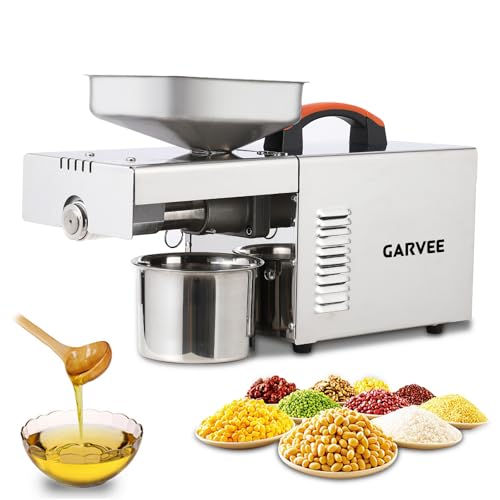
- Cold, hot, and frying settings
- 304 food-grade stainless steel body
- Includes cleaning and pressing accessories
Best For: Straightforward home pressing of common nuts and seeds
Best Digital Monitoring
Adjustable-Temperature Oil Press

- Digital temperature display and 8-minute preheat timer
- Cold and hot pressing modes
- Stated 6.61–13.22 lb hourly processing range
Best For: Users who want monitored temperatures and easier cleanup
Best Adjustable-Temperature Pick – Automatic Stainless Steel Oil Press
This automatic electric oil press is a practical choice for home users who want control over pressing temperature and the flexibility to work with several seeds and nuts. Its adjustable 50–250°C range supports both hot and cold-style pressing, while the stainless steel housing is designed for easier cleaning and long-term use.
Best For: Home users pressing peanuts, sesame, sunflower seeds, soybeans, walnuts, coconut, and similar ingredients.
Pros:
- Adjustable 50–250°C pressing temperature with automatic heating and display control.
- Handles a broad selection of oil-bearing materials, including peanuts, sunflower seeds, soybeans, and walnuts.
- Stainless steel exterior resists rust and corrosion and is easier to clean.
- Includes an oil cup, filter, heat-resistant gloves, and instruction manual.
Cons:
- Listed output is approximately 3–6 kg of raw material per hour, which may be limited for higher-volume production.
- Product notes contain differing motor and wattage references, so buyers should confirm the exact specifications before ordering.
With adjustable heat and a versatile ingredient range, this model is a capable entry point among electric oil presses. It is better suited to household or light-duty use than to operations needing continuous commercial throughput.
Best Dual-Head Workhorse – 1600W Dual Motor Oil Press
For buyers comparing electric oil presses for productivity, this dual-motor model stands out with two independent pressing chambers and outlets. It can run both sides together or operate one side independently, making it useful when pressing different ingredients or maintaining a steady workflow.
Best For: Home businesses, farms, workshops, and small commercial operations that need simultaneous pressing.
Pros:
- Dual motors, chambers, and oil outlets can press two ingredients at the same time without flavor mixing.
- Constant hot-press system is designed for consistent operation and up to 24-hour continuous use.
- Food-grade 304 stainless steel pressing chamber and reinforced all-steel gear drive support demanding use.
- Includes two hoppers, oil cups, strainers, outlet tubes, a brush, glove, and one-touch reverse function.
Cons:
- The dual-head design may be more machine than occasional household users need.
- Notes emphasize hot pressing rather than adjustable cold-press temperature control.
This is the productivity-focused option in the group. Its dual independent system and continuous-operation design make it appealing for frequent pressing, provided you have the space and ingredient volume to justify its larger setup.
Best Versatile Capacity Option – VEVOR 11-Lb/H Oil Press
This VEVOR electric oil press combines an advertised capacity of up to 11 pounds per hour with temperature settings from 122°F to 572°F. It is a versatile choice for buyers who want to press more than one type of nut or seed for home, restaurant, or market use.
Best For: Users wanting broad ingredient compatibility and adjustable temperatures for both hot and cold pressing.
Pros:
- Advertised hot-press capacity reaches up to 11 pounds of flaxseed per hour.
- 122–572°F temperature adjustment supports different ingredients and pressing approaches.
- Compatible with more than 30 nuts, seeds, and oil-rich ingredients, including sesame, soybeans, almonds, and walnuts.
- Includes a stainless steel oil cup, filter screen, heat-insulating gloves, and cleaning brush.
Cons:
- The listed 220-volt power requirement may not suit every household electrical setup.
- Its 28.7-pound weight makes it less convenient to move frequently.
- Product details list multiple power figures, so confirm the operating specifications before purchase.
Its combination of capacity, wide ingredient compatibility, and broad temperature range makes this a flexible all-purpose selection. Check your available voltage first, especially if you plan to use it in a standard household kitchen.
Best Commercial Throughput – CGOLDENWALL 3000W Oil Press
Designed for serious production, this CGOLDENWALL machine is the commercial-scale choice among these electric oil presses. It offers a rated 22-pound-per-hour peanut pressing speed, intelligent temperature control from 100–300°C, forced-air cooling, and a design rated for continuous operation.
Best For: Commercial users, workshops, and production environments that need high throughput and extended operating time.
Pros:
- Advertised pressing speed is up to 22 pounds per hour for peanuts.
- Intelligent temperature control monitors and adjusts heat within a 100–300°C setting range.
- Forced-air cooling and overheat protection support continuous operation, including a stated 24-hour work time.
- 304 food-grade stainless steel construction and included pots, filter, brush, gloves, and tool set support regular use.
Cons:
- At 44 pounds, it is considerably less portable than smaller home-oriented machines.
- The 110V US-plug configuration limits use where compatible power is unavailable.
- Its commercial capacity and 3000W maximum power may be excessive for occasional household pressing.
Choose this model when throughput and long operating sessions matter more than compactness. Its cooling system, temperature controls, and commercial construction make it the strongest fit for demanding production, while casual users may prefer a smaller press.
Best Overall for Flexible Pressing – 820W Hot & Cold Oil Press
This 820W machine is a versatile choice among electric oil presses for home users and small commercial operations. Its hot and cold modes, adjustable temperature range, and stainless-steel construction make it suitable for pressing several common nuts and seeds.
Best For: Home cooks and small businesses that want hot- or cold-pressed oil with automatic temperature monitoring.
Pros:
- Offers both hot- and cold-pressing modes.
- Supports continuous operation for up to 24 hours.
- Handles up to 9–13.5 pounds per hour according to the supplied specifications.
- Includes an intelligent panel with real-time temperature display and adjustment.
Cons:
- Not intended for olives, cocoa beans, spices, flowers, herbs, or coffee beans.
- Hand-wash care may require extra cleanup time.
With broad ingredient compatibility and straightforward controls, this is a practical all-around option. Choose it if you want flexibility without stepping up to a dual-motor design.
Best for High-Volume Dual Pressing – 1500W Double-Outlet Oil Press
This 1500W model stands out among electric oil presses for its two independent motors and double oil outlets. It is designed for users who want to press different materials simultaneously or run each pressing system independently.
Best For: Commercial and domestic users who prioritize dual-batch processing and extended operation.
Pros:
- Uses two independent 1500W motors and double oil outlets.
- Can press different materials at the same time without interference.
- Four-stage gears are designed for continuous operation of up to 24 hours.
- Specified operating noise is below 70 dB, with claimed energy use of 0.5–0.6 kWh per hour.
Cons:
- Its 18.5-inch depth may require substantial counter or floor space.
- The supplied notes describe preheating and button operation but do not list a cold-press mode.
The dual-motor layout makes this the most production-oriented choice in the group. It is worth considering when throughput and parallel pressing matter more than compact size or simpler operation.
Best for Temperature Precision – 1800W Hot & Cold Oil Press
This 1800W machine is a strong option among electric oil presses for users who want high output and precise heat control. It combines hot and cold pressing with a 40–300°C temperature range, continuous temperature display, and a reverse function to help release the pressing rod after use.
Best For: Home and light-commercial users who need higher throughput and adjustable temperatures for varied seeds and nuts.
Pros:
- Produces a stated 5–9 kg, or 11–20 lb, per hour.
- Supports hot and cold pressing for more control over extraction.
- Offers 40–300°C temperature adjustment with LED monitoring.
- Includes a reverse function, filter, brush, glove, hopper, and oil cup.
Cons:
- At 26 pounds, it is less convenient to move than a lightweight countertop appliance.
- Its higher power and output may be more than casual users need.
This model is the best fit when temperature control and production capacity are top priorities. The included accessories and reverse function also make it a practical choice for repeated batches and easier cleanup.
Best Overall Control – CGOLDENWALL 1000W Oil Press
For shoppers comparing electric oil presses, the CGOLDENWALL stands out for its broad temperature range and automatic heating. It supports both cold and hot pressing, includes a 1000W motor, and is rated to process up to 10 pounds per hour for peanuts.
Best For: Home users who want adjustable temperature control, versatile seed compatibility, and a higher-capacity stainless-steel machine.
Pros:
- Intelligent temperature control adjusts from 32–572°F.
- Supports both cold and hot pressing methods.
- 304 food-grade stainless-steel construction with a 2-year warranty.
- Includes two pots, a filter, brush, gloves, and tool set.
Cons:
- At 29 pounds, it is less convenient to move than a lighter countertop appliance.
- Cold and hot pressing require adequately dried raw materials and preheating.
Its precise temperature range and included accessories make this a well-equipped option for users who expect to press a variety of oil-rich seeds regularly. The larger footprint and weight are worth considering if counter space is limited.
Best Simple Operation – Garvee 900W Oil Press
The Garvee is a practical choice among electric oil presses if you want straightforward cold- and hot-pressing options. Its 900W design uses 304 food-grade stainless steel and offers hot, cold, and frying settings for common nuts and seeds.
Best For: Users looking for an easy-to-operate machine for peanuts, sesame, walnuts, almonds, pumpkin seeds, flaxseed, and rapeseed.
Pros:
- Offers cold, hot, and frying settings.
- Built with 304 food-grade stainless steel.
- Includes insulation gloves, a cleaning brush, oil barrel, colander, and power cable.
- Supports a range of commonly pressed nuts and seeds.
Cons:
- The supplied notes do not specify a processing rate or adjustable temperature range.
- Its listed dimensions make it relatively large for a countertop appliance.
- Olive pits require the flesh to be removed and dried before pressing.
Garvee focuses on accessible operation and flexible pressing modes rather than detailed capacity specifications. It is a sensible fit for routine small-batch experimentation with familiar oil-bearing ingredients.
Best Digital Monitoring – Adjustable-Temperature Oil Press
This adjustable-temperature model is one of the more feature-focused electric oil presses in the roundup. It combines cold and hot modes with a digital temperature display, an 8-minute preheat timer, and an automatic thermostatic system.
Best For: Home users who prioritize digital monitoring, easier cleanup, and a stated processing range of 6.61–13.22 pounds of raw material per hour.
Pros:
- Digital panel displays preset and real-time temperatures.
- Automatic temperature regulation and an 8-minute preheat timer simplify hot pressing.
- Supports cold and hot pressing for nuts and seeds.
- Detachable components and smooth surfaces are designed for easier cleaning.
Cons:
- The supplied details list a 610W maximum power rating while the bullet description specifies a 150W motor, so the power figures are not fully consistent.
- Only the oil press machine is listed among the included components.
- Hand washing is specified for care.
The digital controls and cleaning-focused design make this a compelling option for users who want more feedback during pressing. Before buying, verify the advertised power and included accessories because the supplied specifications contain discrepancies.
How We Picked the Best Electric Oil Presses
We compared these Electric Oil Presses by looking at the features that most affect real-world pressing performance: motor wattage, stated throughput, hot- and cold-press capability, temperature adjustment, construction, outlet design, and suitability for continuous operation. We also considered whether each machine appears better suited to occasional household use, small-batch production, or commercial workloads.
Specifications can vary by seed type, moisture content, preparation, and temperature, so advertised capacity should be treated as a guideline rather than a guarantee. A machine that performs well with peanuts may produce different results with harder or less oily seeds.
Quick Comparison
- Best for higher output: Choose a 1,500W to 3,000W commercial-style model with a stronger motor and larger throughput rating.
- Best for home use: An 820W to 1,000W machine is generally easier to place, operate, and maintain for occasional batches.
- Best for flexibility: Look for adjustable temperature and both hot- and cold-press modes.
- Best for faster collection: Double oil outlets can help separate oil flow and pressed cake, depending on the design.
Key Buying Factors for Electric Oil Presses
Power and Capacity
Higher wattage may support faster pressing and tougher workloads, but it can also mean more heat, noise, energy use, and countertop space. Match the motor to your expected batch size instead of choosing the highest number automatically.
Temperature Control
Adjustable temperature is valuable when switching between seeds or choosing hot pressing for greater yield. Cold pressing generally emphasizes lower processing temperatures, while hot pressing may improve flow and extraction efficiency.
Build Quality and Cleaning
Stainless steel contact surfaces are desirable for durability and easier cleanup. Check whether the pressing chamber, hopper, nozzle, and oil-contact parts can be removed safely. Residual meal can harden, so straightforward cleaning is an important long-term advantage.
Operating Design
Automatic feeding, clear controls, overload protection, and stable feet make a machine easier to use. If you plan long sessions, verify the stated continuous-operation rating and allow appropriate cooling time.
Who Should Buy Which Electric Oil Presses?
Home users and beginners should prioritize compact dimensions, simple controls, manageable cleaning, and adjustable hot/cold settings over maximum wattage. Small farms and specialty food producers may benefit from 1,500W to 1,800W machines with higher throughput and double outlets. Commercial operators should focus on industrial motors, robust stainless-steel construction, intelligent temperature control, and confirmed continuous-duty capability. Before purchasing, confirm voltage, available counter space, seed compatibility, warranty coverage, and replacement-part availability.