Fresh lemon, lime, orange, and grapefruit juice can add brightness to drinks, sauces, marinades, and recipes without much effort. The best citrus juicer under $100 balances extraction power, control, cleanup, and storage.
This roundup compares electric and manual models, from compact handheld presses to countertop juicers with larger capacities, so you can match the tool to your routine and preferred citrus fruits.
Best 10 Citrus Juicer Under 100 Picks for 2026
Best Electric Batch Juicer

- 32-ounce clear juice container
- Auto-reversing cones and pulp control
- Dishwasher-safe removable parts
Best For: Home citrus juice batches and recipe prep
Best Compact Manual Press
Zulay Kitchen Lemon Lime Squeezer

- Manual, cord-free operation
- Coated aluminum bowl with ergonomic handle
- Seed-filtering holes for cleaner juice
Best For: Lemons, limes, and small citrus for drinks or recipes
Best Compact Electric Value

- 40-watt auto-reversing motor
- 24-ounce capacity for small batches
- Compact BPA-free design with pour spout
Best For: Small kitchens and two-to-three-serving batches
Best Low-Effort Lemon Squeezer
Chef'n FreshForce Citrus Juicer

- Dual gears reduce hand strain
- Designed for lemons and small citrus
- Dishwasher-safe with pulp-and-pit basket
Best For: Cocktails, dressings, and frequent lemon or lime pressing
Best Manual Stainless-Steel Pick

- 304 stainless-steel body
- Reinforced, comfortable handles
- Dishwasher-safe design
Best For: Home cooks and bartenders pressing lemons and limes
Best Electric Option

- Two cone sizes for varied citrus
- 24-ounce BPA-free container
- Bidirectional electric rotation
Best For: Households making several glasses of juice
Best Budget Hand Press

- Rust-resistant aluminum body
- Long design for added leverage
- Filters seeds and pulp
Best For: Home bartenders and cooks making lime-based recipes
Best Space-Saving Pick

- Folds flat for compact drawer storage
- Built-in pip catcher guides and strains juice
- Side-squeezing design needs less force
Best For: Small kitchens and lemon or lime juice
Best Aluminum Value
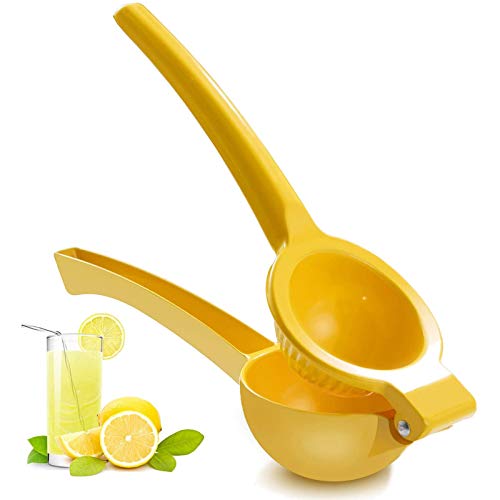
- Food-grade aluminum body
- Deep bowl helps contain seeds and pulp
- Ergonomic handles improve leverage
Best For: Everyday lemon and lime pressing
Best Large-Bowl Design

- 2.76-inch bowl fits lemons, limes, and small oranges
- Long handle and reinforced hinge improve leverage
- Deep bowl helps reduce splashing
Best For: Quick pressing and home bartending
Best Electric Batch Juicer – BLACK+DECKER CJ625
If you want a citrus juicer under 100 for regular orange juice and recipe prep, the BLACK+DECKER CJ625 offers electric, pressure-activated operation with a generous 32-ounce container. Its auto-reversing cones and adjustable pulp control make it a practical choice for home batches.
Best For: Home users who want electric juicing, adjustable pulp, and a pitcher-style container.
Pros:
- Auto-reversing cones help extract juice from citrus efficiently.
- Adjustable pulp control lets you customize the texture.
- Clear measurement markings, a handle, and a drip-free pour spout simplify serving.
- Removable dishwasher-safe parts make cleanup easier.
Cons:
- Its corded design requires access to a 120-volt outlet.
- The plastic construction may feel less substantial than metal alternatives.
The CJ625 is a strong fit when capacity and convenience matter more than portability. Its 32-ounce vessel and pulp basket make it especially useful for preparing juice for several servings.
Best Compact Manual Press – Zulay Kitchen Lemon Lime Squeezer
For a citrus juicer under 100 that needs no outlet or counter space, the Zulay Kitchen 2-in-1 squeezer is a compact manual option. Its coated aluminum bowl is designed for lemons, limes, and small oranges, while the perforated base helps filter seeds and pulp.
Best For: Drinks, dressings, and recipes that use lemons, limes, or small oranges.
Pros:
- Manual operation avoids batteries, cords, and bulky countertop equipment.
- Ergonomic handle and heavy-duty aluminum bowl support comfortable pressing.
- Built-in holes help keep seeds and excess pulp out of the juice.
- Compact size stores easily and the product includes a lifetime guarantee.
Cons:
- Its smaller bowl is not intended for large juice batches.
- The supplied care details recommend hand washing, so cleanup may require more attention.
This squeezer is a sensible pick for quick, single-fruit pressing and small kitchen spaces. Choose it over an electric model when portability, simplicity, and fast drink preparation are the priorities.
Best Compact Electric Value – Elite Gourmet ETS623
The Elite Gourmet ETS623 is a practical citrus juicer under 100 for small households, apartments, dorms, RVs, and other space-limited kitchens. Its 40-watt motor, auto-reversing reamer, and 24-ounce capacity are suited to modest juice batches.
Best For: Two to three servings of orange, lemon, lime, or grapefruit juice in a compact kitchen.
Pros:
- 40-watt motor provides more power than standard 25-watt models listed in the notes.
- Auto-reversing extraction activates with a push-down motion.
- Integrated pulp and seed filter plus a pour spout help reduce mess.
- Removable parts are top-rack dishwasher safe and the materials are BPA-free.
Cons:
- The 24-ounce capacity is smaller than some batch-oriented electric juicers.
- The product notes recommend hand washing for the longest product life.
With a quiet motor and space-saving footprint, the ETS623 balances convenience and compactness. It is best suited to everyday personal or small-family servings rather than large entertaining batches.
Best Low-Effort Lemon Squeezer – Chef'n FreshForce Citrus Juicer
If you prefer a citrus juicer under 100 that maximizes manual leverage, the Chef’n FreshForce uses a dual-gear mechanism to reduce squeezing effort. It is designed primarily for lemons, key limes, and similar small citrus, making it useful for cocktails, dressings, and recipes.
Best For: Frequent lemon and lime pressing when reduced hand strain is important.
Pros:
- Dual-gear mechanism is designed to deliver up to 20% more juice than standard squeezers.
- Non-slip handles provide a comfortable, secure grip.
- Basket catches pulp and pits during pressing.
- Top-rack dishwasher-safe construction simplifies cleanup.
Cons:
- It is specialized for small citrus rather than large-volume juice batches.
- The manual design requires repeated hand pressing.
The FreshForce stands out for leverage and ergonomic operation in a compact handheld format. It is a better match for concentrated lemon or lime use than for filling a pitcher with orange or grapefruit juice.
Best Manual Stainless-Steel Pick – Large Lemon Squeezer
If you want a citrus juicer under 100 that is simple, sturdy, and easy to operate, this manual stainless-steel squeezer is a practical choice. Its reinforced construction and silicone-bonded handles are designed to help extract juice from lemons, limes, and other small citrus fruits.
Best For: Home cooks and bartenders who want a durable hand press for lemons and limes.
Pros:
- 304 stainless-steel construction is corrosion-resistant and does not react with fruit juice.
- Designed for high extraction, with the manufacturer claiming up to 20% more juice than other citrus juicers.
- Reinforced hinges, thick casting, and silicone handle sleeves support comfortable pressing.
- Dishwasher-safe design allows for convenient cleanup.
Cons:
- Manual operation requires hand pressure.
- The bowl capacity is listed at 0.5 liters, so it is intended for smaller batches.
Overall, this model fits shoppers prioritizing durability and straightforward operation. It is especially well suited to occasional citrus prep, cocktails, and recipes where a compact handheld tool is more convenient than an electric machine.
Best Electric Option – 24-Ounce Citrus Juicer
For shoppers comparing a citrus juicer under 100 that reduces manual effort, this electric model offers two pressing cones and bidirectional rotation. Its removable 24-ounce container is sized for preparing several glasses of juice at once.
Best For: Singles and families who want hands-free citrus juicing with a larger container.
Pros:
- Two rotation directions are designed to help maximize juice yield without significant hand force.
- Two cone sizes accommodate oranges, lemons, limes, and grapefruits.
- Transparent 24-ounce BPA-free container includes a measuring scale.
- Non-slip rubber feet provide stability, while individual parts are dishwasher-safe according to the product description.
Cons:
- It is a corded electric appliance with a listed 220-volt specification.
- The product-care details also state hand wash only, so cleaning instructions may require attention.
- Its 7.8-inch footprint and 12.2-inch height take more storage space than a handheld press.
This is the most convenient choice of the three for producing multiple servings with less effort. Consider it when capacity and powered operation matter more than compact storage or purely manual control.
Best Budget Hand Press – Green Lime Squeezer
This aluminum hand press is a straightforward citrus juicer under 100 for lemons, limes, and everyday recipes. Its long profile is intended to provide leverage, while precision holes help separate seeds and pulp from the extracted juice.
Best For: Home bartenders and cooks who want an affordable manual press for lime-based drinks and recipes.
Pros:
- Durable, rust-resistant aluminum construction is lightweight and easy to handle.
- Long 9.84-inch design is intended to provide leverage for citrus extraction.
- Precision-engineered holes filter out seeds and pulp for cleaner juice.
- Metal hanging ring supports convenient kitchen storage.
Cons:
- Hand wash only, rather than dishwasher cleaning.
- It is designed primarily for manual use, so larger batches require repeated pressing.
- The listed warranty is limited to 30 days.
With its simple construction and lime-focused design, this IMUSA press is a sensible pick for margaritas, marinades, lemonade, and similar tasks. It offers useful leverage and easy storage, provided hand washing and the short warranty are acceptable.
Best Space-Saving Pick – Dreamfarm Fluicer Fold-Flat
If drawer space is a priority, the Dreamfarm Fluicer is a practical citrus juicer under 100 for lemons and limes. Its hinged design presses fruit from the sides, while the flat-folding body stores neatly after use.
Best For: Small kitchens, lemon and lime juice, and shoppers who want compact storage.
Pros:
- Folds completely flat for space-saving storage.
- Built-in pip catcher helps strain juice and guide it into a glass or bowl.
- Side-squeezing mechanism is designed to require less force.
- Dishwasher-safe construction.
Cons:
- Recommended specifically for lemons and limes.
- Plastic construction may feel less substantial than a metal press.
The Fluicer stands out for its slim profile and thoughtful juice-control features. Choose it when easy storage matters as much as straightforward manual squeezing.
Best Aluminum Value – Y-ME Manual Citrus Press
The Y-ME manual press is a straightforward citrus juicer under 100 for everyday lemon and lime squeezing. Its aluminum body, deep bowl, and long ergonomic handles are suited to drinks, cooking, and baking.
Best For: Home cooks, bartenders, and frequent lemon or lime use.
Pros:
- Food-grade aluminum construction is described as durable and rust-resistant.
- Deep bowl helps capture juice while keeping seeds and excess pulp out.
- Ergonomic handles provide leverage with less hand strain.
- Compact and dishwasher-safe for simpler cleanup.
Cons:
- Designed for lemons and limes rather than larger citrus fruit.
- Aluminum construction may not suit shoppers seeking a fold-flat design.
This is a conventional handheld press with useful everyday features and a compact footprint. It is a sensible choice if you prefer metal construction and easy cleanup over specialty storage features.
Best Large-Bowl Design – YZQ Metal Lemon Squeezer
For shoppers comparing a citrus juicer under 100 with a larger pressing bowl, this YZQ model offers a 2.76-inch round bowl and a reinforced long handle. It is designed for lemons, limes, and small oranges, with a focus on contained, low-mess pressing.
Best For: Quick juice extraction, bartending, and occasional small-orange squeezing.
Pros:
- Large round bowl is designed for lemons, limes, and small oranges.
- Long handle and reinforced hinge help reduce squeezing effort.
- Deep bowl and juice outlets are intended to limit splashing and dripping.
- Polished aluminum surface is described as rust-resistant and easy to rinse.
Cons:
- Hand-wash only according to the supplied care instructions.
- Juice is best suited to smaller citrus fruit, not full-size oranges or grapefruits.
The YZQ is a practical option when you want a metal handheld press with a relatively roomy bowl. Its manual design keeps operation simple, though hand washing adds a little cleanup work.
How We Picked the Best Citrus Juicer Under 100
We focused on practical features that matter in everyday use: juice yield, ease of operation, fruit compatibility, pulp control, capacity, cleanup, durability, and storage. The lineup includes electric models for repeated batches and manual squeezers for quick, portable use. We also considered useful design details such as interchangeable cones, pressure-activated operation, pip catchers, dishwasher-safe parts, fold-flat storage, and sturdy metal construction.
Because “best” depends on how you juice, the selections cover several needs rather than ranking every model by one feature. A compact lemon squeezer may be ideal for occasional cocktails, while an electric citrus juicer is more practical for breakfast juice or family-size recipes.
Quick Comparison
| Type | Best For | Advantages | Trade-Offs |
|---|---|---|---|
| Electric countertop | Frequent juicing and larger batches | Less hand effort, consistent extraction, higher capacity | Uses counter space and requires an outlet |
| Manual handheld press | Lemons, limes, cocktails, and recipes | Fast, portable, simple to clean | Requires hand pressure and may not suit large oranges |
| Metal manual juicer | Durability and strong pressing power | Sturdy construction and no electricity | Heavier and less compact than some handheld designs |
Key Buying Factors for a Citrus Juicer Under 100
Manual or Electric Operation
Choose an electric model if you regularly juice oranges or multiple fruits at once. Electric reamers reduce repetitive hand pressure and often include a reservoir for collecting juice. Manual presses are better for small quantities, travel, cocktails, and quick recipe prep.
Fruit Size and Cone Design
Check whether the juicer is designed for lemons and limes only or can handle larger oranges and grapefruit. Multiple cones or an adjustable reamer provide more flexibility. A broad bowl and strong hinge are especially useful for larger fruit.
Yield, Pulp, and Seeds
Strainers can help catch seeds, while adjustable pulp settings let you customize texture. For maximum yield, look for a deep press, dual-gear mechanism, or motor that reverses direction. Remember that yield also depends on fruit freshness, temperature, and pressure.
Cleanup and Storage
Removable, dishwasher-safe parts simplify electric juicer cleanup. Manual tools should rinse easily without trapping pulp in hinges or seams. Fold-flat or compact designs are valuable if drawer and counter space are limited.
Build Quality and Comfort
Stainless steel and reinforced metal can withstand frequent pressing, while textured or padded handles make manual use more comfortable. For electric models, look for stable bases, simple controls, BPA-free juice-contact parts, and a capacity suited to your usual batch size.
Who Should Buy Which Citrus Juicer Under 100?
- Choose an electric countertop juicer if you want lower-effort extraction, make juice often, or need to process several fruits in one session.
- Choose a handheld lemon or lime squeezer if you mainly juice small citrus for drinks, dressings, marinades, and recipes.
- Choose a heavy-duty metal press if durability and maximum manual leverage matter more than lightweight storage.
- Choose a compact or fold-flat model if you have limited kitchen space or want a juicer that stores neatly in a drawer.
Before buying, match the juicer’s fruit capacity and cleaning requirements to your routine. For occasional small-batch use, a manual model usually offers the simplest value; for regular breakfast juice, an electric option can justify its larger footprint and higher convenience.